
There are many things I never dreamed of doing. Not because I had no desire to do them but because they simply never came onto my radar. One example would be sitting looking out of a train window as it traversed the Swiss Alps. But that’s exactly where I found myself at the start of May 2025. Saying I ‘found myself’ there implies that I was abducted and woke up on the train. My turn of phrase merely reflects the fact that when it comes to journeys, I tend to be less imaginative than my wife. She is the one who sources and books the trips while I busy myself recording the experience on my camera-not exactly an onerous task and definitely my preferred role.
The Train I refer to was the Bernina Express. It runs on the 384 Km narrowgauge network of the Rhaetian Railway which links Switzerland with Italy. Our schedule included a 48 km stretch of the network, known as the Bernina Line-the only Swiss railway to cross the Alps. In order to catch the train, we travelled by bus from Lake Como in Italy, through Lugano in Switzerland, stopping briefly in Tirano and finally on to Poschiavo station. The low cloud looming over the Basilica of the Madonna di Tirano gave a clue as to the weather conditions we could expect as we began ascending to higher altitudes.
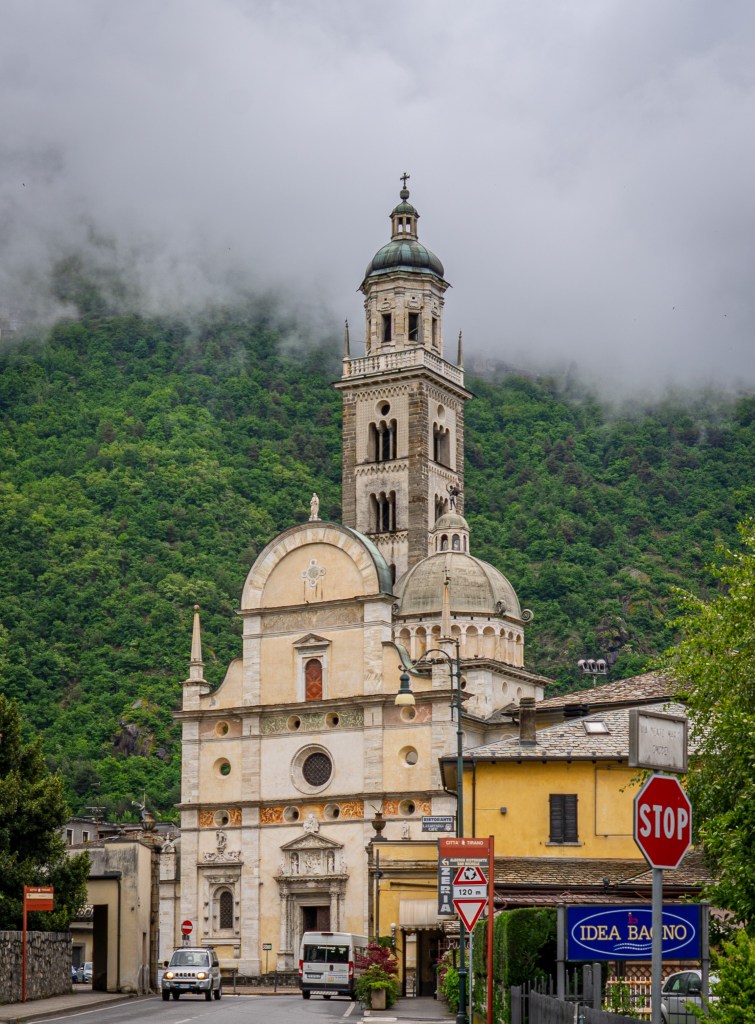
Basilica of the Madonna di Tirano
The bus was an unexpectedly interesting leg of the journey. We were informed by the guide as we crossed the Swiss border that Switzerland has four official languages: German, spoken by 62%, French (23%) Italian (8%) and Romansh (only spoken by 0.5%). We also passed a small town inside the Swiss border called Campione d’Italia which is administered by Italy and belongs to the province of Como. It seems Ireland isn’t the only country with border issues!
We also passed close to the village of Dongo on the upper reaches of Lake Como. It was here, in April 1945, in the final days of World War II, that Mussolini, the fascist dictator, was captured by Italian partisans. He was accompanied by his mistress, Claretta Petacci and several other senior fascists who were fleeing Milan and heading for the Swiss border. The next day they were executed and their bodies brought back to Milan, where they were hung upside down in a suburban square, Piazzale Loreto.
At Poschiavo we boarded the Bernina Express. There was some confusion about which part of the train was allocated to our group and by fluke, we ended up in a half empty carriage. The brochures I had read always gave prominence to photos of carriages with extended windows which curved up over the roof of the train for enhanced viewing. The first thing I noticed were the regular windows, similar to most trains. My initial ire was dispelled when it occurred to me that the extended windows were fixed units that couldn’t be opened. These ones could! I’m guessing that opening the windows, if not prohibited, is discouraged. But as anyone who has ever taken photos through a window pane will know, the reflections of ‘ghosts’ can ruin the image. So, taking the proverbial bull by the horns, I pulled (with considerable effort!) the sash of the window down. In my defense, I tried a couple of shots through the window first but couldn’t entertain the thought of missing an opportunity that may never come again. As in all such cases, it only takes one instigator and soon all the windows were being opened as the hitherto sedate passengers took on a more rebellious demeanour!
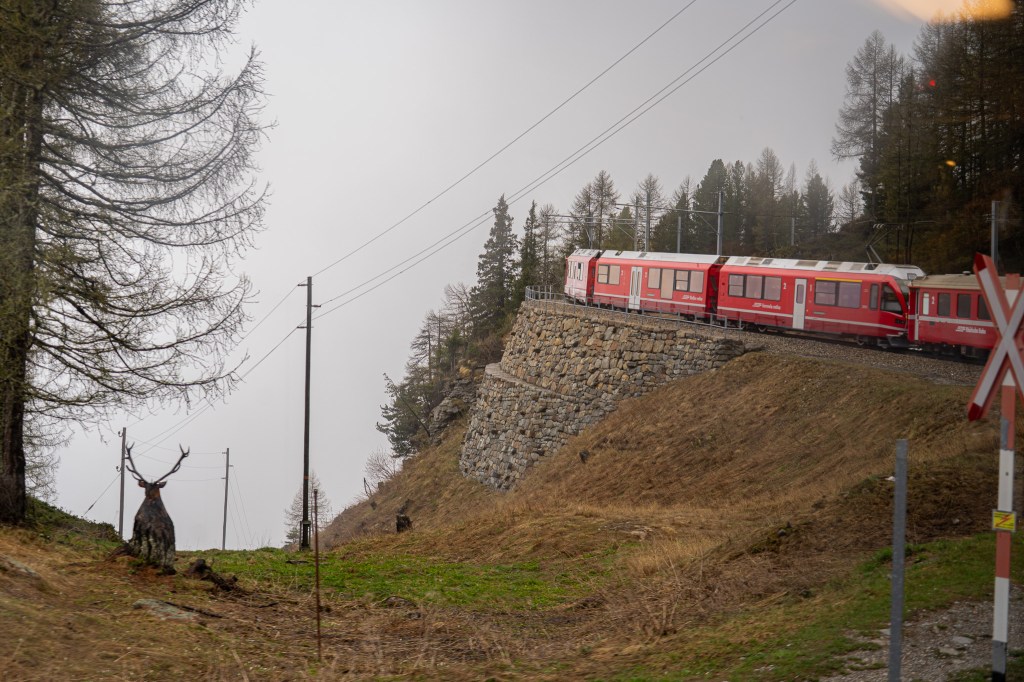
A shot through the window with those annoying reflections in the top right of the photo. I wish I could say that the deer walked into the shot but he’s made of stone!
As the train left Poschiavo, at an altitude of just over 1,000 m (3,330 ft) it seemed as if we were ascending into the clouds. One of the unique features of the railway is the use of sharp bends in the track which allow the train to climb the steep gradient. This provides good opportunities to capture the carriages as they snake their way upwards. This is also why you should pick a front or rear carriage. That way you can get more of the train into your shots.
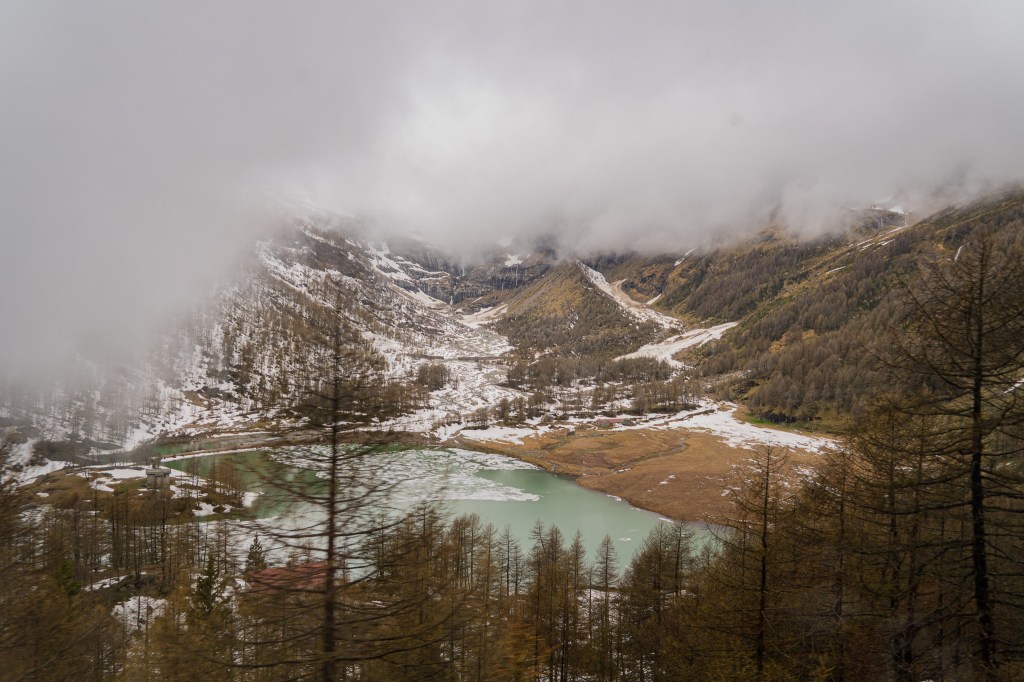
Occasional breaks in the cloud revealed aquamarine lakes and alpine slopes sprinkled with snow.
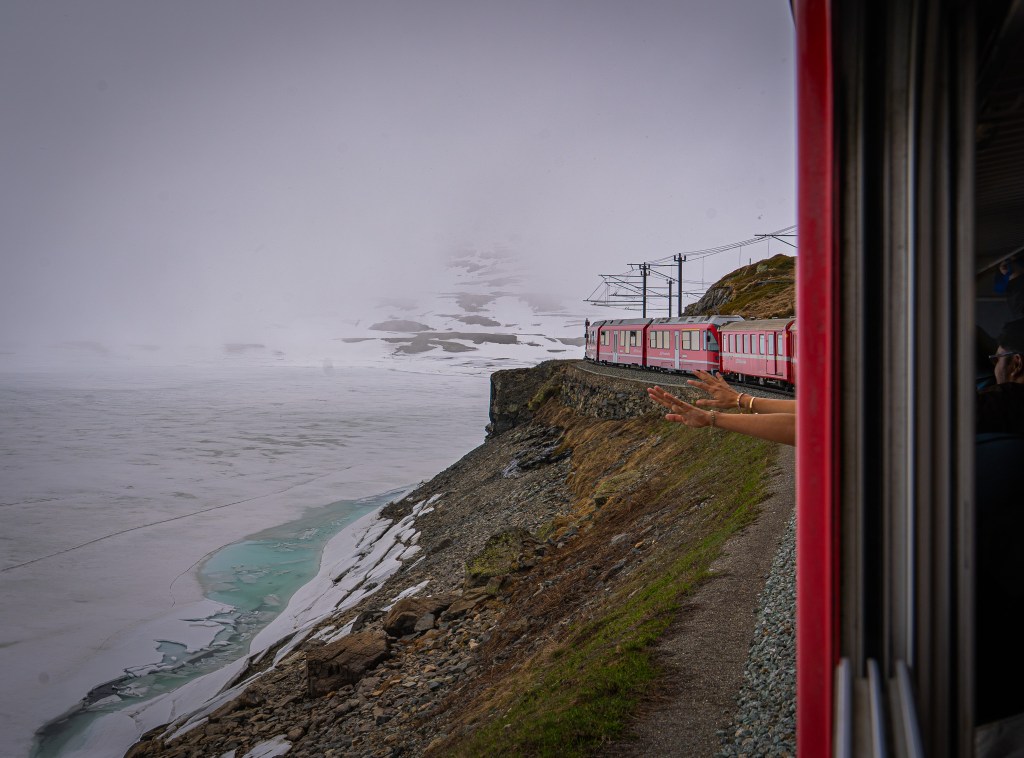
And the occasional frozen lake, plus anonymous hands of fellow passengers. Maybe they’re thanking me for initiating the mass opening of the windows!
The train slowed down, almost to a halt, as we entered Alp Grum railway station. The altitude here is 2,090 m (6,860 ft). Normally the train would stop here for passengers to enjoy the panoramic view but we were now passing through dense cloud and there wasn’t much to see. As we passed through Ospizio Bernina, the highest point of the Bernina Line at 2,253 m (7,392 ft), above sea level, the prospect of some good photos was dwindling. Then, as if by magic, the carriage lit up with bright sunshine and the landscape appeared again in all its splendour.
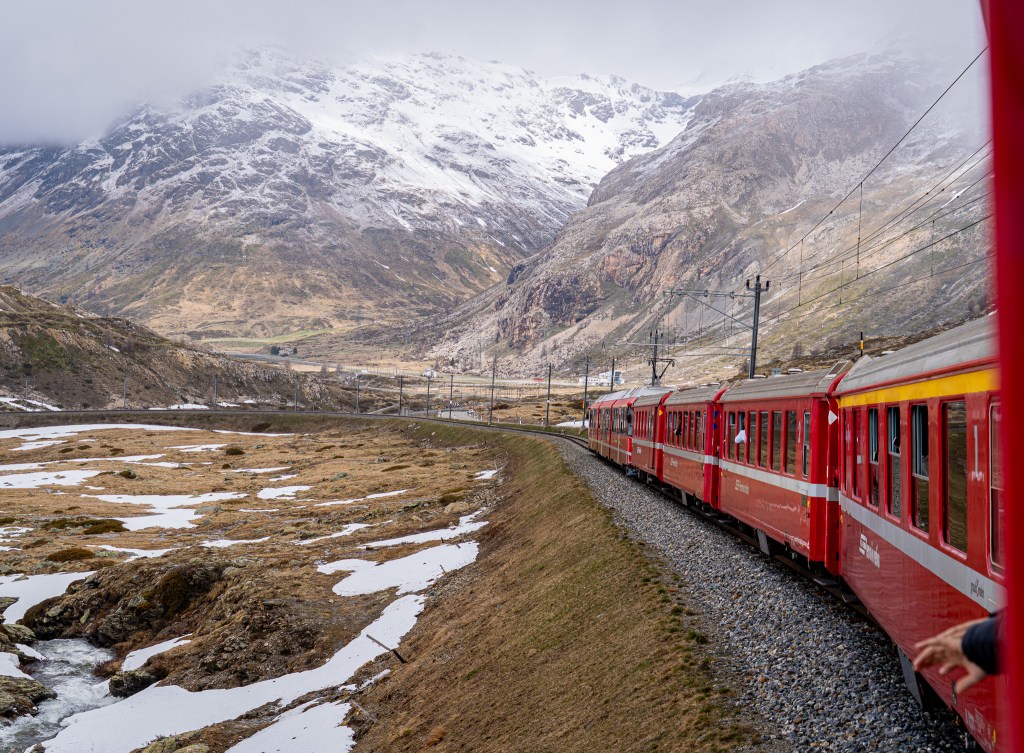
Descending below the clouds outside Bernina Diavolezza at approximately 2,080 m (6,820 ft) above sea level.
I was happy to be coming away with at least some decent photos that would serve as mementos of a unique experience. I was also reminded that when it comes to any form of landscape photography, nature is the boss. It decides when and where it will provide the optimum conditions. Regardless of weather, this was a pleasure. In fact, to witness the majestic beauty of this part of the world was more than a pleasure. It was a privilege. One for which I will always be grateful.

A cable car crosses the railway line at Bernina Diavolezza, our final stop on the Bernina Express.
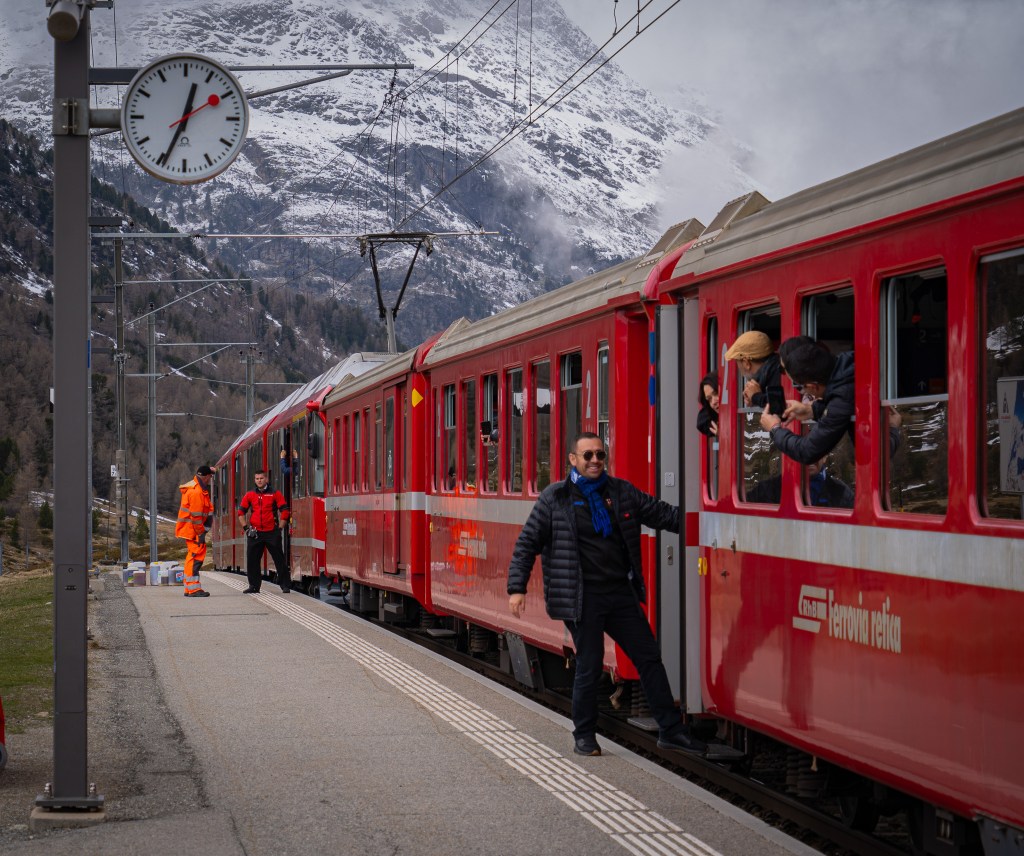
Bernina Diavolezza station.
From Bernina Diavolezza, we travelled a short distance by coach into St Moritz. If I had to sum up this town in one word, it would be ‘anticlimactic’. Given its reputation as a world class ski resort, I had imagined a bit of style and polish but we were both in agreement about the nondescript character of the place. It didn’t help that a lot of the shops were closed for a ‘between season break’. I’m not a skier and I reckon that is its biggest draw, the skiing and its location, a perfect base for exploring the Alps. And maybe it looks better when covered in snow. But let’s not end on a negative. Before getting back on the coach for the return trip to Italy, I had a pleasant surprise. I took a walk across the road to the lakeshore and a break in the stormy sky created a scene which lasted less than a minute before the rain started again. What did I say about nature being the boss?
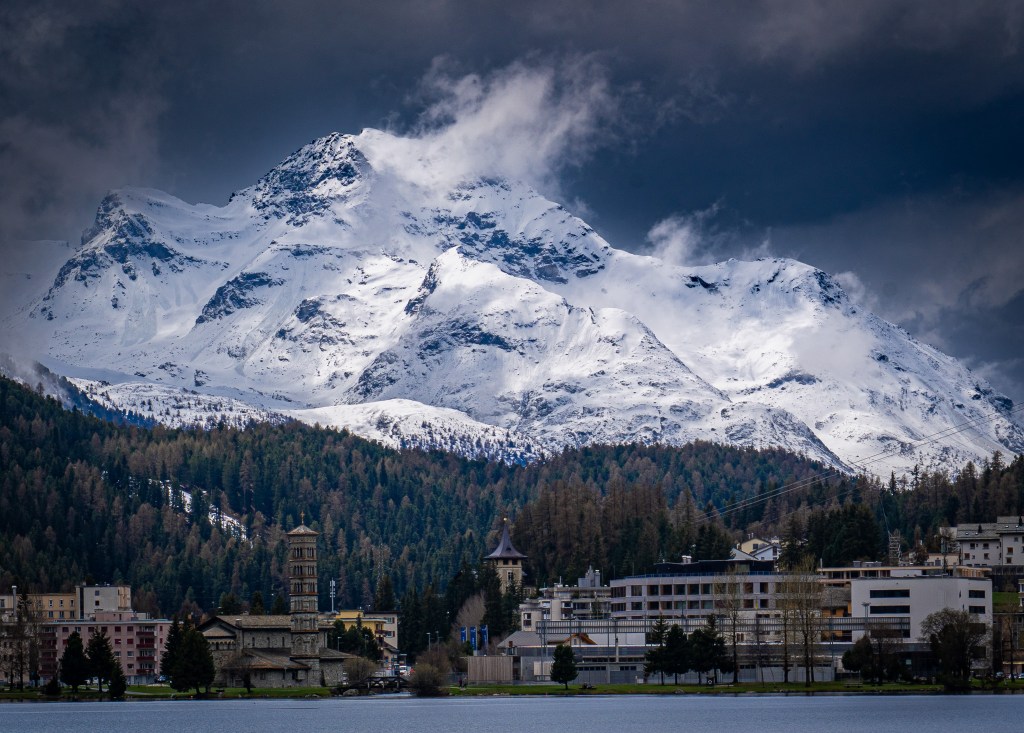
The sun broke threw the clouds to create a dramatic contrast between the snow capped peaks and the storm clouds.
And so, St Moritz having provided some photographic compensation, we boarded the bus and settled in for the return journey to Lake Como.
Thoughts and Tips
A great experience. As I have alluded to, the weather conditions will determine how much you will see. People have a tendency to expect the views to be exactly like the brochures but you have to remember that the brochures show places in perfect weather.
Which train to choose? This is a tricky one. As I mentioned, there are different ‘classes’ of train. The most expensive train will have the carriages with the extended windows but if photos are your priority, take the train with windows that open. It’s also worth noting that normal service trains run on the same line. If you have the time, you can travel longer stretches of the line, getting off at different stations and catching the next train to continue on to your next destination. One major benefit of using these trains is that your ticket allows flexibility. You don’t have to travel on a particular day. If you buy a ticket for the Bernina Express, you must use it on a specific day and time.
What time of year is best? It depends on what type of experience you want. In winter you will see dazzling snow covered landscapes. In summer, lush pines and alpine flora will be the order of the day. Spring or Autumn will offer a mixture as the seasons change from one to the other. But remember. When you are travelling at such high altitudes, weather conditions are volatile and your experience will be in the hands of the Gods. This is where the flexibility of the regular service trains will be an advantage. If you are spending a few days or longer in the region, you can follow the weather forecast and pick the best day to travel.
Would I go back? Yes but as I said in my previous post, independent travel would allow the flexibility I’ve talked about above. But that comes at a cost. Our trip was part of a package and while that meant less flexibility, it made the the trip more cost effective. Also, independent travel isn’t for everyone. For some travellers, a package means not having the hassle and responsibility of booking trains, buses, accommodation etc. As I have already mentioned, I don’t have to do that anyway, so as long as I have my camera, I’m a happy lad.
 Bleeding Dove