Wake up and smell the roses. Rose Fair at Lady Dixon Park. July 2025.

White Gold

Sir Thomas and Lady Dixon Park is its proper title but the residents of Belfast simply refer to it as Lady Dixon. While the park has a wide range of trees, shrubs and flowers, its most famous attraction is ‘Rose Week’. Roses of all varieties from all over Europe turn the park into a celebration of colour and scent. The rose garden itself, featuring some 20,000 rose bushes, was created almost sixty years ago but the Rose Week event began in 1975 and ran until 2020. In the post-COVID era it was rebranded as the Summer Rose Fair and now takes place over a weekend in July but many people still know it as ‘Rose week’. For the dedicated team of gardeners, however, preparations begin long before that.

Welcome to this insight into one of Belfast’s unique events.

Late May and already some of the early blooms have arrived. Each bed is meticulously edged with hand shears.
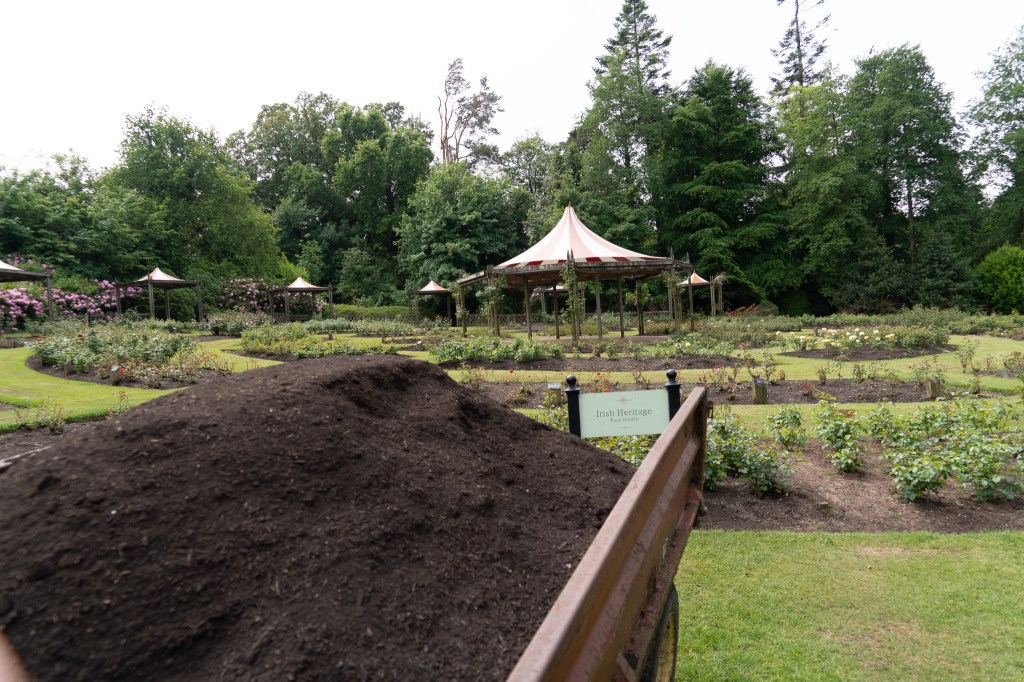
Trailer loads of mulch being delivered to one of the many rose gardens. The mulch acts as a weed suppressant and is manually shovelled by the gardeners into the beds.
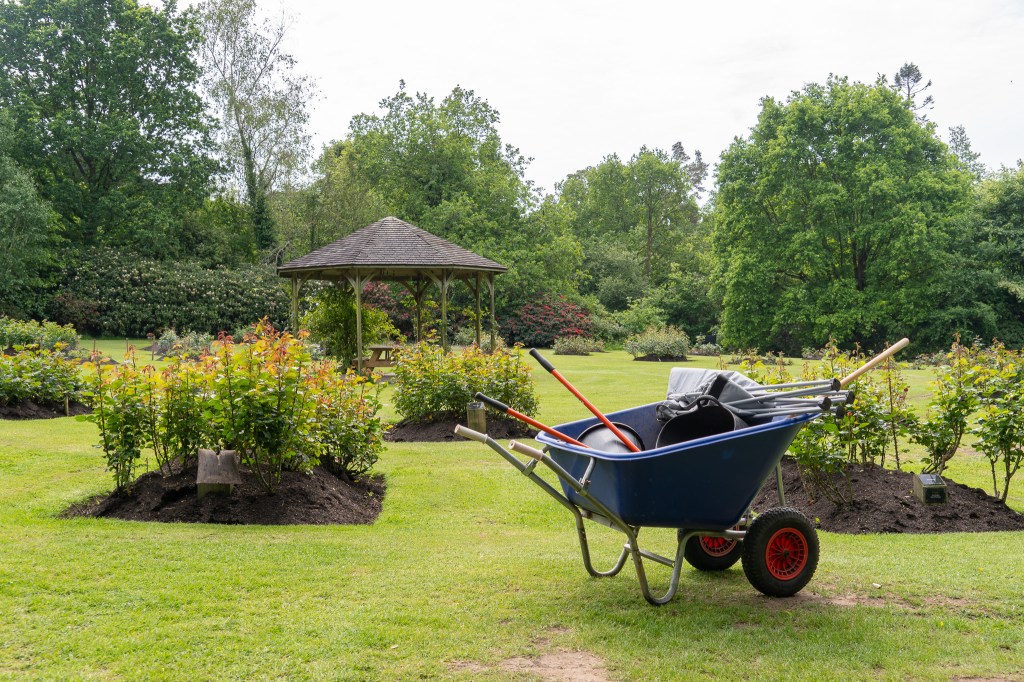
While mechanisation has made life easier for gardeners, the tools of the trade in the rose garden haven’t changed much over the decades. Here, elbow grease, skill, stamina and dedication are the main requirements.
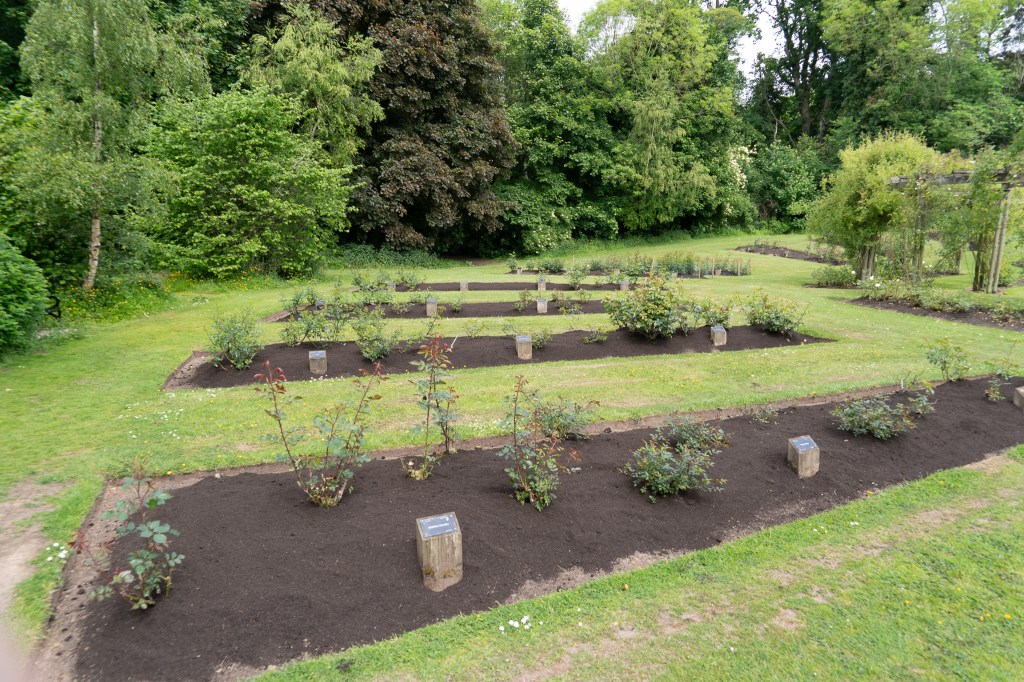
Mulching complete. The grass around the beds showing the wear and tear of work boots. Time for reseeding.
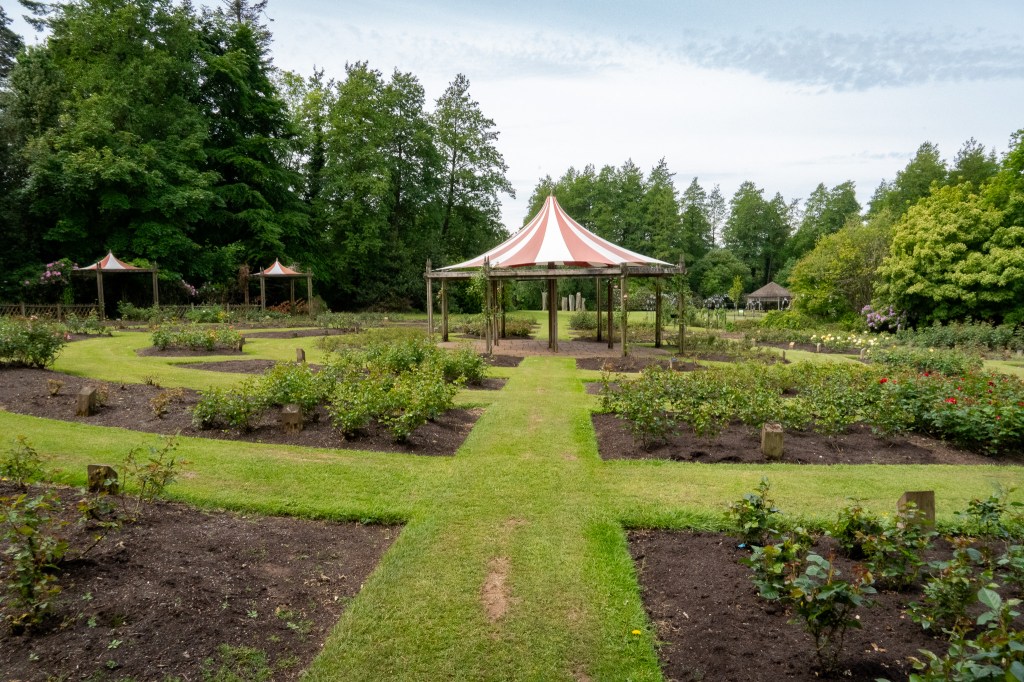
Soon the green foliage will be lost among a blanket of colour.

Rotation of beds. Visiting the rose gardens year after year, it appears to the untrained eye that the layout of the beds remains unchanged. However, every September 30 beds are seeded over with grass seed and 30 new ones created as part of a 5 year rotation scheme. This means that no roses are growing in the same soil for more than 5 years. This optimises nutrient availability and minimises risk from disease. This is a specialised job that requires exacting skills in measuring and marking out to ensure the symmetry of the gardens is unaffected.

Pest Control. A big part of summer maintenance is keeping on top of diseases and pests. While horticultural expertise is employed to tackle disease, there is a less obvious challenge for the team of gardeners who look after the roses. Rabbits!
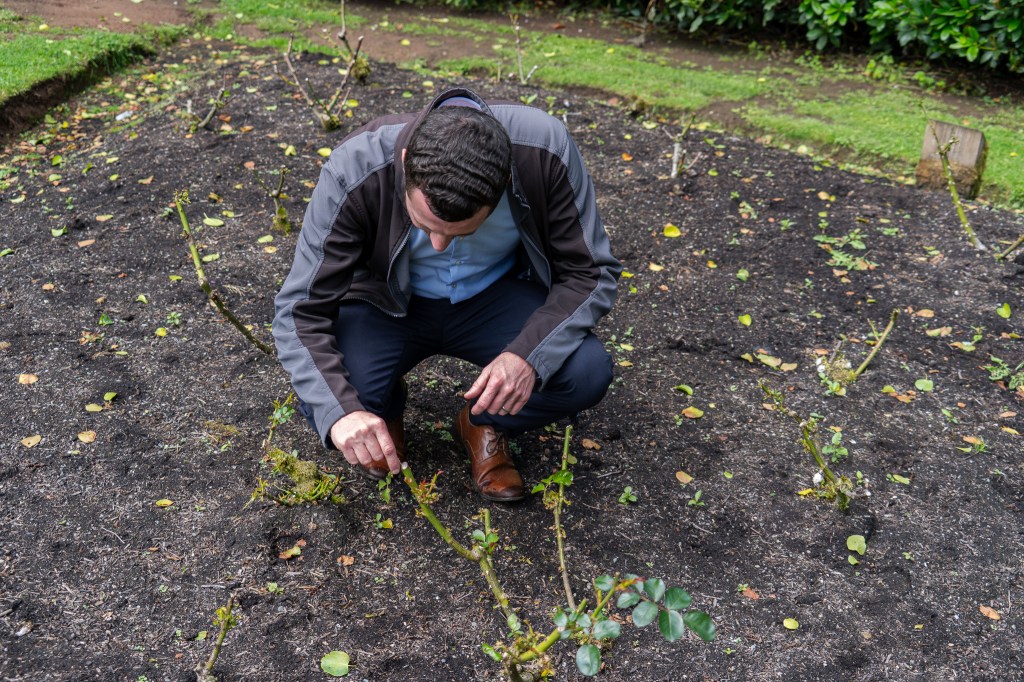
Diarmaid, the manager responsible for the rose gardens, surveys the scant remains of what would have been a bed of roses.

It seems the pesky bunnies love nothing more than a feast of fresh young leaves of the rose variety. Controlling the rabbit population is not an exact science and any methods that result in their demise could be controversial. It’s a considerable challenge because the hedges and shrubs that act as an effective wind break for the roses, also provide a convenient cover from where the rabbits launch their attacks.

Timing is everything. We are all too aware of the impact of climate change and how it affects plants and flowers. Early blooms caused by mild winters. Flowers killed by late frosts etc. Roses are no different and this is an ever present concern for the team at Lady Dixon. Their year’s work culminates in a single weekend in July. Imagine how demoralising it would be to have the roses bloom a month before Rose Fair and for the thousands of visitors to miss the spectacle. This year’s Rose Fair was brought forward by a fortnight and that decision paid off. While there will always be many early or late blooms, the gardens were in prime condition for the public to enjoy.
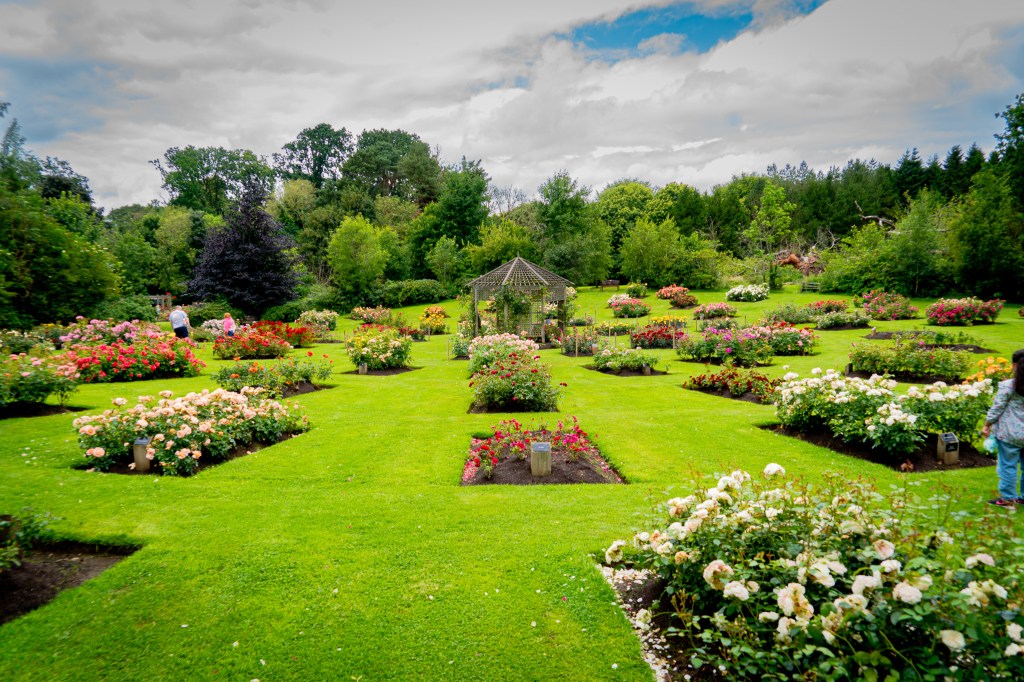
A treat for the senses. Vibrant colours and heady scents were the order of the day at the Rose Fair.
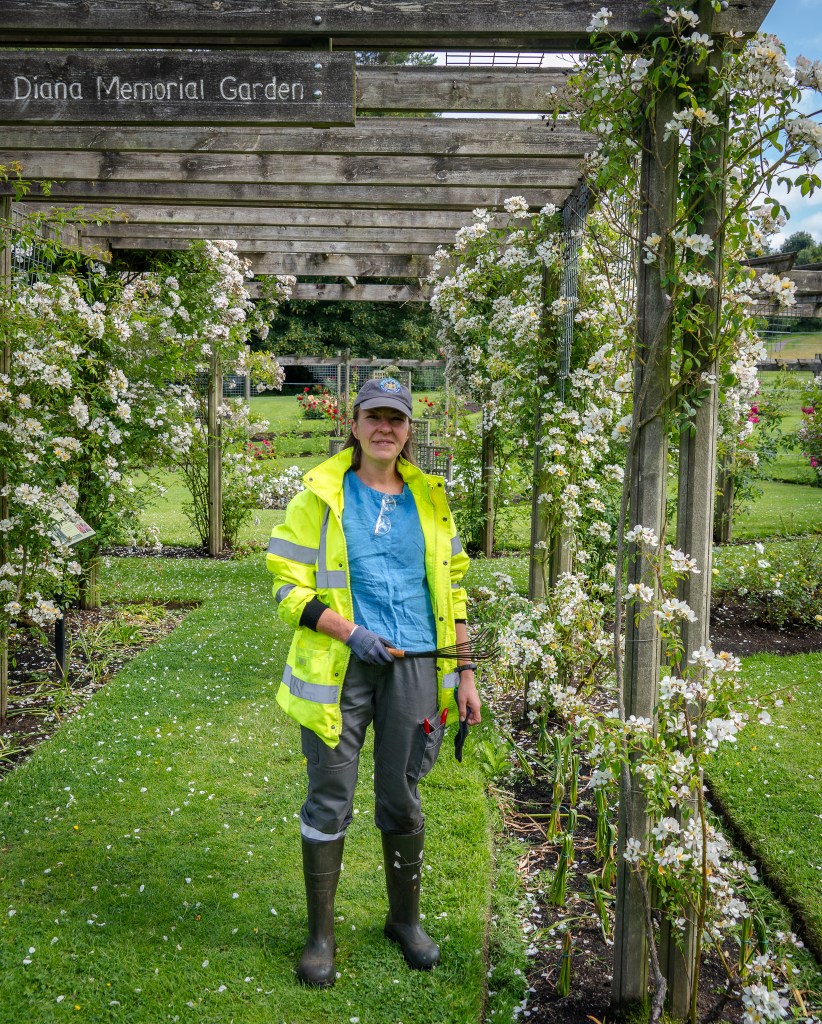
Michaela, who tends the Diana Memorial Garden. The rose arch was in full bloom two weeks before the Rose Fair but still looked great on the day. She has worked all over Europe and the UK but says this is her dream job.

Orlaith, getting to grips with the weeds a couple of weeks before the Rose Fair. It’s a relentless battle and one not always appreciated by us casual observers.

A carpet of petals adds to the sense of occasion.
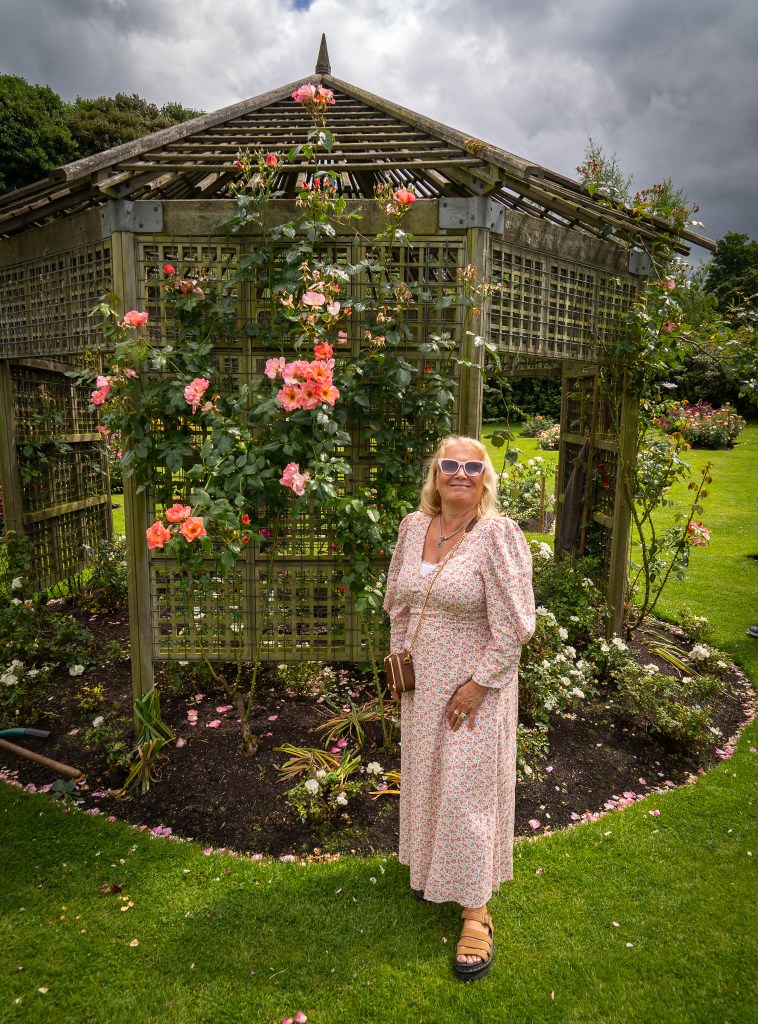
A Rosie among the roses. Enjoying Rose Fair and blending in nicely.
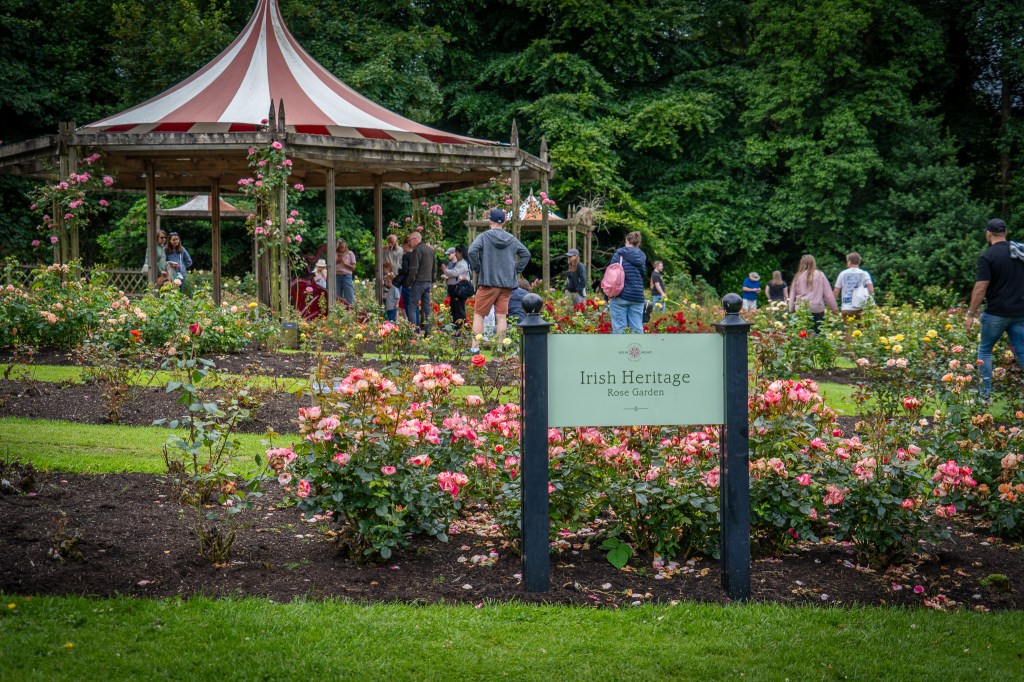
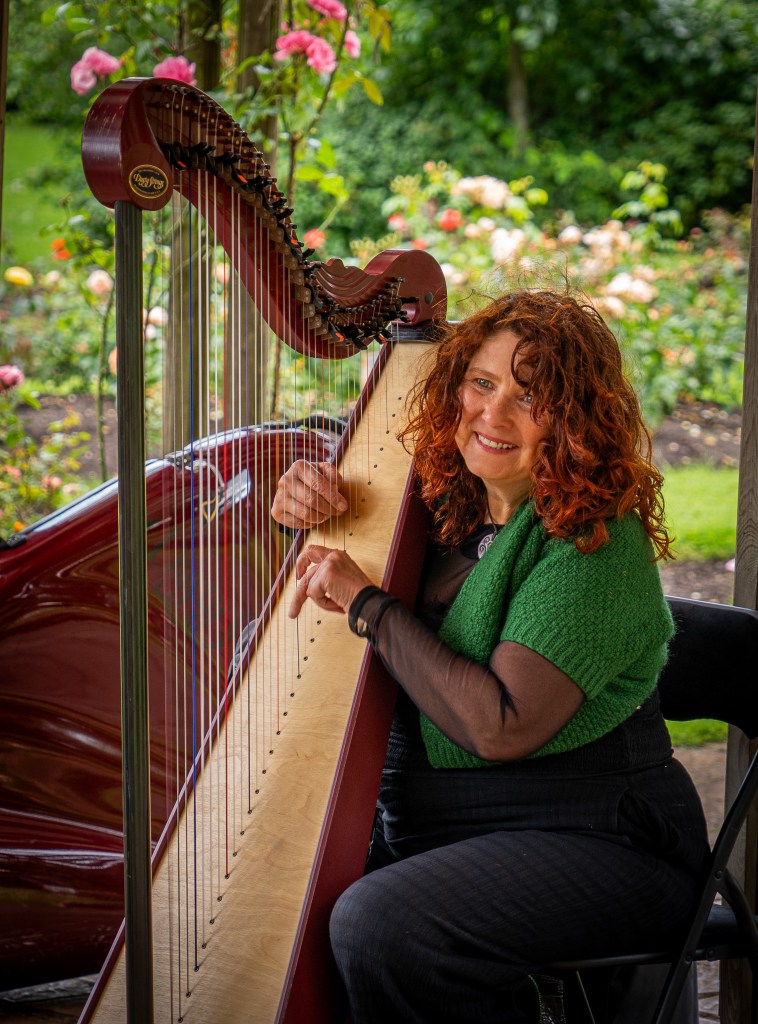
A bit of culture in the Irish Heritage Garden. There’s something about ‘Danny Boy’ when it’s played in such a setting.

A rose by any other name. I always considered roses old fashioned. Maybe that’s why in my latter years, I have developed an appreciation for them. Or maybe only a mature mind can truly ‘see’ them. For me, the complexity of their structure is what captures my attention initially, followed by their colour and scent. A few of my favourites (in addition to White Gold above)…
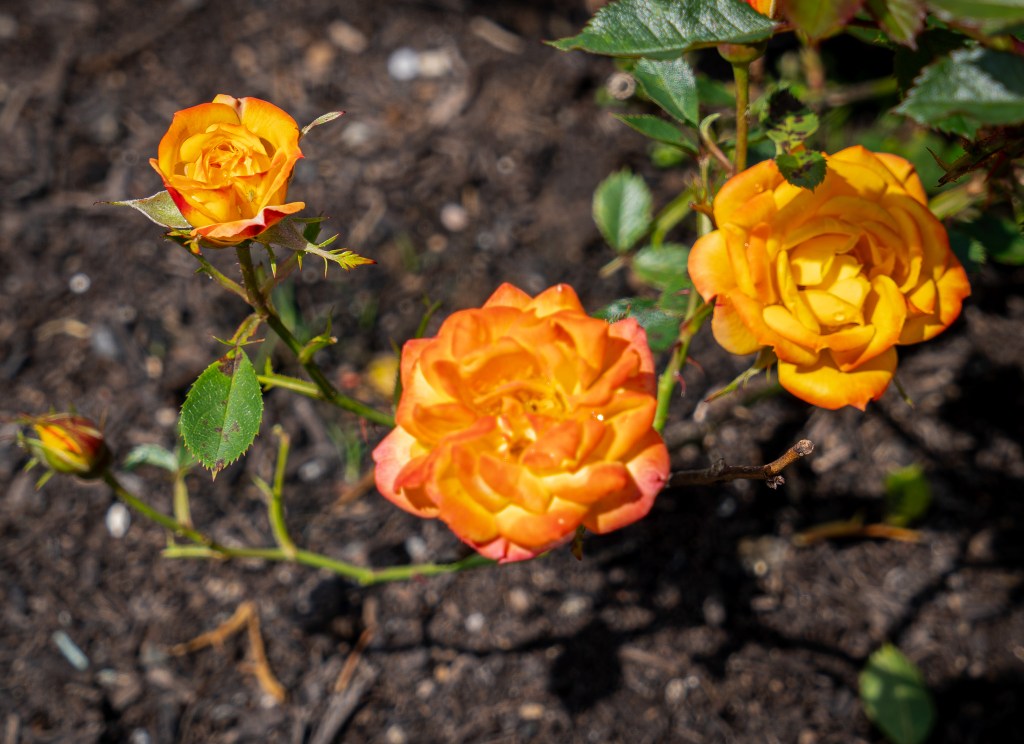
Irish Eyes, whose colours evolve as the petals develop.

Summer of Love, which reminded me of Clove Rock, the hard boiled sweets that kept a generation of dentists in a job.
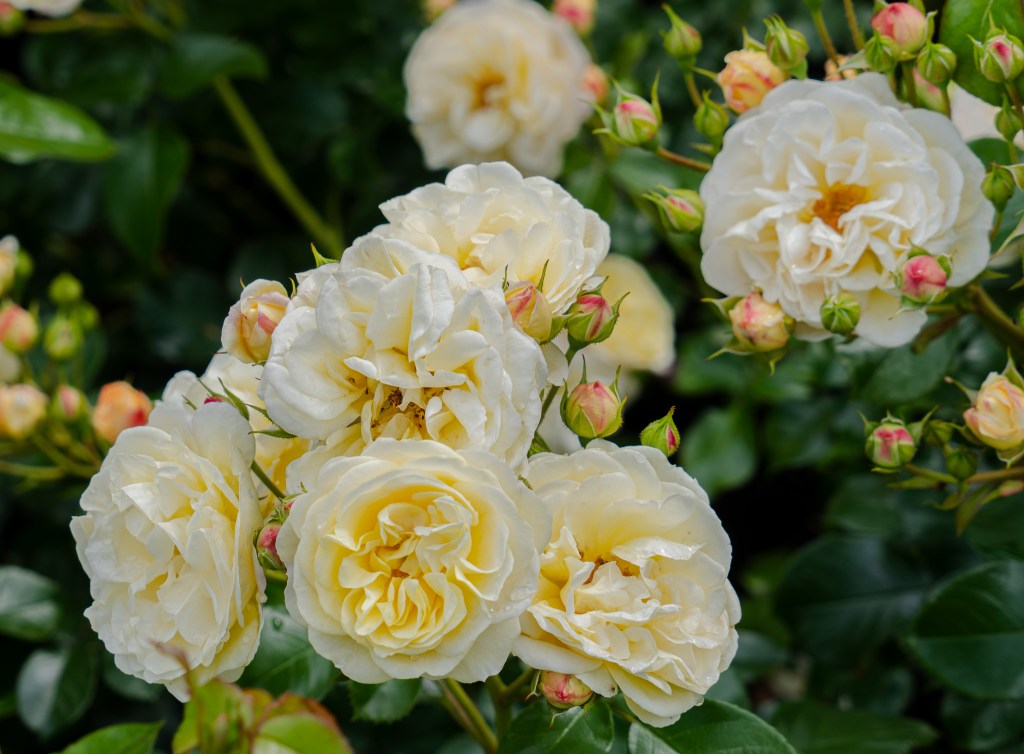
Light Fantastic. It just yells ‘Summer’.

Honey Bee Mine. A big hit this year with gardeners and visitors alike. And of course, bees!

The fragrant section is an assault on the senses and will evoke different memories for different people.
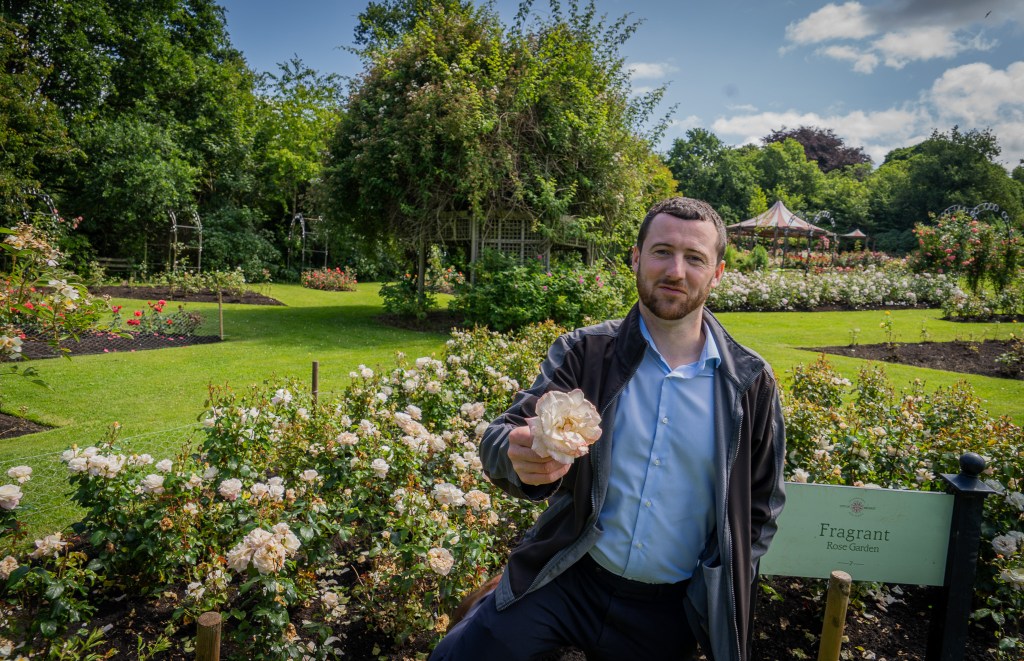
A rare photo of the main man, Diarmaid, serving up a fragrant treat. I’m not sure what the name of this rose was but i think its official score was 8.5 out of 10.

Diarmaid, 35 years old, began his horticultural career 19 years ago as an apprentice gardener. I asked him about any changes that he had noticed over the years and what he considers the main challenges ahead? He explained that many of the roses, especially from mainland Europe, are grown from cuttings instead of traditional propagation methods where buds are grafted onto an established root stock. The combination of the newer method and selective breeding to make roses disease resistant have had two regrettable consequences. The roses don’t live as long and their scent is diluted.

The Summer Rose Fair has reached a pivotal point in its history. Due to the impact of Brexit-related difficulties, such as increased compliance documentation for plant imports, there has been a dramatic decrease in the variety and quantity of roses coming from Europe. As Diarmaid explains, there are still European entries for the International Rose Trials, which are an integral part of the rose garden. Growers from all over Europe are still keen to achieve recognition and reward for their roses but they only send small numbers for the judges to consider. Post competition, they are reluctant to export in bulk.

In addition to the European issue, he explained that the supply of roses from domestic growers on the island of Ireland is in a precarious position. There is one major grower in the North and one in the South. Due to retirement and a lack of successors, this source of roses is also at risk of disappearing.

COVID arguably posed the biggest threat to the existence of the rose gardens. Staff absence and changes in working practices, as well as attitudes to work, presented unprecedented challenges. There is currently one gardener per rose garden but for a protracted period of months in 2020, the roses were tended by one gardener-Diarmaid. For him this meant pruning over 20,000 rose bushes with an average of 10 cuts per plant. Yes, 200,000 cuts! An impossible expectation and unsustainable situation and one which almost forced him to reconsider his career. His exceptional work ethic and pride in his job prevailed and he now manages a fantastic team who are dedicated to their craft and the preservation of the rose gardens. If the demise of the rose gardens at Lady Dixon is brought about by a lack of growers/suppliers, it will be an unfortunate outcome for him and his colleagues whose commitment and passion have maintained this jewel on the edge of Belfast that thousands of its citizens enjoy every year.

Thank you to all the team who took time to talk to me over the last few weeks. You are a credit to yourselves and the people of Belfast. And a special thanks to Diarmaid for sacrificing his lunch break to share his knowledge with me. If there are any inaccuracies in this piece, you can be sure they are a result of my poor listening skills. I should also declare at this stage that he probably felt that he didn’t have any choice but to cooperate. You see, I have known him for all of his 35 years because he is my son! Nice one, Bernard (private joke).

Bernina Express

There are many things I never dreamed of doing. Not because I had no desire to do them but because they simply never came onto my radar. One example would be sitting looking out of a train window as it traversed the Swiss Alps. But that’s exactly where I found myself at the start of May 2025. Saying I ‘found myself’ there implies that I was abducted and woke up on the train. My turn of phrase merely reflects the fact that when it comes to journeys, I tend to be less imaginative than my wife. She is the one who sources and books the trips while I busy myself recording the experience on my camera-not exactly an onerous task and definitely my preferred role.

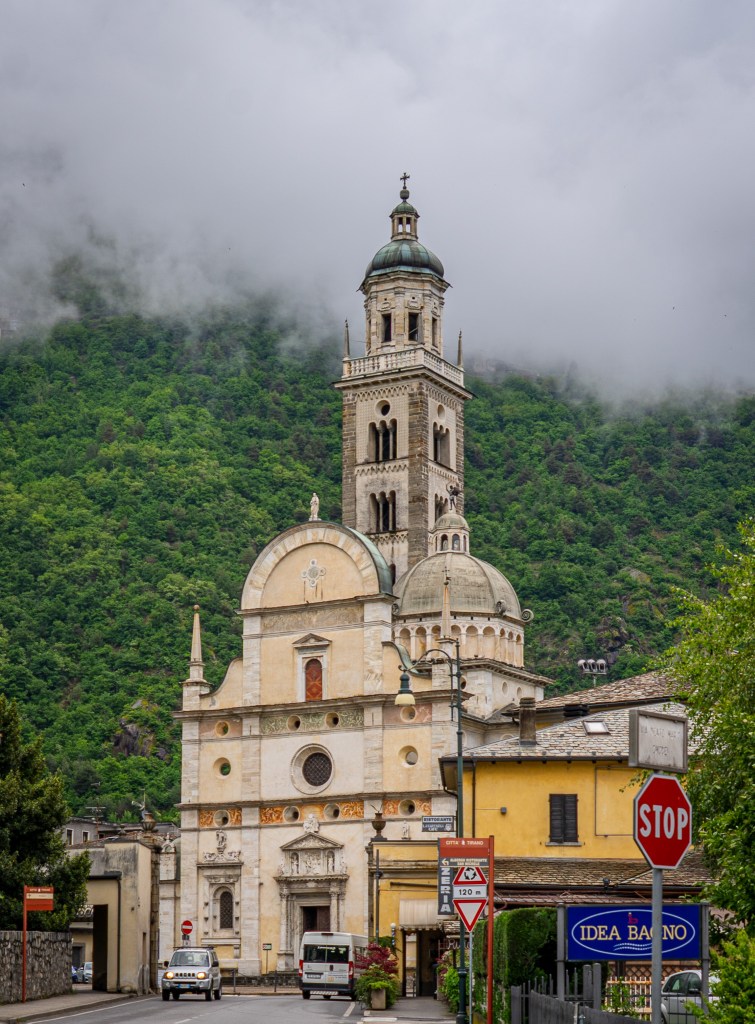
The Train I refer to was the Bernina Express. It runs on the 384 Km narrowgauge network of the Rhaetian Railway which links Switzerland with Italy. Our schedule included a 48 km stretch of the network, known as the Bernina Line-the only Swiss railway to cross the Alps. In order to catch the train, we travelled by bus from Lake Como in Italy, through Lugano in Switzerland, stopping briefly in Tirano and finally on to Poschiavo station. The low cloud looming over the Basilica of the Madonna di Tirano gave a clue as to the weather conditions we could expect as we began ascending to higher altitudes.

Basilica of the Madonna di Tirano

The bus was an unexpectedly interesting leg of the journey. We were informed by the guide as we crossed the Swiss border that Switzerland has four official languages: German, spoken by 62%, French (23%) Italian (8%) and Romansh (only spoken by 0.5%). We also passed a small town inside the Swiss border called Campione d’Italia which is administered by Italy and belongs to the province of Como. It seems Ireland isn’t the only country with border issues!

We also passed close to the village of Dongo on the upper reaches of Lake Como. It was here, in April 1945, in the final days of World War II, that Mussolini, the fascist dictator, was captured by Italian partisans. He was accompanied by his mistress, Claretta Petacci and several other senior fascists who were fleeing Milan and heading for the Swiss border. The next day they were executed and their bodies brought back to Milan, where they were hung upside down in a suburban square, Piazzale Loreto.

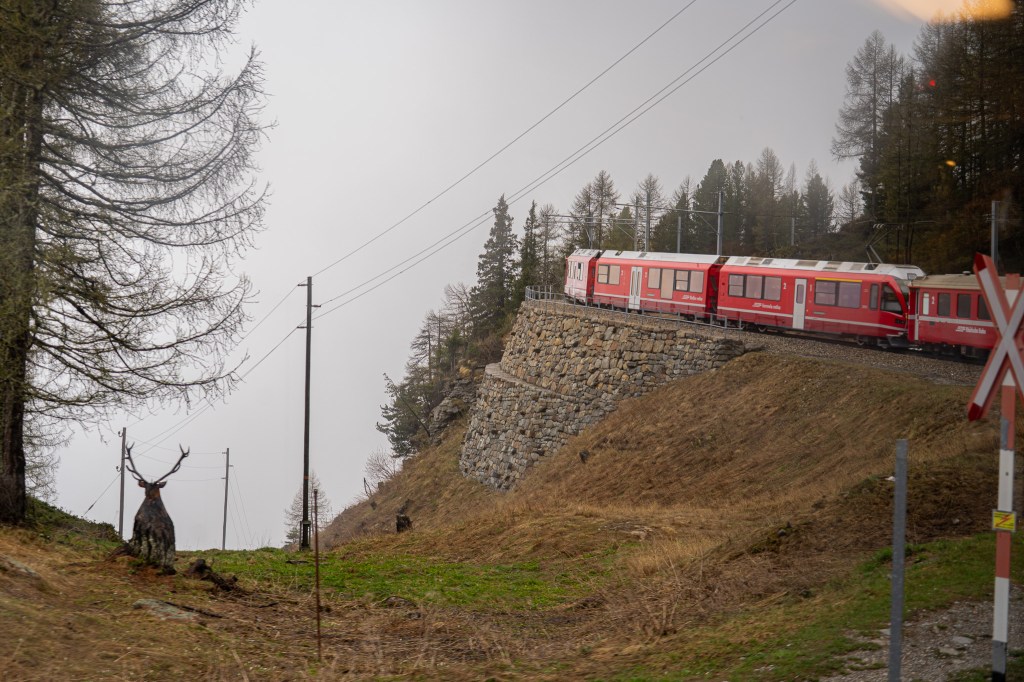
At Poschiavo we boarded the Bernina Express. There was some confusion about which part of the train was allocated to our group and by fluke, we ended up in a half empty carriage. The brochures I had read always gave prominence to photos of carriages with extended windows which curved up over the roof of the train for enhanced viewing. The first thing I noticed were the regular windows, similar to most trains. My initial ire was dispelled when it occurred to me that the extended windows were fixed units that couldn’t be opened. These ones could! I’m guessing that opening the windows, if not prohibited, is discouraged. But as anyone who has ever taken photos through a window pane will know, the reflections of ‘ghosts’ can ruin the image. So, taking the proverbial bull by the horns, I pulled (with considerable effort!) the sash of the window down. In my defense, I tried a couple of shots through the window first but couldn’t entertain the thought of missing an opportunity that may never come again. As in all such cases, it only takes one instigator and soon all the windows were being opened as the hitherto sedate passengers took on a more rebellious demeanour!

A shot through the window with those annoying reflections in the top right of the photo. I wish I could say that the deer walked into the shot but he’s made of stone!

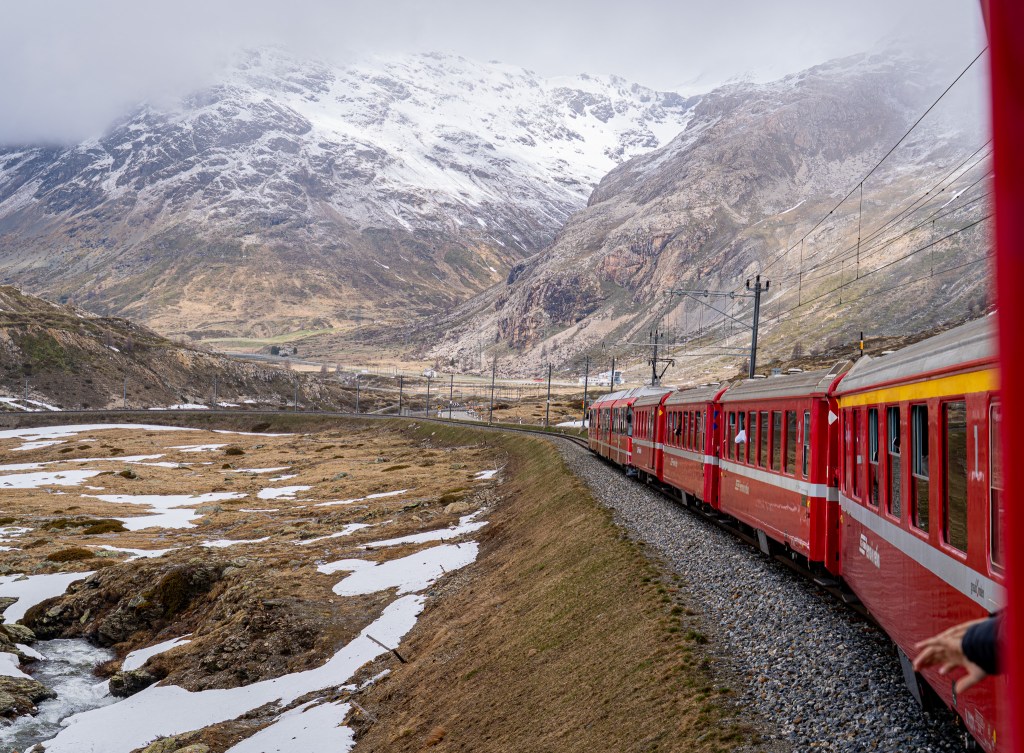
As the train left Poschiavo, at an altitude of just over 1,000 m (3,330 ft) it seemed as if we were ascending into the clouds. One of the unique features of the railway is the use of sharp bends in the track which allow the train to climb the steep gradient. This provides good opportunities to capture the carriages as they snake their way upwards. This is also why you should pick a front or rear carriage. That way you can get more of the train into your shots.

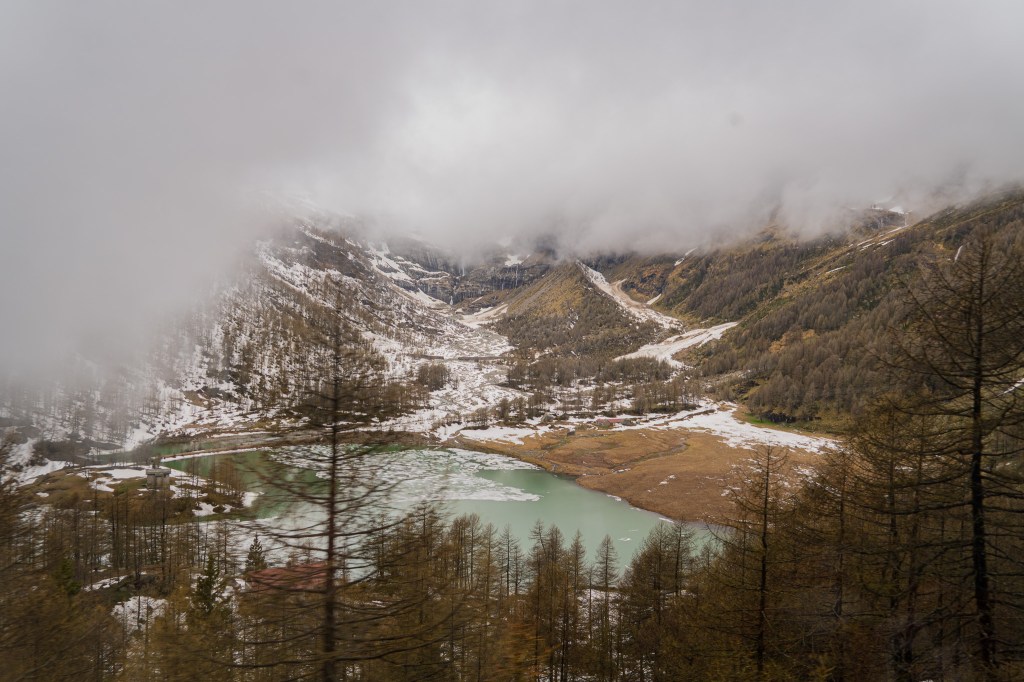
Occasional breaks in the cloud revealed aquamarine lakes and alpine slopes sprinkled with snow.

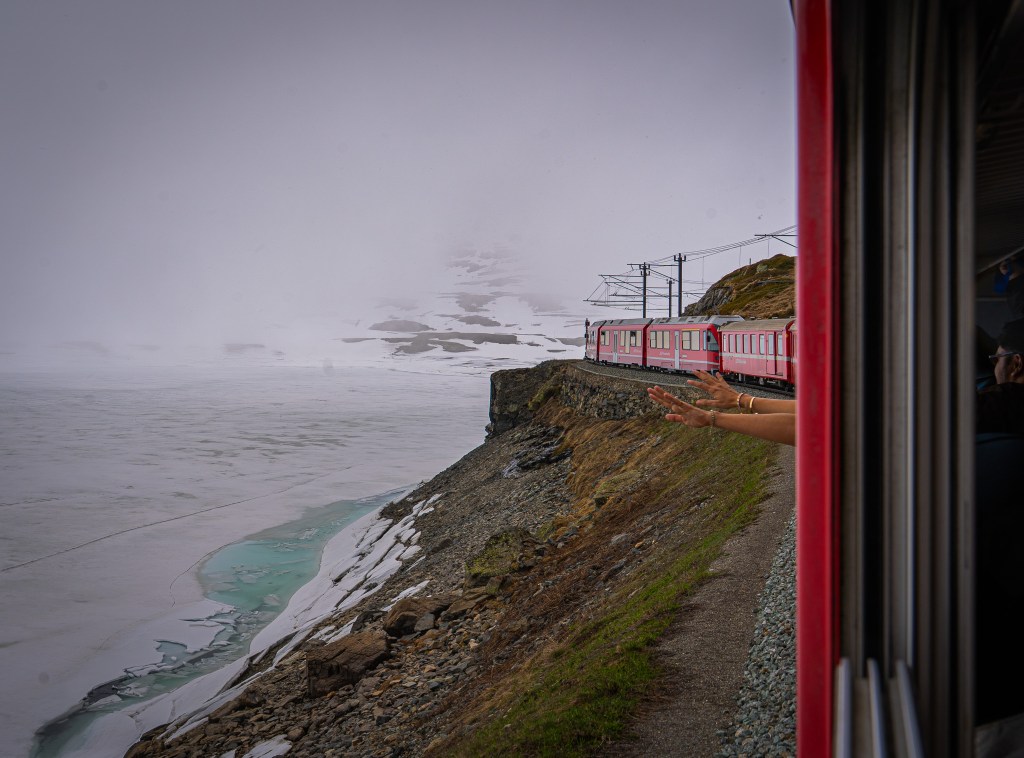
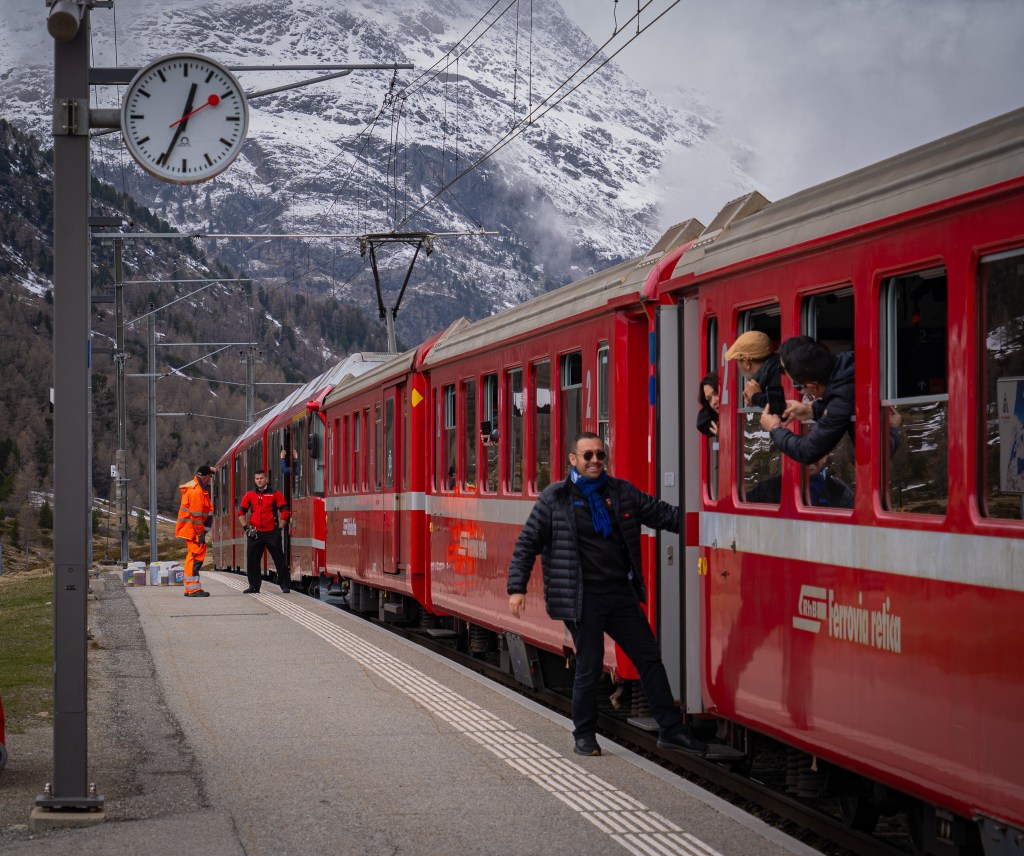
And the occasional frozen lake, plus anonymous hands of fellow passengers. Maybe they’re thanking me for initiating the mass opening of the windows!

The train slowed down, almost to a halt, as we entered Alp Grum railway station. The altitude here is 2,090 m (6,860 ft). Normally the train would stop here for passengers to enjoy the panoramic view but we were now passing through dense cloud and there wasn’t much to see. As we passed through Ospizio Bernina, the highest point of the Bernina Line at 2,253 m (7,392 ft), above sea level, the prospect of some good photos was dwindling. Then, as if by magic, the carriage lit up with bright sunshine and the landscape appeared again in all its splendour.

Descending below the clouds outside Bernina Diavolezza at approximately 2,080 m (6,820 ft) above sea level.

I was happy to be coming away with at least some decent photos that would serve as mementos of a unique experience. I was also reminded that when it comes to any form of landscape photography, nature is the boss. It decides when and where it will provide the optimum conditions. Regardless of weather, this was a pleasure. In fact, to witness the majestic beauty of this part of the world was more than a pleasure. It was a privilege. One for which I will always be grateful.

A cable car crosses the railway line at Bernina Diavolezza, our final stop on the Bernina Express.

Bernina Diavolezza station.

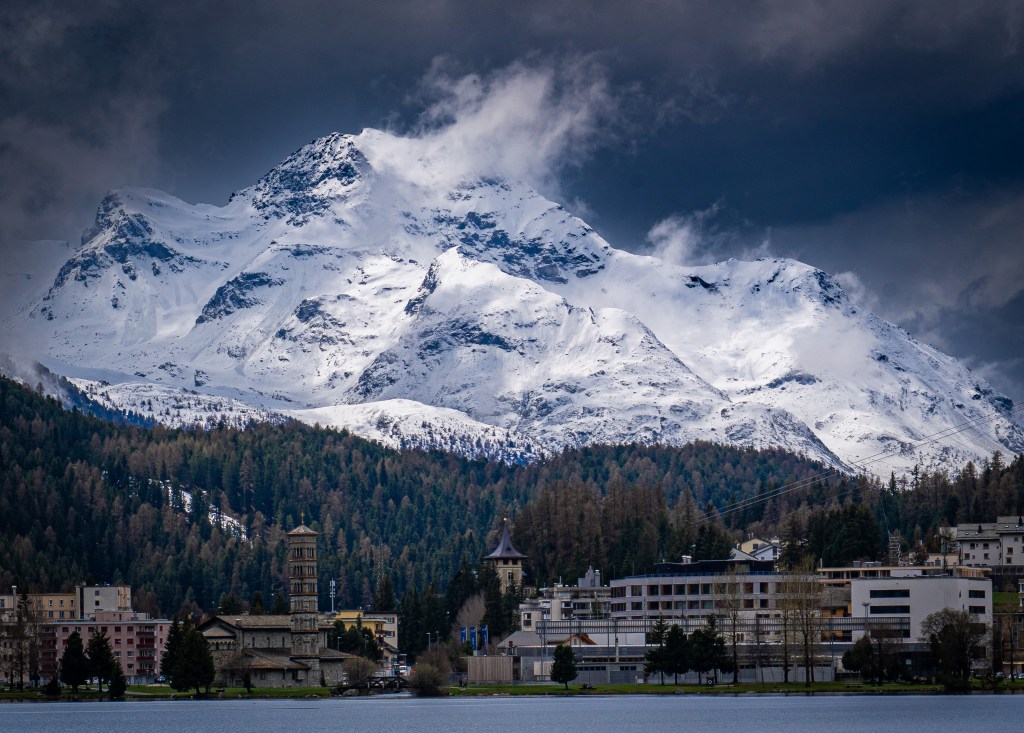
From Bernina Diavolezza, we travelled a short distance by coach into St Moritz. If I had to sum up this town in one word, it would be ‘anticlimactic’. Given its reputation as a world class ski resort, I had imagined a bit of style and polish but we were both in agreement about the nondescript character of the place. It didn’t help that a lot of the shops were closed for a ‘between season break’. I’m not a skier and I reckon that is its biggest draw, the skiing and its location, a perfect base for exploring the Alps. And maybe it looks better when covered in snow. But let’s not end on a negative. Before getting back on the coach for the return trip to Italy, I had a pleasant surprise. I took a walk across the road to the lakeshore and a break in the stormy sky created a scene which lasted less than a minute before the rain started again. What did I say about nature being the boss?

The sun broke threw the clouds to create a dramatic contrast between the snow capped peaks and the storm clouds.

And so, St Moritz having provided some photographic compensation, we boarded the bus and settled in for the return journey to Lake Como.

Thoughts and Tips

A great experience. As I have alluded to, the weather conditions will determine how much you will see. People have a tendency to expect the views to be exactly like the brochures but you have to remember that the brochures show places in perfect weather.

Which train to choose? This is a tricky one. As I mentioned, there are different ‘classes’ of train. The most expensive train will have the carriages with the extended windows but if photos are your priority, take the train with windows that open. It’s also worth noting that normal service trains run on the same line. If you have the time, you can travel longer stretches of the line, getting off at different stations and catching the next train to continue on to your next destination. One major benefit of using these trains is that your ticket allows flexibility. You don’t have to travel on a particular day. If you buy a ticket for the Bernina Express, you must use it on a specific day and time.

What time of year is best? It depends on what type of experience you want. In winter you will see dazzling snow covered landscapes. In summer, lush pines and alpine flora will be the order of the day. Spring or Autumn will offer a mixture as the seasons change from one to the other. But remember. When you are travelling at such high altitudes, weather conditions are volatile and your experience will be in the hands of the Gods. This is where the flexibility of the regular service trains will be an advantage. If you are spending a few days or longer in the region, you can follow the weather forecast and pick the best day to travel.

Would I go back? Yes but as I said in my previous post, independent travel would allow the flexibility I’ve talked about above. But that comes at a cost. Our trip was part of a package and while that meant less flexibility, it made the the trip more cost effective. Also, independent travel isn’t for everyone. For some travellers, a package means not having the hassle and responsibility of booking trains, buses, accommodation etc. As I have already mentioned, I don’t have to do that anyway, so as long as I have my camera, I’m a happy lad.

Lake Como

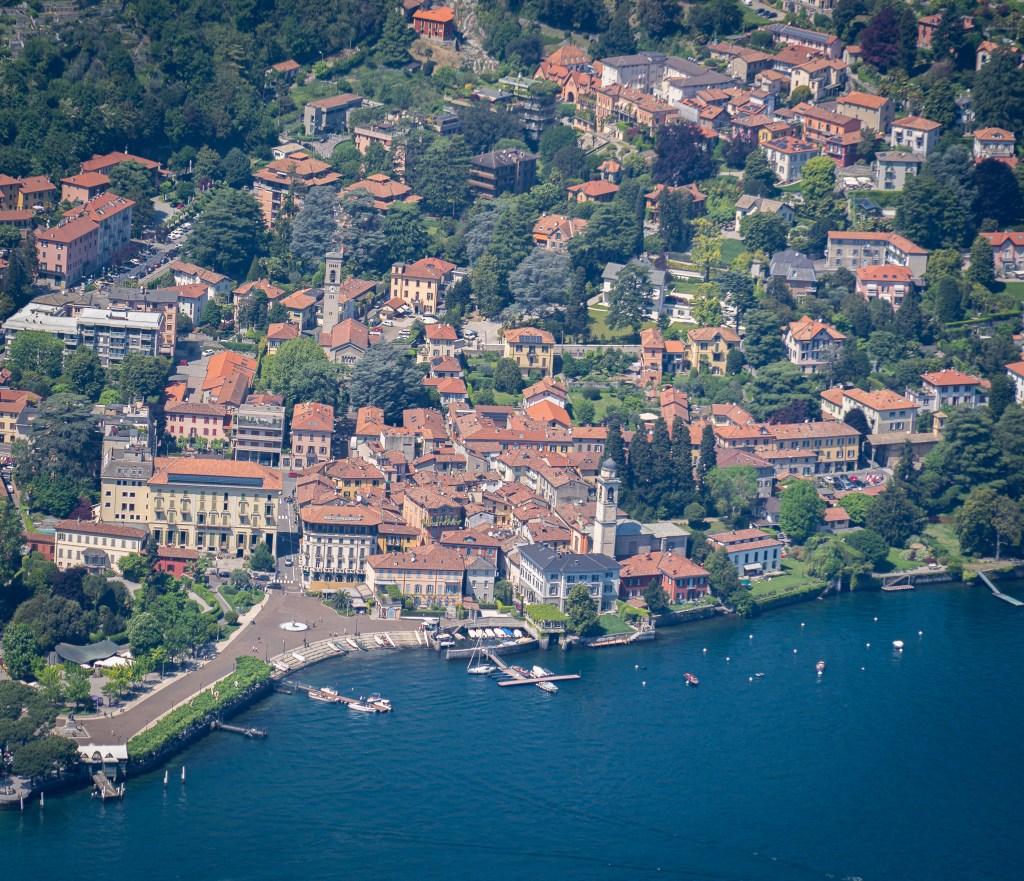
Lake Como is situated in the Lombardy region of Italy. Formed by glacial processes, it has a distinctive inverted Y shape. It’s the third largest of the Italian Lakes (146km2) after Lake Garda and Lake Maggiore. It is also one of the deepest lakes in Europe at 400m.

The lake sits at the base of the Alps and its shores are punctuated with picturesque villages and luxury villas. This is one of the most scenic locations we have ever visited. With the dramatic backdrop of the Alps and the striking coastal landscape, it’s no wonder this has been the setting for many movies, including Hitchcock’s debut film, The Pleasure Garden (1925), Star Wars: Episode 2 (2002), Ocean’s Twelve (2004) and Casino Royale (2006).

This house is part of Richard Branson’s site. It’s his gardener’s house!

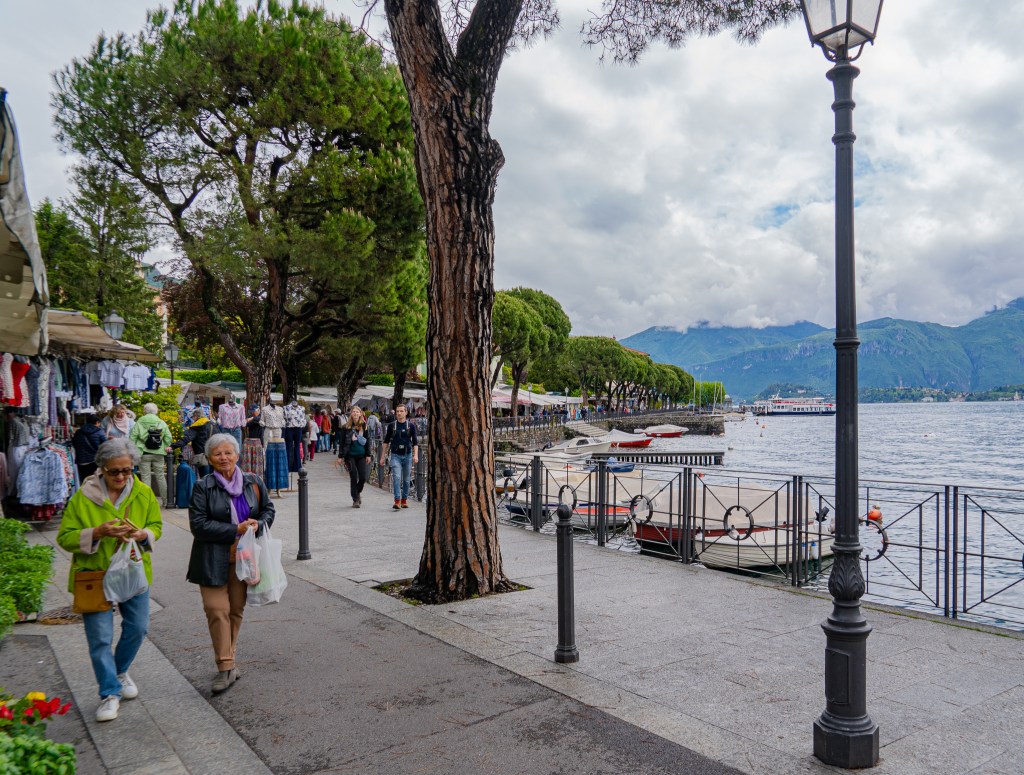
Our hotel was on the lakeshore at Tremezzo and watching boats of all descriptions, from yachts to water taxis, on the lake was a pastime of dreams.

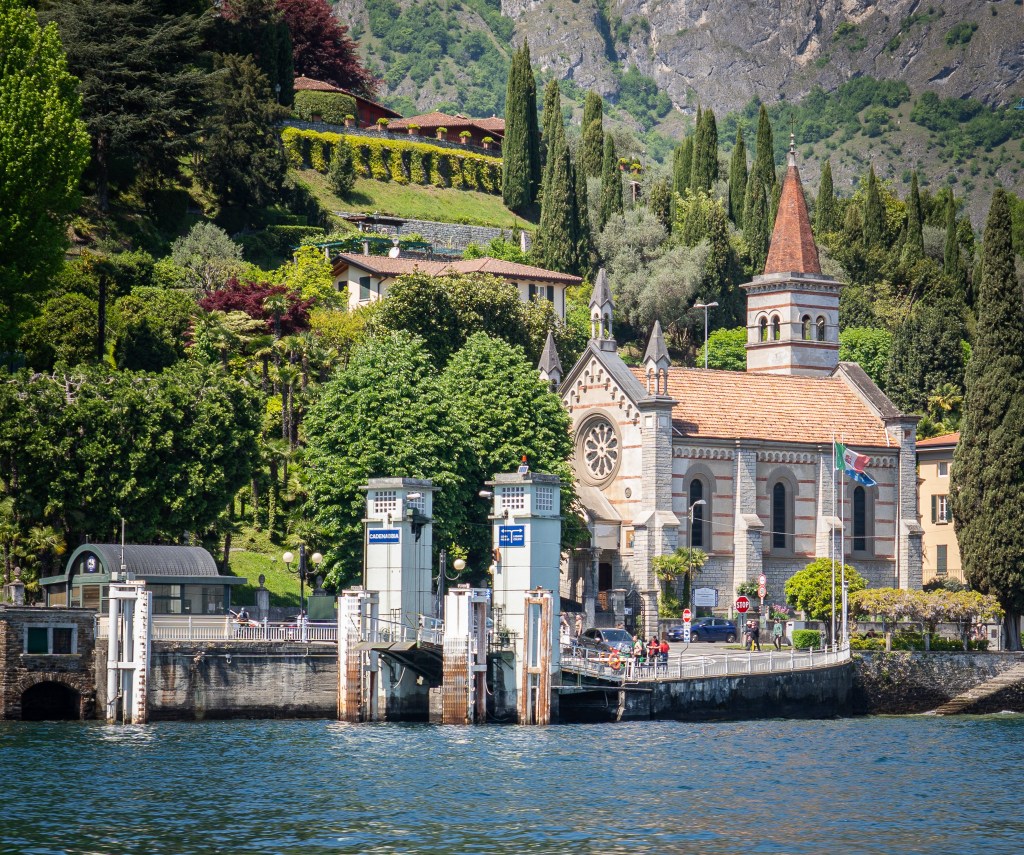
Tremezzo. One of the many ferries that carries passengers to the various towns and villages. Photo taken from the hotel room balcony.

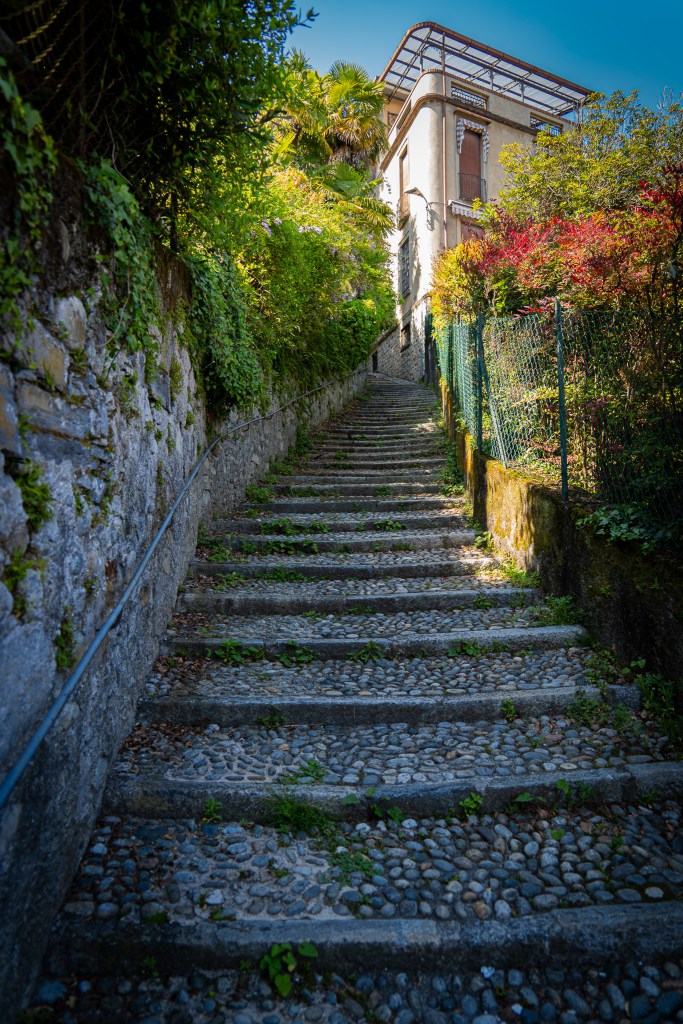
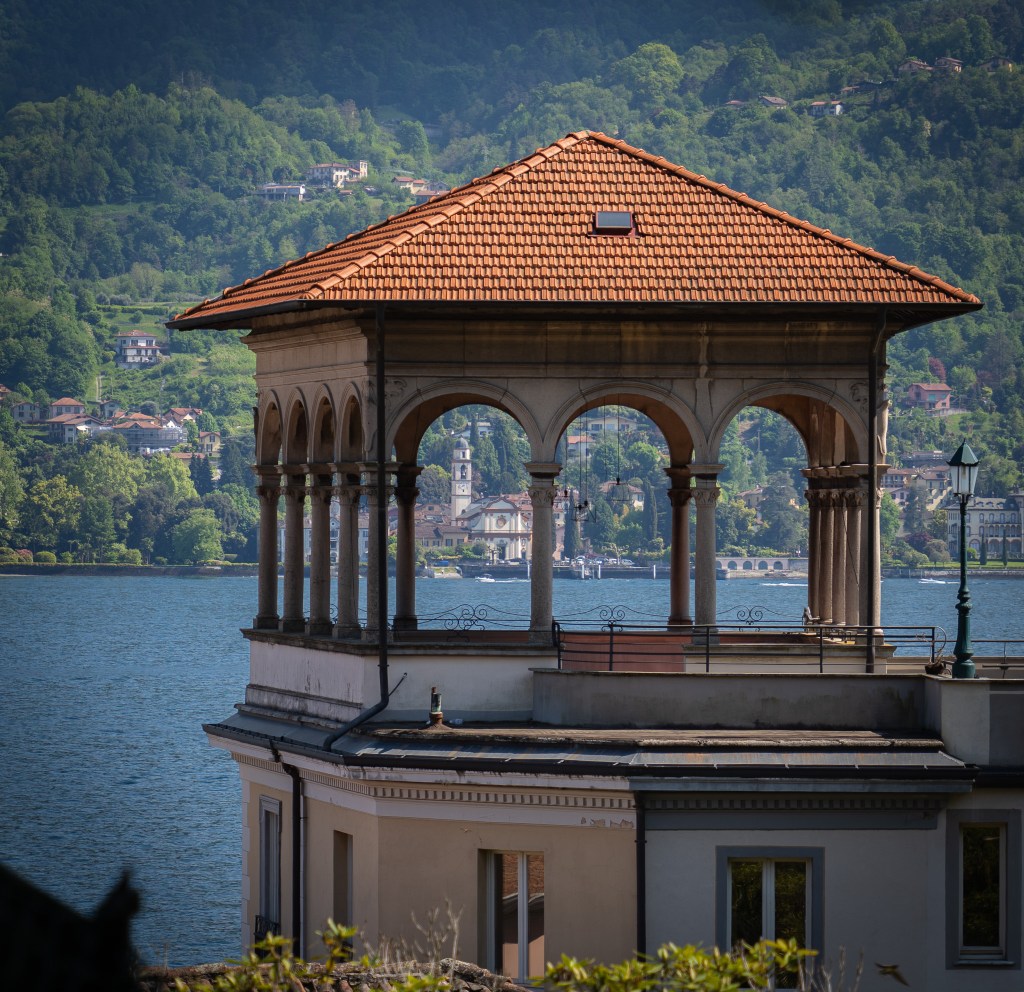
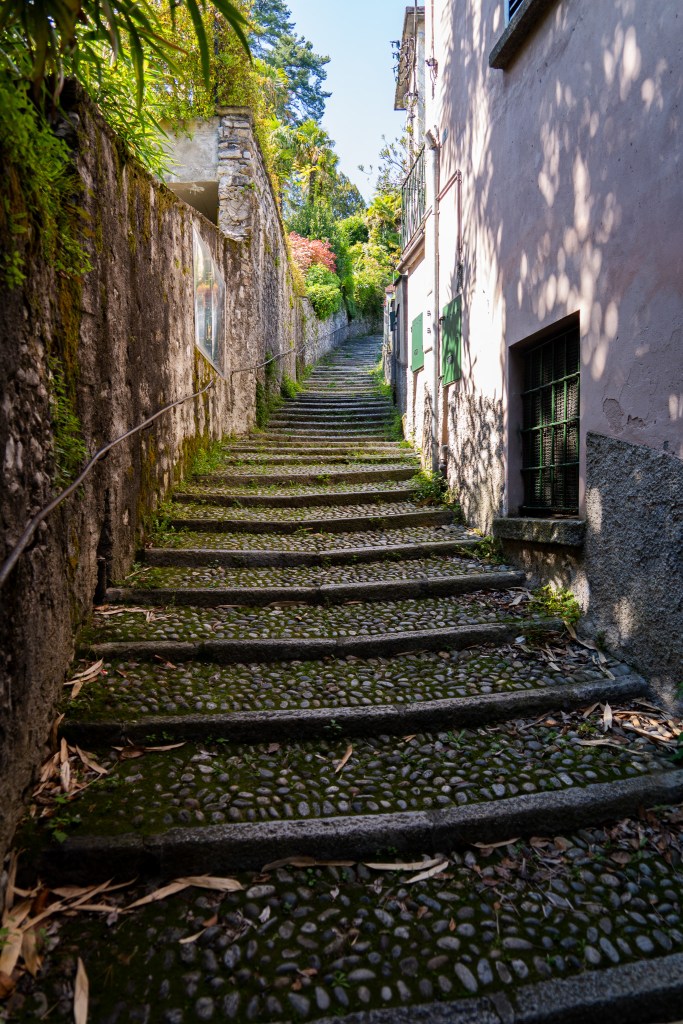
The cobbled lanes behind the hotel revealed lots of villas tucked away.

Not to mention some impressive views over the lake.

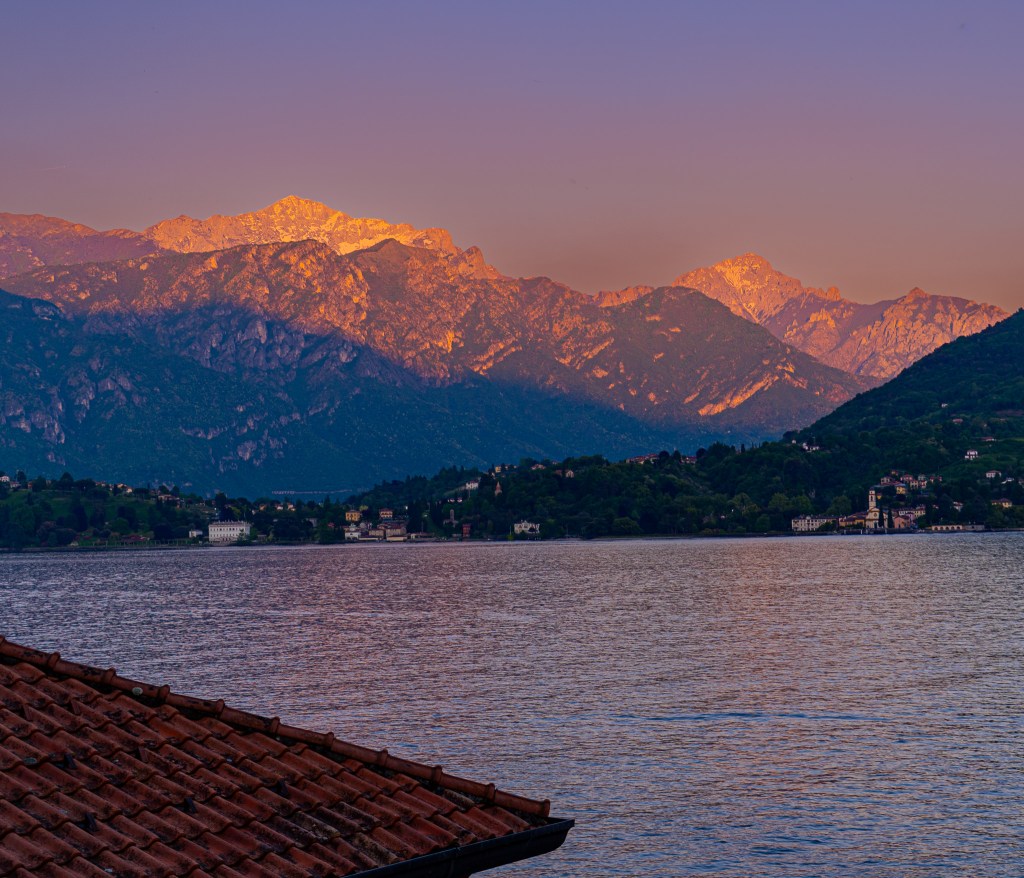
The setting sun painting the Alps in evening tones. View from the hotel room balcony.

Although there are many towns and villages dotted around the shores of Lake Como, we only had time to visit four: Bellaggio, Varenna, Lenno and Como. Each one had their own unique appeal and I would recommend a visit to all of them.

Bellaggio was probably the most polished town we visited.

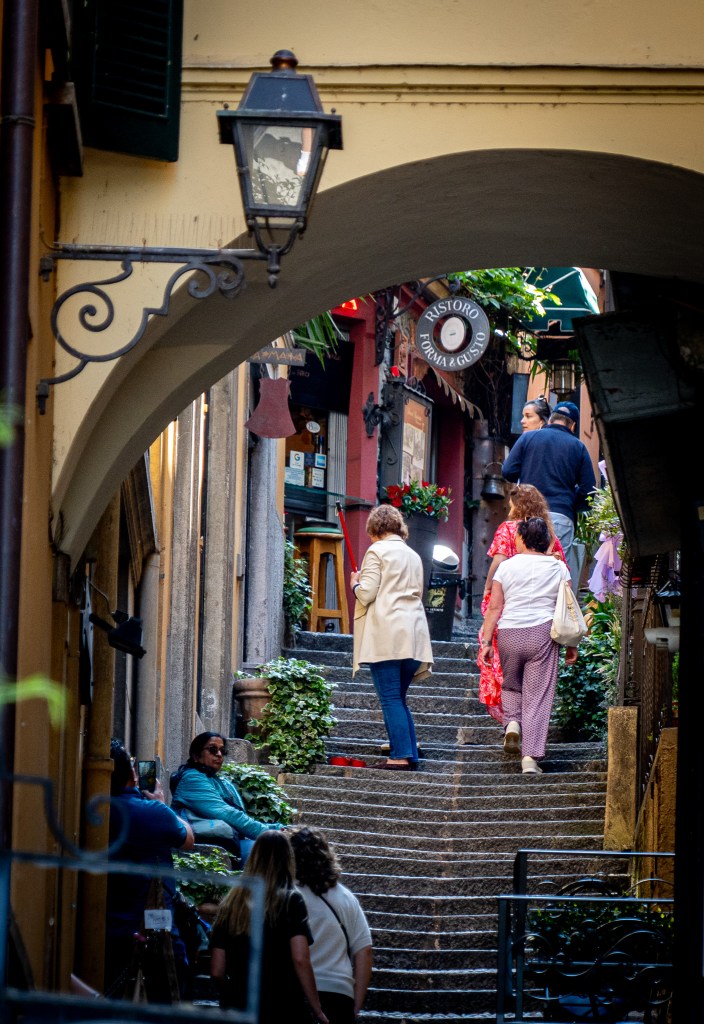
Bellaggio’s steep cobbled streets were lined with shops of every description. From jewellery to glass to silk, for which the region is famous.

Both a shopper’s paradise and a photographer’s dream.

Streets full of character.

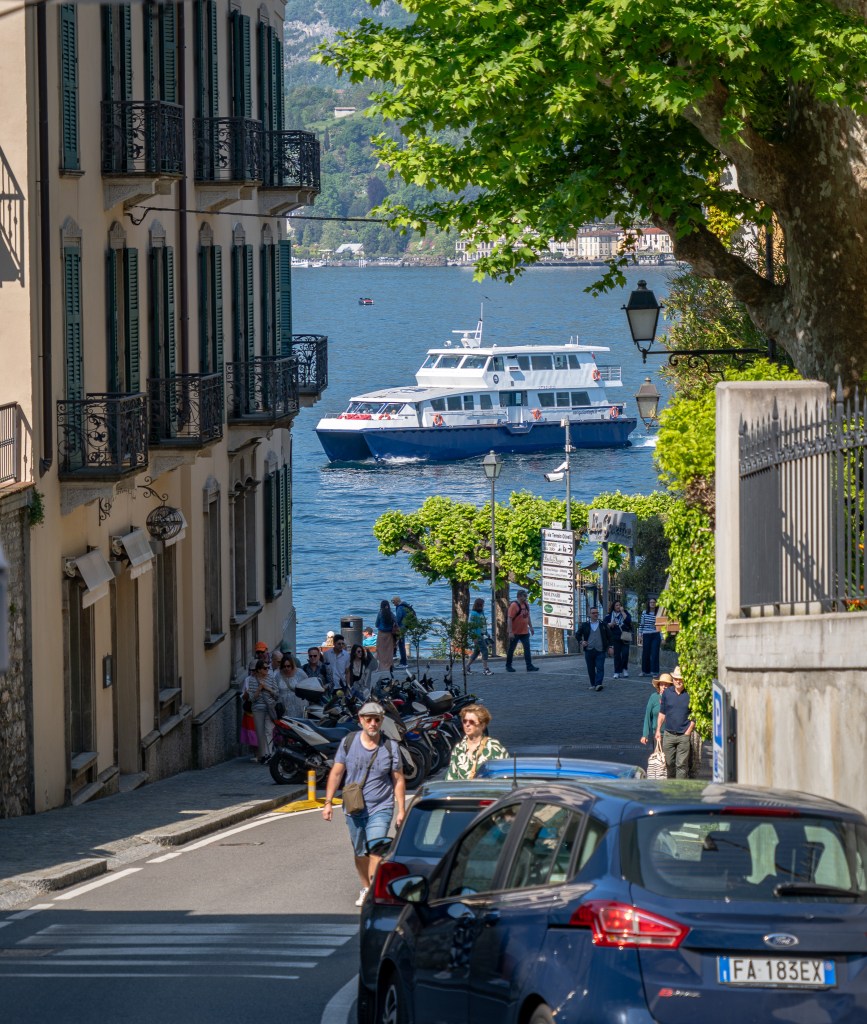
The next ferry is never far away.

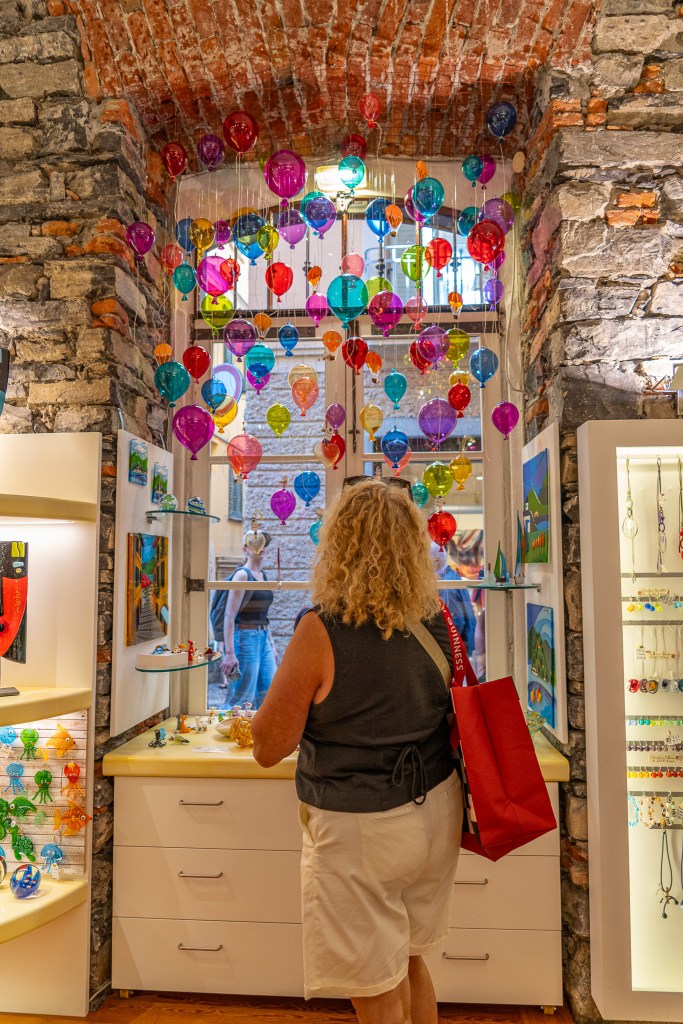
One of the many artisans in Bellaggio, specializing in glass. Including an eye catching range of coloured glass balloons.

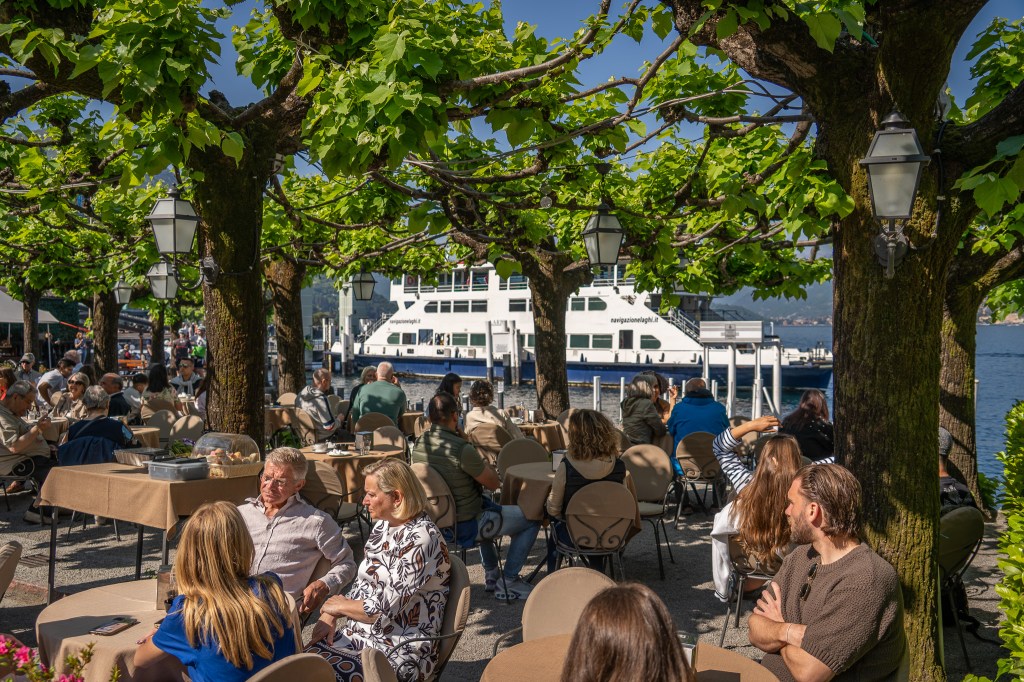
While the narrow cobbled streets cater for the shoppers, the lake front offers a wide range of eateries.

Lunch by the lake.

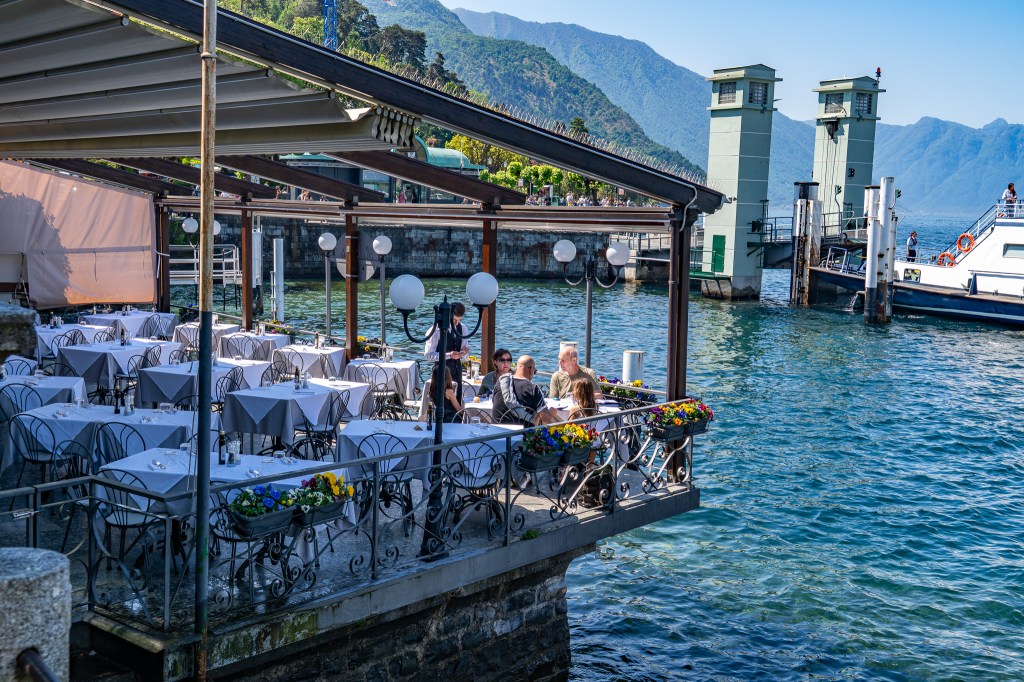
As close as you can get to the lake without being in it!

If Bellaggio is the most polished town, Varenna has to be the most picturesque. It is situated approximately 15 minutes, by boat, from Bellaggio. Stepping off the boat it soon becomes obvious that Varenna lacks the elegance of Bellaggio but if it lacks elegance, it overcompensates with charm and rustic beauty.

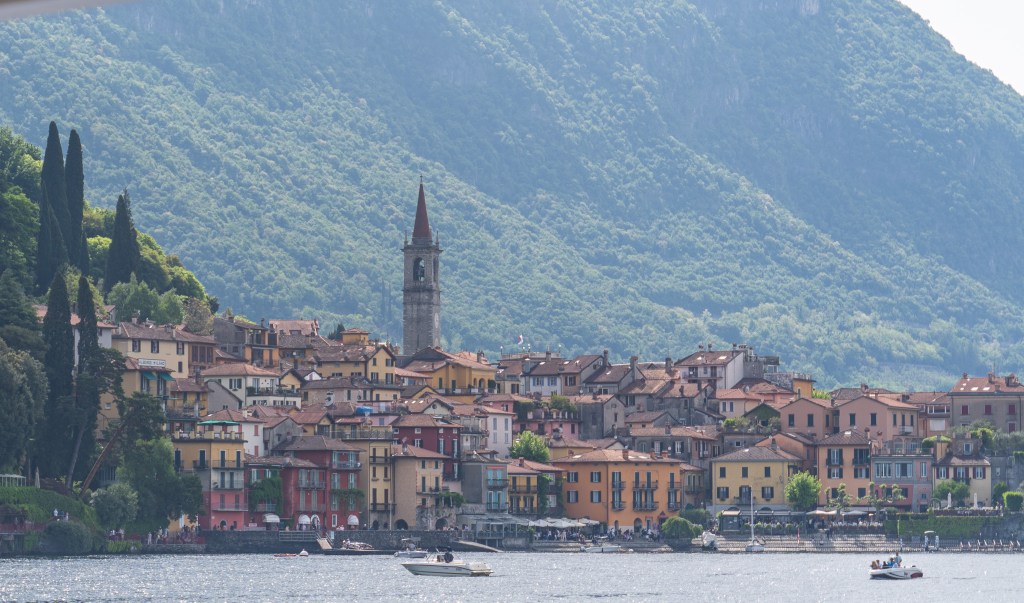
Varenna. Capturing this scene was a long standing goal of mine. The combination of lighting conditions and the vibrant colours resulted in a photo with a postcard feel and made the wait worthwhile.

Varenna invokes the same question as other locations on the lake. Is it a town or a village? It seems too small for the former and too big for the latter. Whatever its status, it oozes history and character. There is no shortage of cafes and restaurants from which to enjoy the atmosphere and watch the world (and endless tourists) go by. A climb up one of the many steep side streets provides an escape from the bustle of the harbour and a glimpse of what everyday existence is like for the locals-unhurried and peaceful.

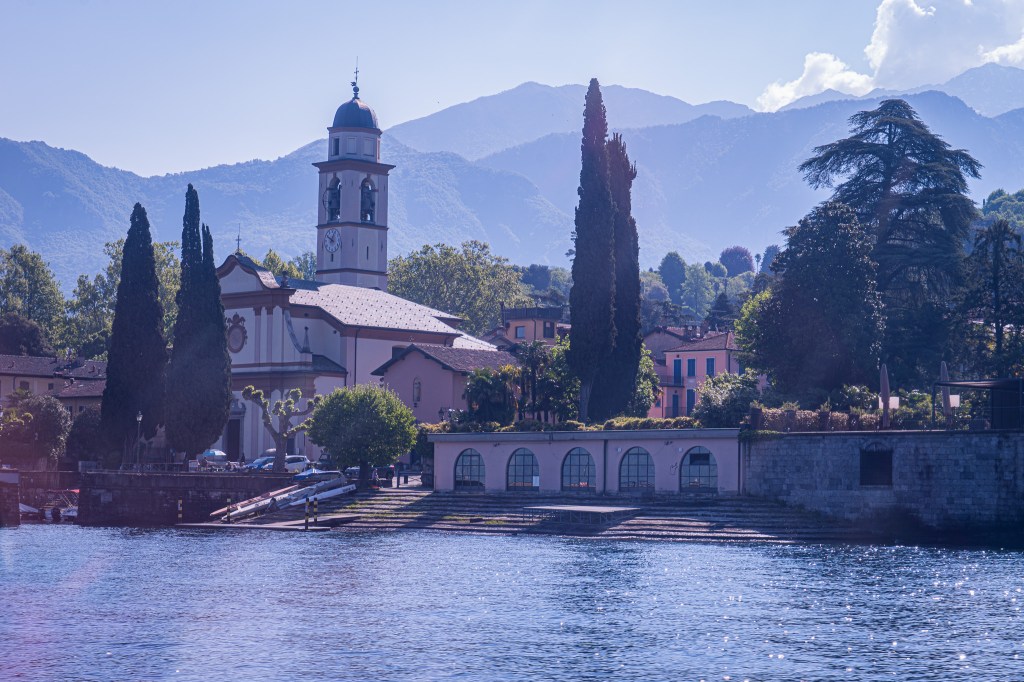
Another 15 minute boat ride, heading south from our hotel in Tremezzo, brought us to Lenno. While not as striking as Bellaggio or Varenna, market day in Lenno has a pleasant ambience. The stalls stretch from the small square in the village down to the waterfront, so if market shopping isn’t your thing, you can always just admire the small boats that are moored in front of the stalls.

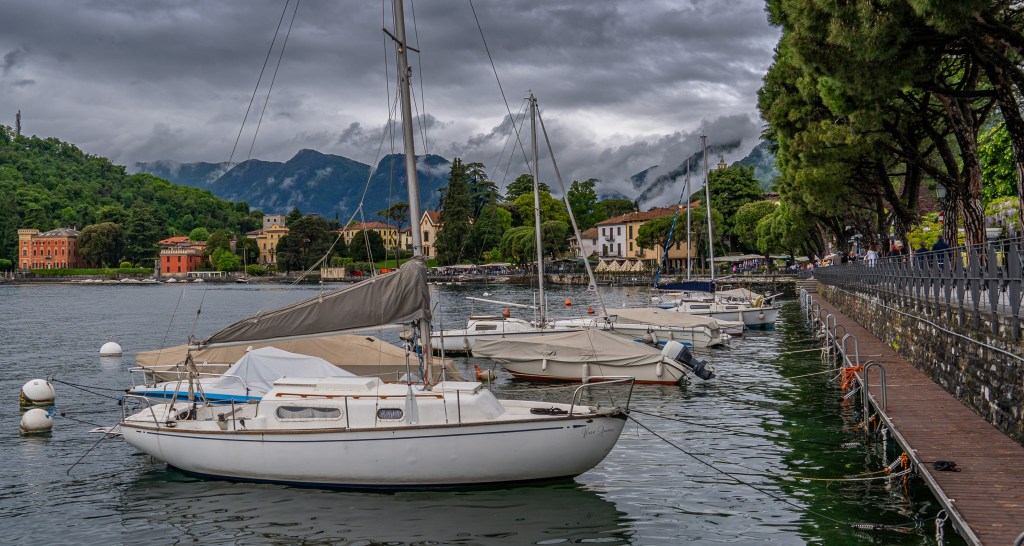
Lenno. Boats moored at the jetty.

Market stalls versus boats. I know which I prefer!

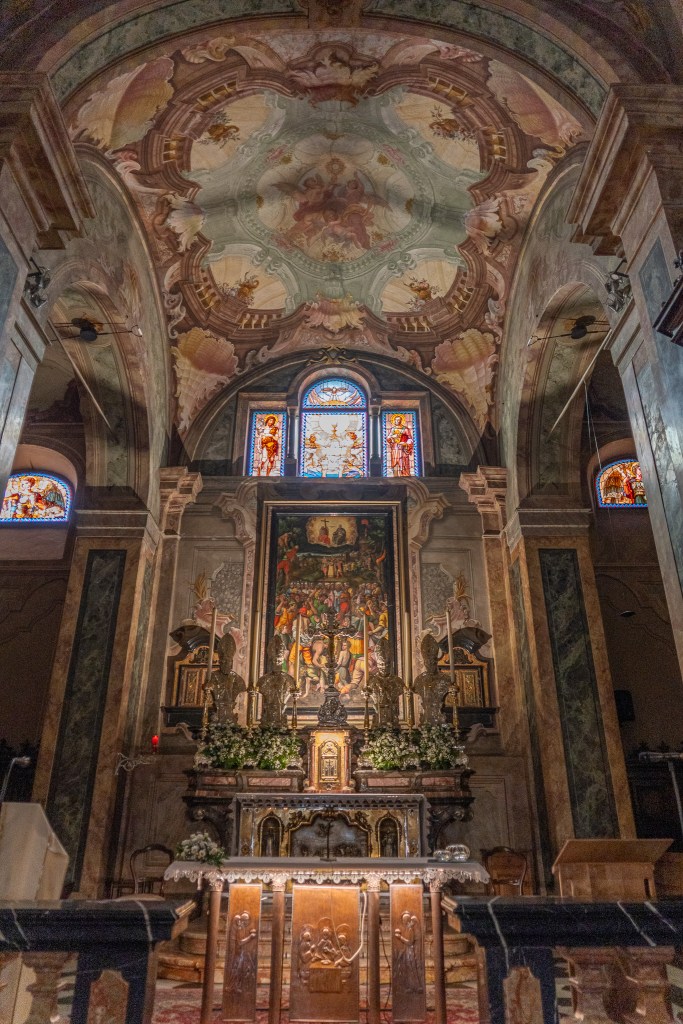
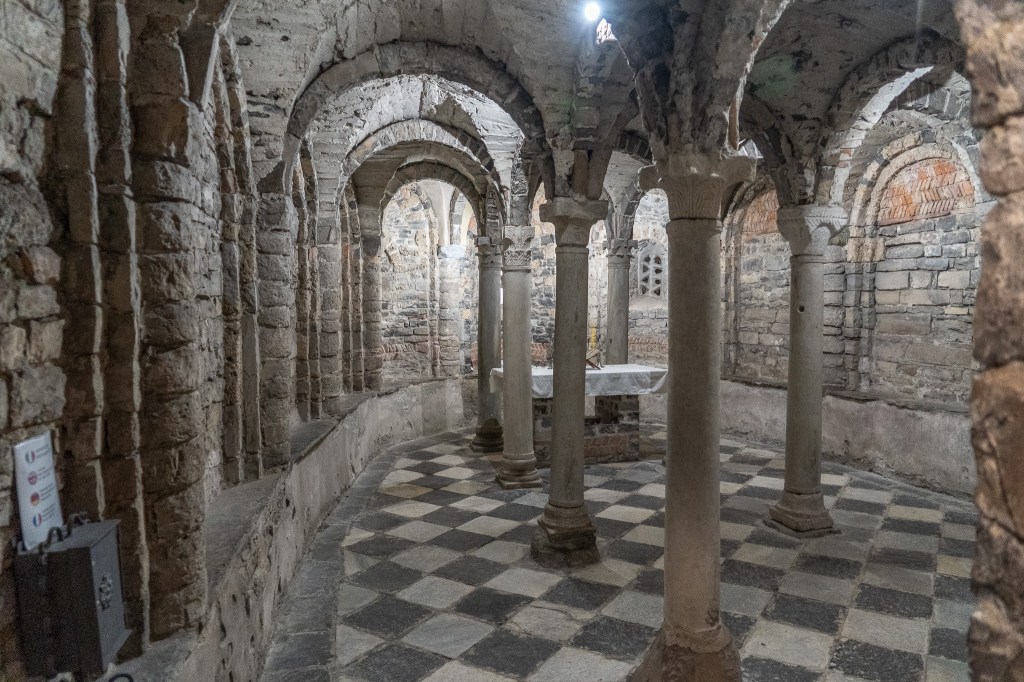
Two hours in Lenno is probably enough unless you stay for a coffee or something to eat. The local church of St Stephen was an interesting and unexpected find and is worth a look. As well as the intricate frescoes, there is a crypt that is accessed from steps in the main body of the church. It dates back to the 12th century and has been impressively preserved. No mean feat, given that it is below the water level of the lake!

Frescoes and stained glass adding colour and interest.

St Stephen’s underground crypt.

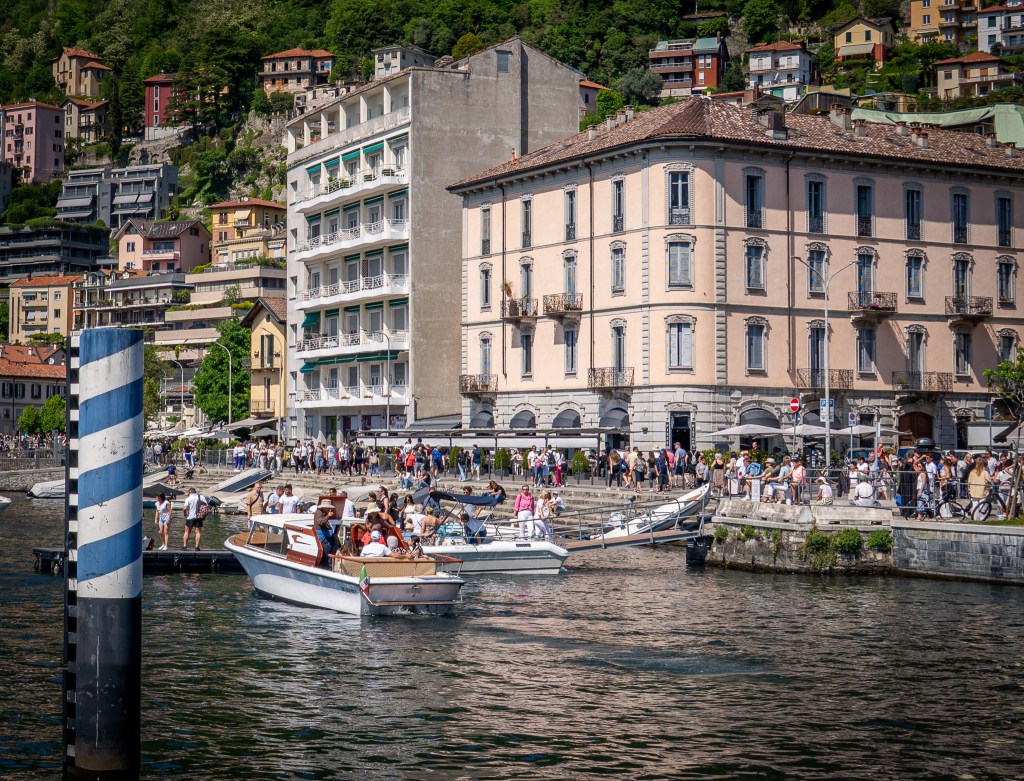
Como was our first trip by bus. Although it is accessible by boat, its position at the southwestern tip of the lake would have meant a 2 hour boat journey. Unlike the previous locations, Como’s status is obvious. It’s most definitely a city. It is the administrative capital of the Province of Como and has a population of 84,000. Como has lots to offer in terms of history, culture and arts, as well as the world’s oldest seaplane club.

The bustling harbour at Como.

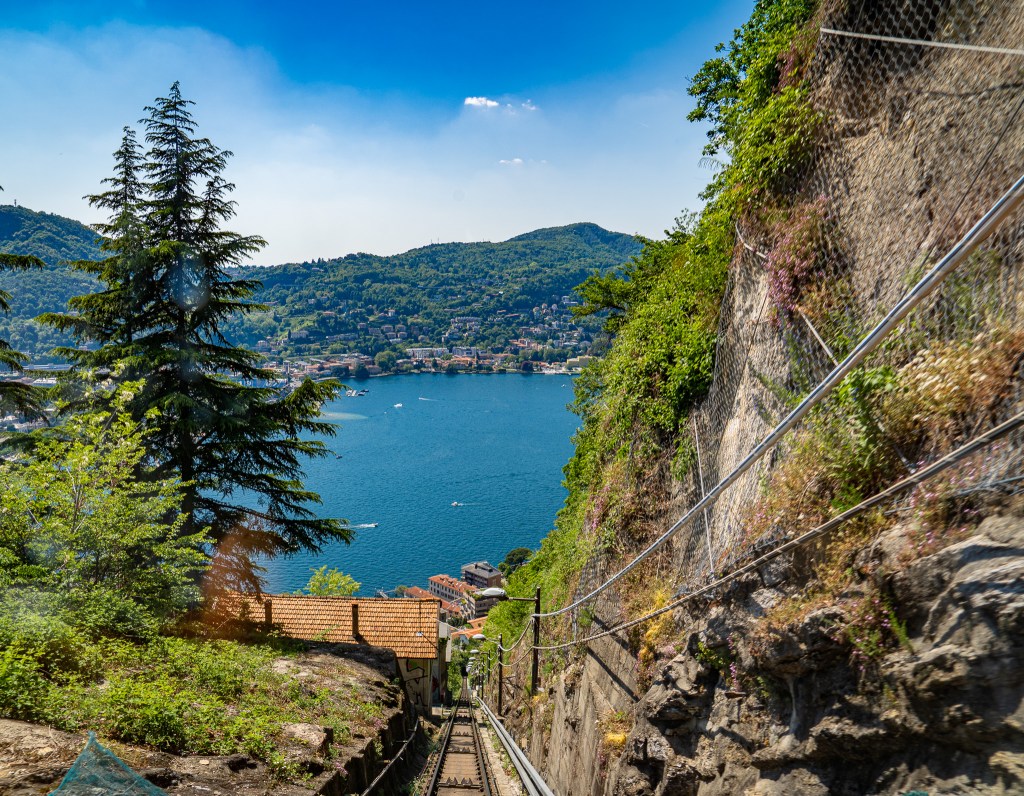
However, we had decided to give priority to taking the funicular railway from Como to Brunate, a village that sits 500 metres above Como. The funicular operates via electric motor and cable, which pulls the train up the steep gradient. Despite leaving the station every 15 minutes, the popularity of the train means that you can expect to queue for 2 hours! We arrived around 10am and the line of people was already snaking its way along the waterfront. Our wait time was around 1.5 hours but the time went quickly as we chatted with two friendly women, Geraldine and Maura, who were also from Ireland.

The upper station on the Como-Brunate funicular railway.

Spectacular views over Lake Como if you’re lucky enough to get a front row seat.

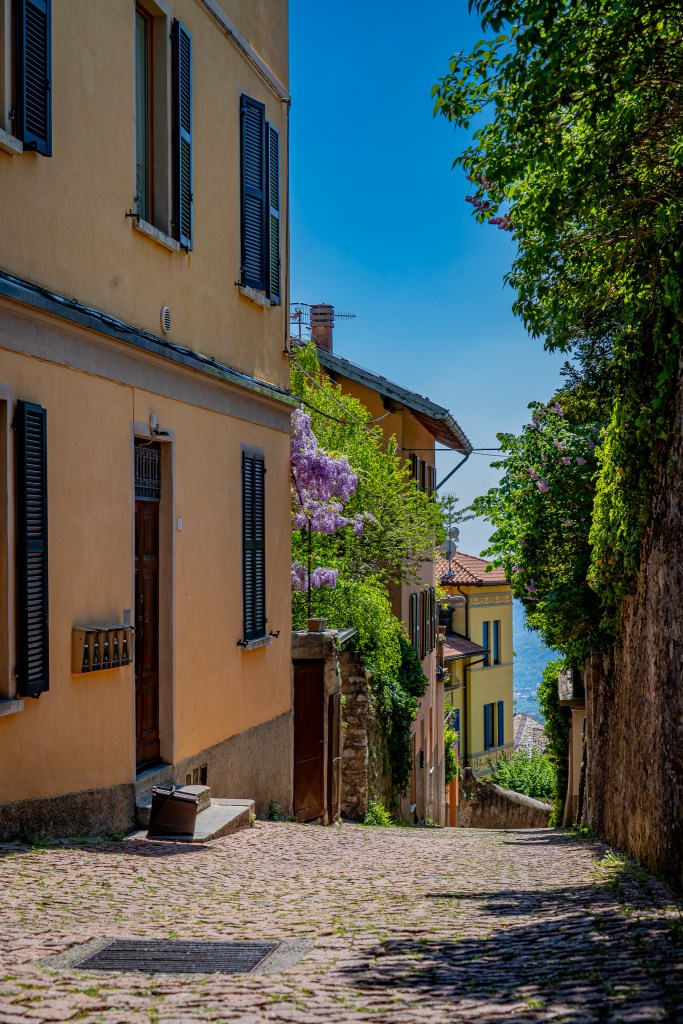
Brunate. The train journey is just over 1km long and takes 7 minutes but alighting at the other end feels like entering a new country. The chalet type houses and quiet lanes, draped in wisteria, portrayed a Swiss vibe.

The serene cobbled lanes of Brunate.

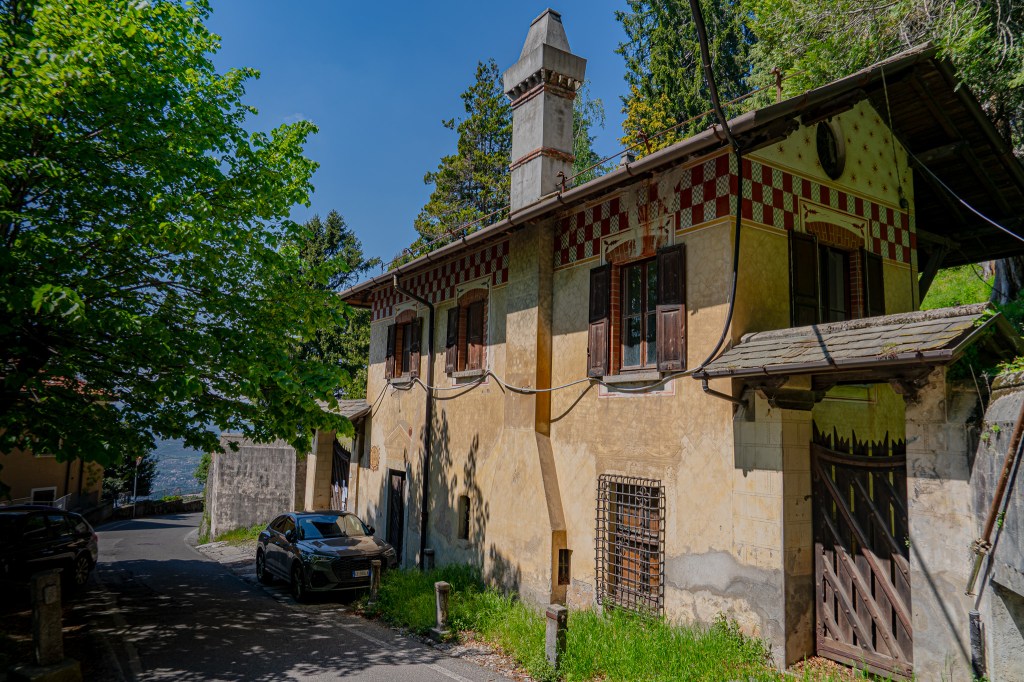
A mix of Swiss, German and Italian architecture give Brunate a unique character.

No crowds here. Probably due to the steep climb.

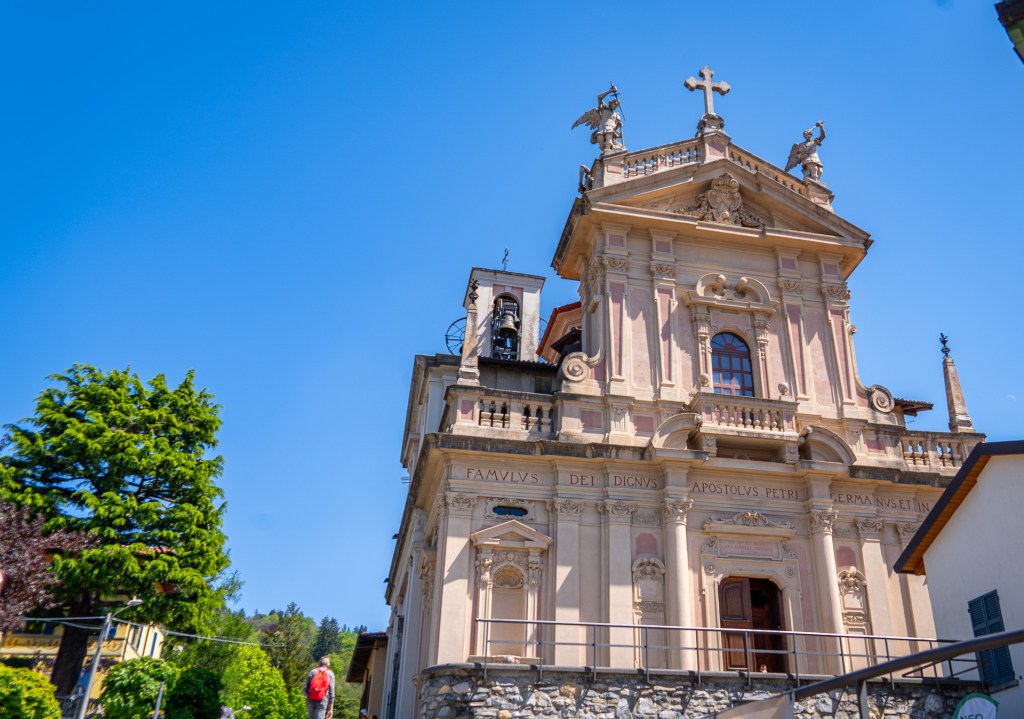
The church at Brunate.

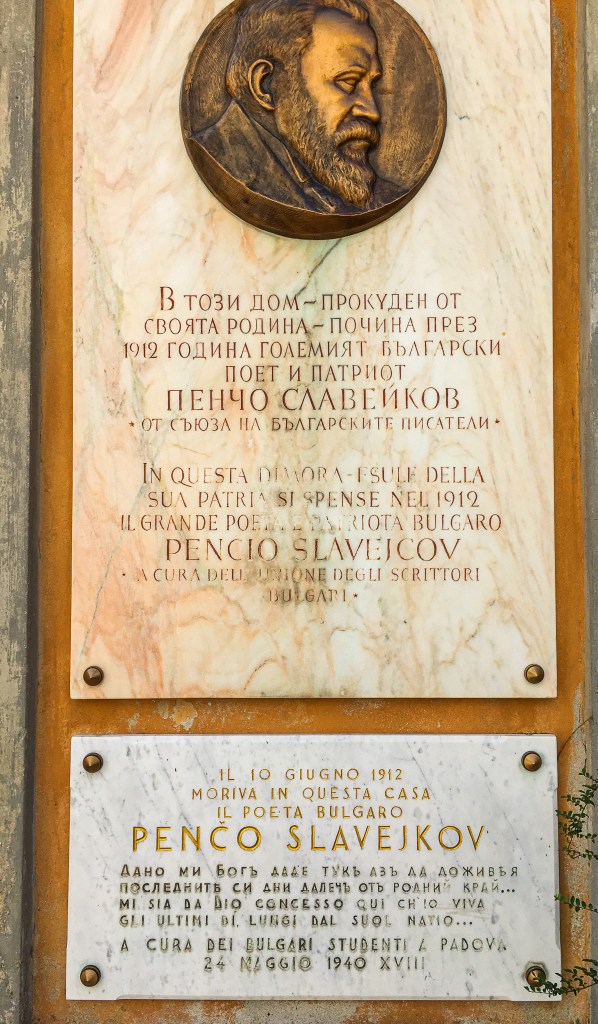
Pencho Slaveykov. Bulgarian poet, writer and philosopher. 1866-1912.

While walking past the church in Brunate, I noticed a commemorative plaque on a wall. It was mostly in Cyrillic script, which I don’t understand. Later that evening in the hotel, I looked him up and discovered a fascinating individual whose life had been dictated by one unfortunate event.

At the age of 18, Pencho fell asleep on a bench during a heavy snowfall. He contracted pneumonia which left him unable to walk without a cane and he had difficulties speaking and writing. He suffered from melancholia and he turned to literature in search of a cure. His work as a poet and philosopher led to extensive travel throughout Europe but his main goal was to find a cure for his condition. After travelling through Italy and Switzerland, he returned to the mountains in Italy. He arrived in Brunate in late May, 1912. He died on 10th June and was buried in the local cemetery. In 1921 his remains were repatriated to his homeland.

In a cruel twist of fate, he had been nominated for a Nobel Prize. Because of his death, the nomination wasn’t considered.

In 1903 Pencho began a relationship with another poet, Mara Belcheva and they remained together until his death. Although they never married, he always referred to her as his wife. They are both depicted on the Bulgarian 50 lev banknotes that were issued in 1999 and 2006. His story was an unexpected and poignant discovery for me. One which gave this picturesque village a very human dimension.

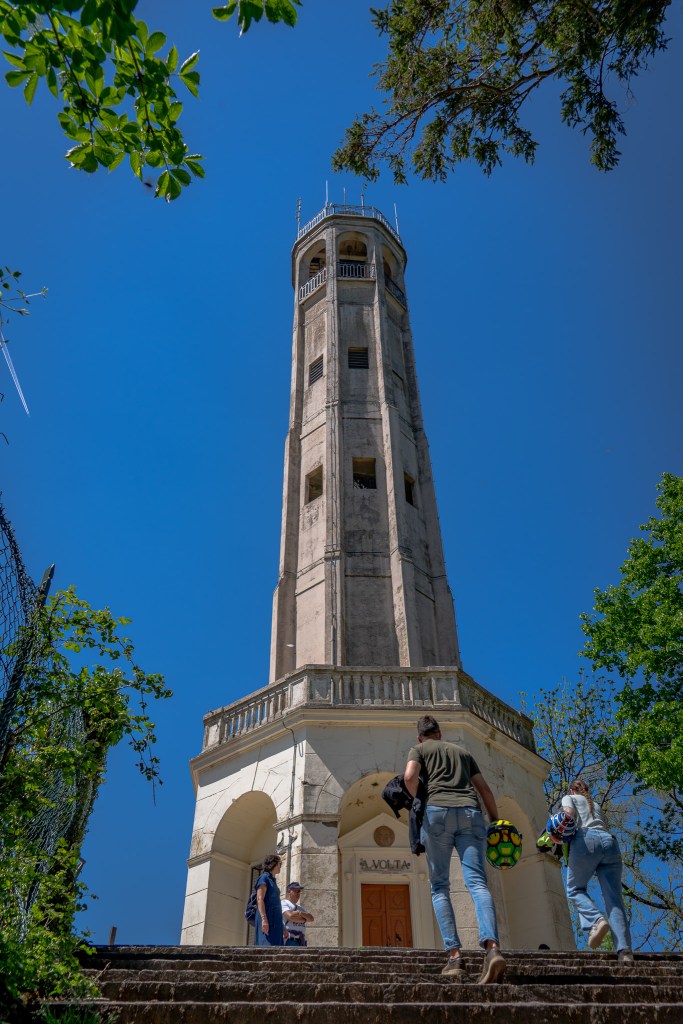
Volta Lighthouse. In and around the station at Brunate, we saw signs for a shuttle bus to Volta Lighthouse but it wasn’t obvious if the bus was operating, so we decided to walk. This was the steepest climb yet and the ground was uneven in places. The distance to the lighthouse is about 1km but it took at least 30 minutes to walk because of the slow pace and frequent stops to catch our breath. Volta Lighthouse sits on a hill in San Maurizio, a tiny village with an elevation 150 metres above Brunate. The lighthouse is named after Alessandro Volta, a chemist and physicist and native of Como. He invented the electric battery and discovered methane.

Volta Lighthouse with its distinctive octagonal shape.

The view from Volta Lighthouse

The walk back to the funicular was almost as challenging as the ascent to the lighthouse and my knees felt it. Before we knew it, our day was at an end. I think Como has a lot more to offer but I’m glad we used our time in the way we did. It was a unique experience and one which may not be possible when the knees are a few years older! We got the bus back to our hotel but it was a long wait because at least two buses didn’t turn up. My recommendation would be to take the ferry and spend two hours on the lake taking in the scenery at a leisurely pace.

Thoughts and tips.

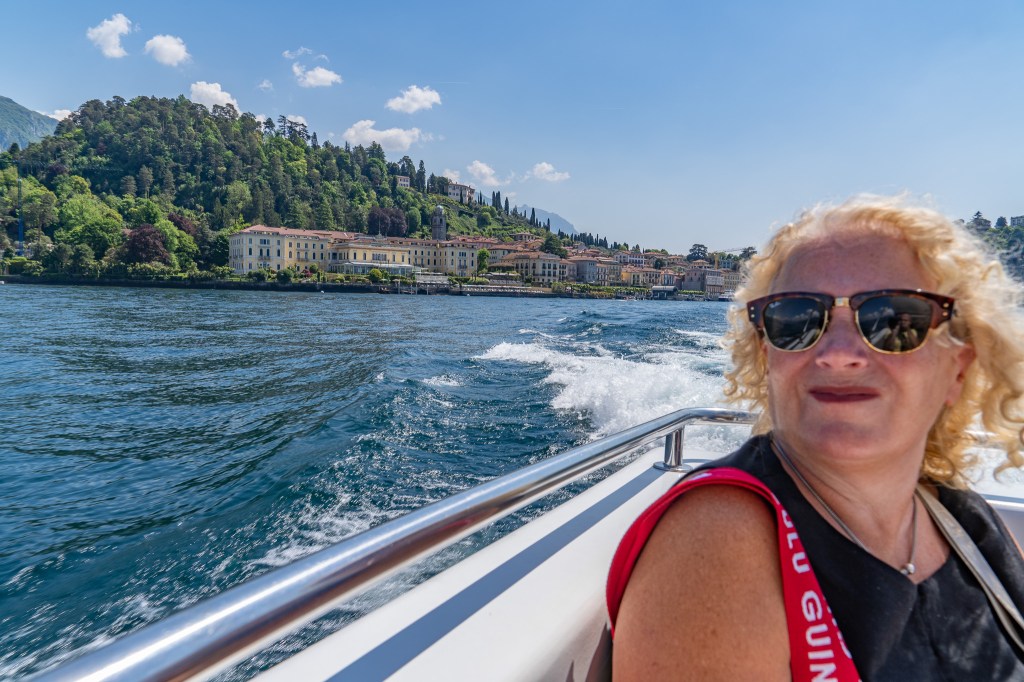
Getting around. The best, and cheapest way to travel to and from the various towns and villages on Lake Como is by boat. There is a wide choice of boat, from ferry to high speed hydrofoil, shuttle boat and water taxi. A Mid Lake day pass costs 15 euro, which allows you to visit all the locations above except Como.

On the water is the fastest, cheapest and most enjoyable mode of transport on Lake Como.

Climate. Lake Como is in the Prealp region. In other words, it sits at the foothills of the Alps and is prone to a range of weather influences. Combined with the effects of evaporation from the lake itself, the region can be humid and rain or low cloud are not uncommon. While summer temperatures may be more predictable, we experienced a wide range of temperatures and weather conditions. If you’re visiting in Springtime, bring layers to allow flexibility.

People. From shopkeepers to bus drivers, I found the Italian people very friendly. Not surprisingly, due to the volume of tourists, everyone spoke at least some English, which made communicating straightforward.

Food. I’m no food critic and most of our meals were included in the hotel booking. The general standard was good and as far as I could tell, prices were reasonable.

Would I go back? Yes. But I think a return trip would be as independent travellers. This was an organised trip, booked through a travel agent. However, my personal preference is independent travel and the freedom and flexibility that brings. One of the greatest pleasures I experienced was sitting on the balcony of the hotel room with a glass of wine, watching the boats on the lake. It was a relaxing and therapeutic ‘activity’. But that didn’t happen often because we were usually out on the various coach tours that were part of the package. As I (half) jokingly remarked one afternoon, “I know it’s not a practical, realistic or healthy aspiration but day drinking on the shores of Lake Como is my idea of the perfect pastime!”

Some more photos...

One of the many boat stops around Lake Como.

Sightseeing boat near Lenno.

Colourful Varenna.

Light and shade in the quiet lanes above Tremezzo.

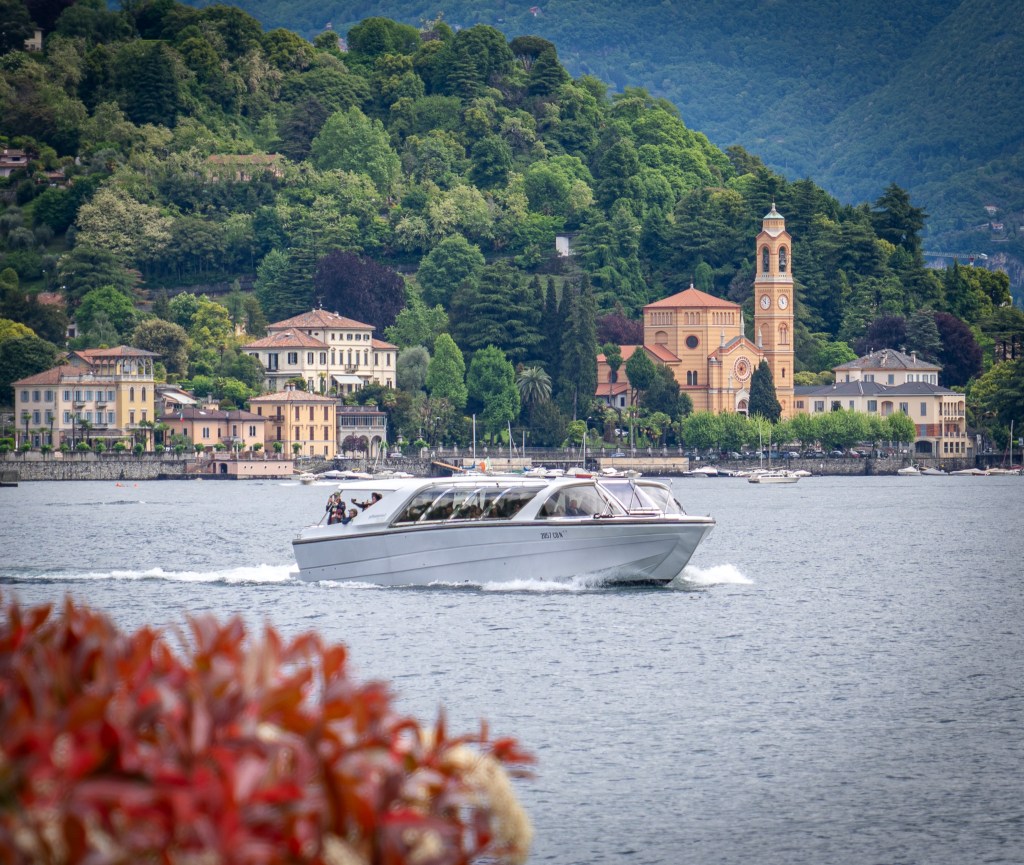
San Giovanni oozing charm. This was visible from our hotel across the lake. At night the tower was illuminated with a red spotlight.

Taxi, Como style.

Arrivederci!

Seville (Sevilla)

Capital city of the autonomous community of Andalusia. Famous for its architecture, culture and rich history. It is also considered the birthplace of Flamenco. And of course, no mention of Seville would be complete without a reference to Seville oranges. The bitter fruit that grows on trees throughout the city is highly sought after in places like Britain for making marmalade. The Spanish use the oranges for aromatherapy, herbal medicine and even clean electricity generation by using the methane generated from the fermentation process. Never as a foodstuff.

We visited the city at the end of October, which unfortunately coincided with some of the worst flooding Spain had seen for years. And while the heaviest rains and the worst consequences (including loss of lives) was in the Valencia region, several hours north, the rain fell for the entire duration of our three day stay. But Seville is such an outstanding city that even the rains didn’t dampen the spirits or spoil the enjoyment.

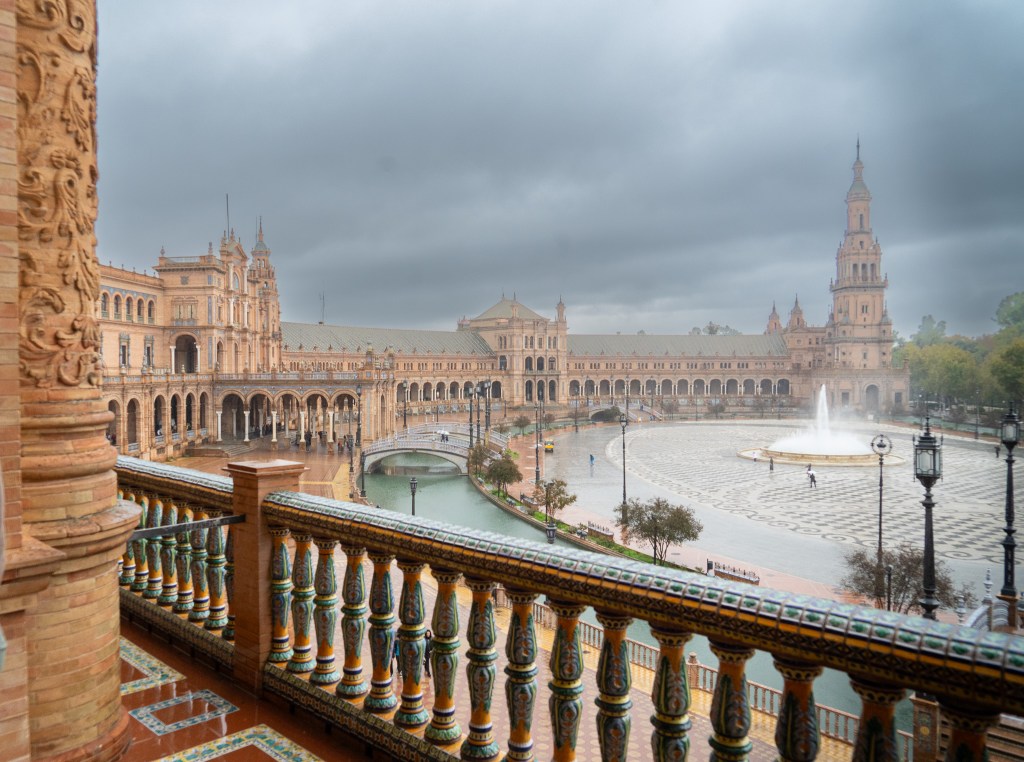
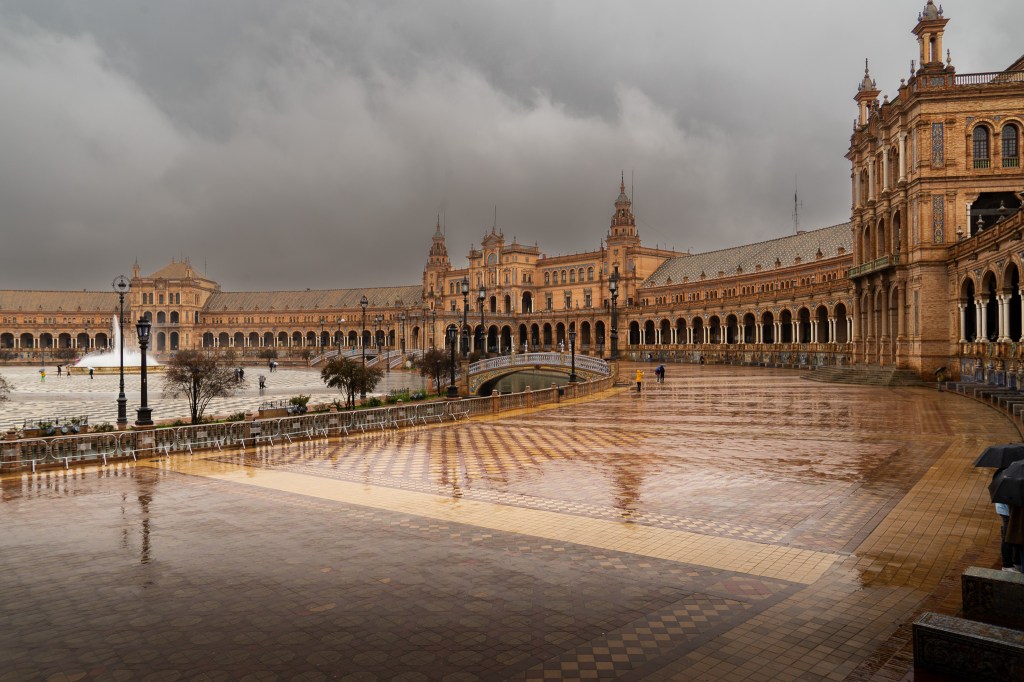
The Plaza de Espana was our fist port of call. Built in 1928 for the Ibero-American Exposition of 1929, it is an imposing structure of huge proportions.

Plaza de Espana. The rain created a softening effect and kept most of the tourists away, which gave the place an almost ethereal feel.

Only extreme weather would cause this place to be so deserted but I wasn’t complaining. The deserted plaza allowed for some dramatic shots.

The cloistered walkway providing respite for the sodden tourists.

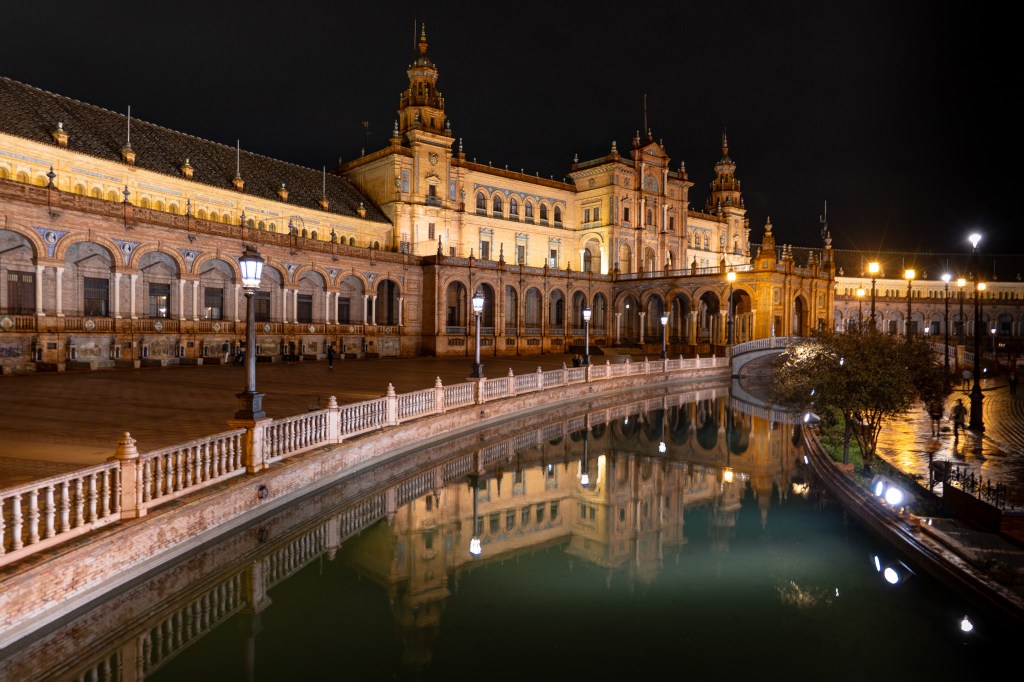
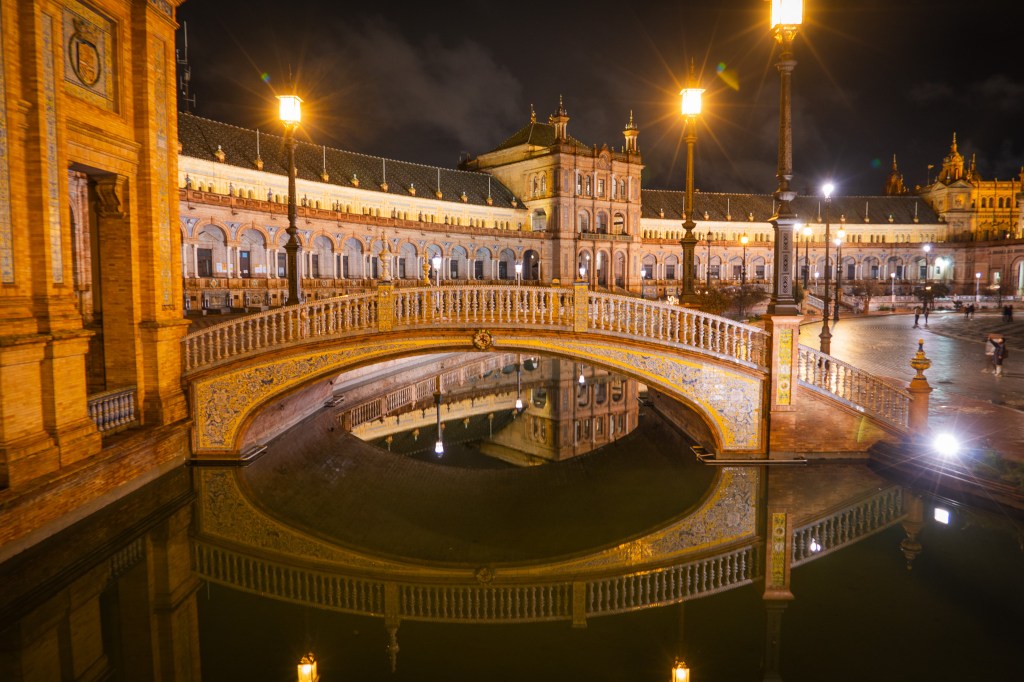
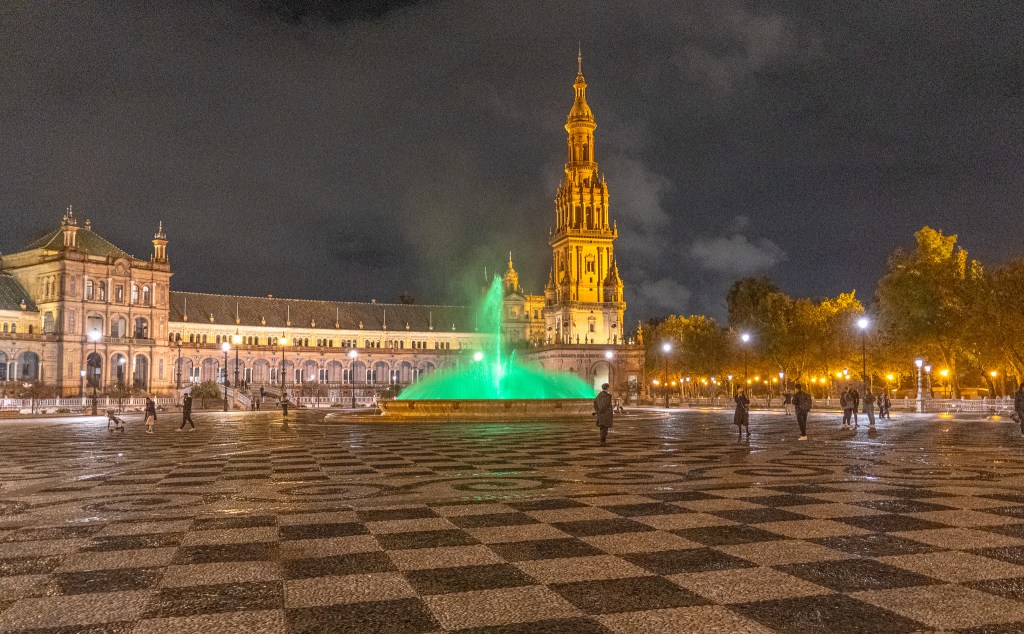
I loved this place so much that we made a return visit at night.

The lights and reflections in the canal created a sereneness that was palpable.

A splash of colour to lift the drenched spirits.

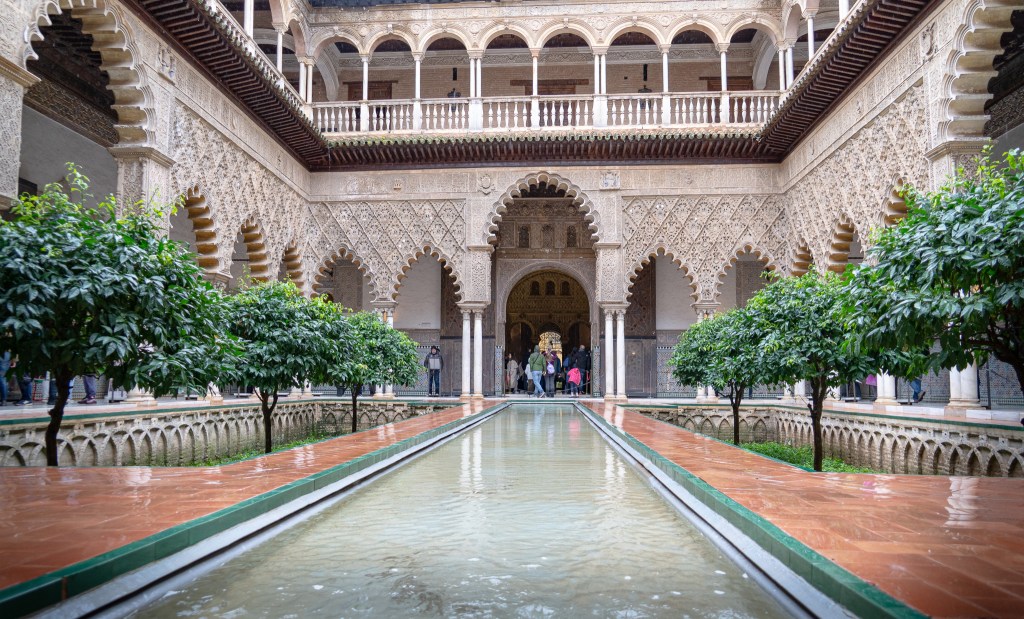
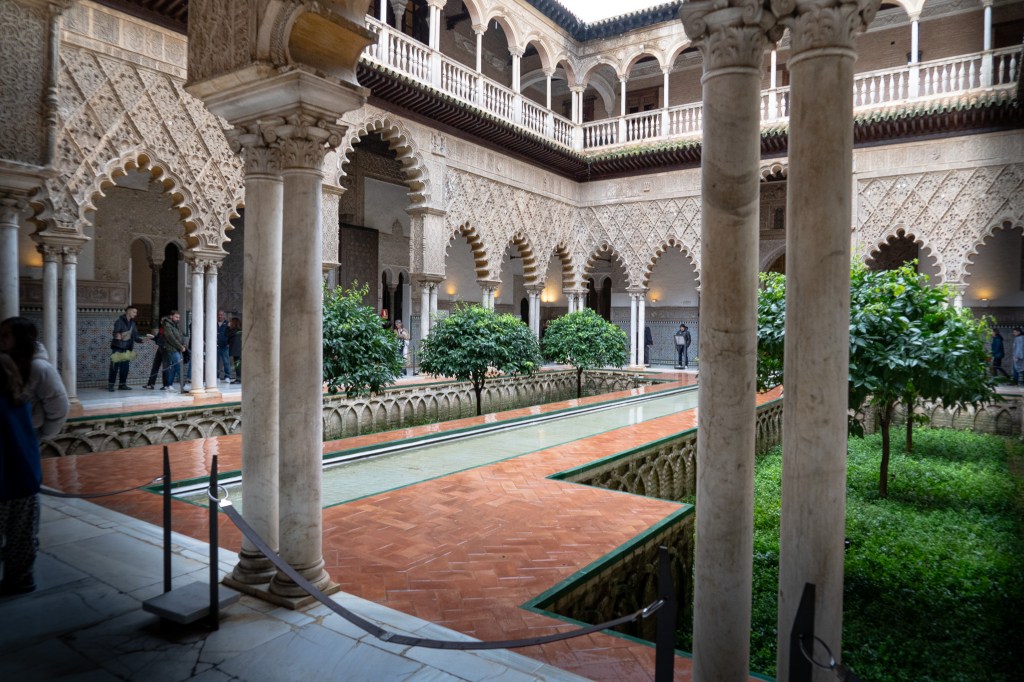
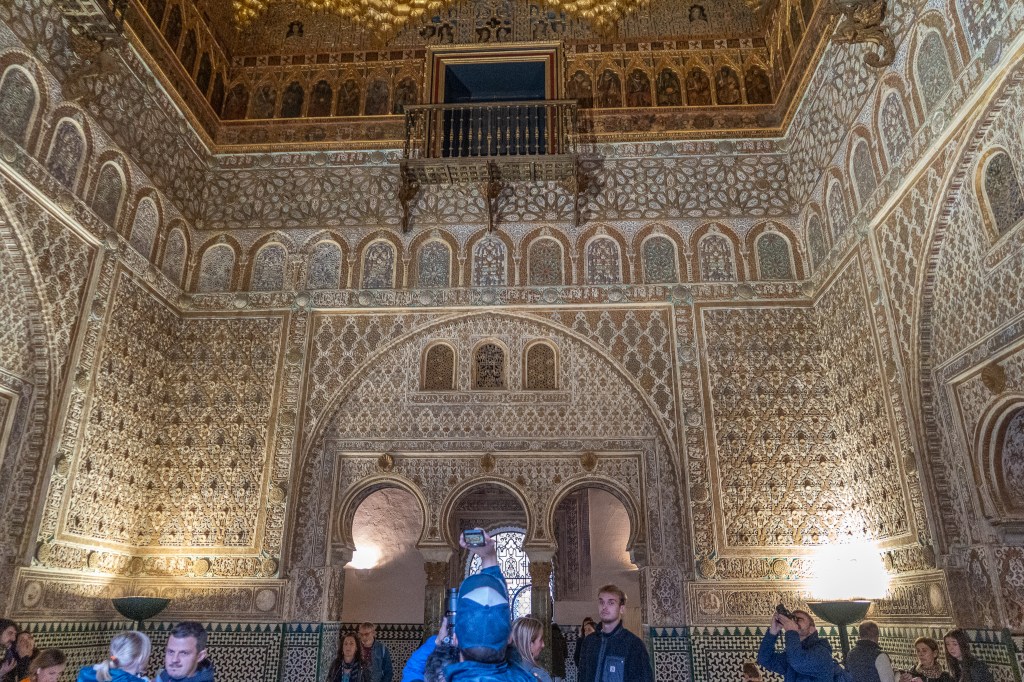
The Plaza de Espana had set a high standard but the Real Alcazar de Sevilla was every bit as impressive. Maybe not in terms of outward grandeur but once inside, the Moorish architecture was stunning. The attention to intricate detail in the stone carved arches alone make this place a work of art.

The term Alcazar is of Arabic origin, ‘al-qasr’, meaning castle or palace. It started life as the citadel of the city during the Islamic era in the 10th century. It was added to by successive Arab dynasties and finally by the Christians in 14th century. Fortunately, the Christians decorated the buildings in the Mudejar style which was derived from Islamic decorative designs, retaining the original character.

The Real Alcazar. An outstanding example of Moorish architecture.

A lot more tourists here than at the Plaza de Espana but I was still able to get the odd photo without the tourists clad in blue and yellow ponchos.

The level of detail in this place was staggering. It’s hard to imagine anything like this being replicated today. Not just because of prohibitive cost. I don’t believe there are enough craftsmen of the calibre needed to do it.

Another must-see in this city is Seville Cathedral (Catedral de Sevilla). A Catholic cathedral and former mosque, it is a UNESCO World Heritage Site. It is the largest Gothic cathedral in the world and dates from the 12th century.

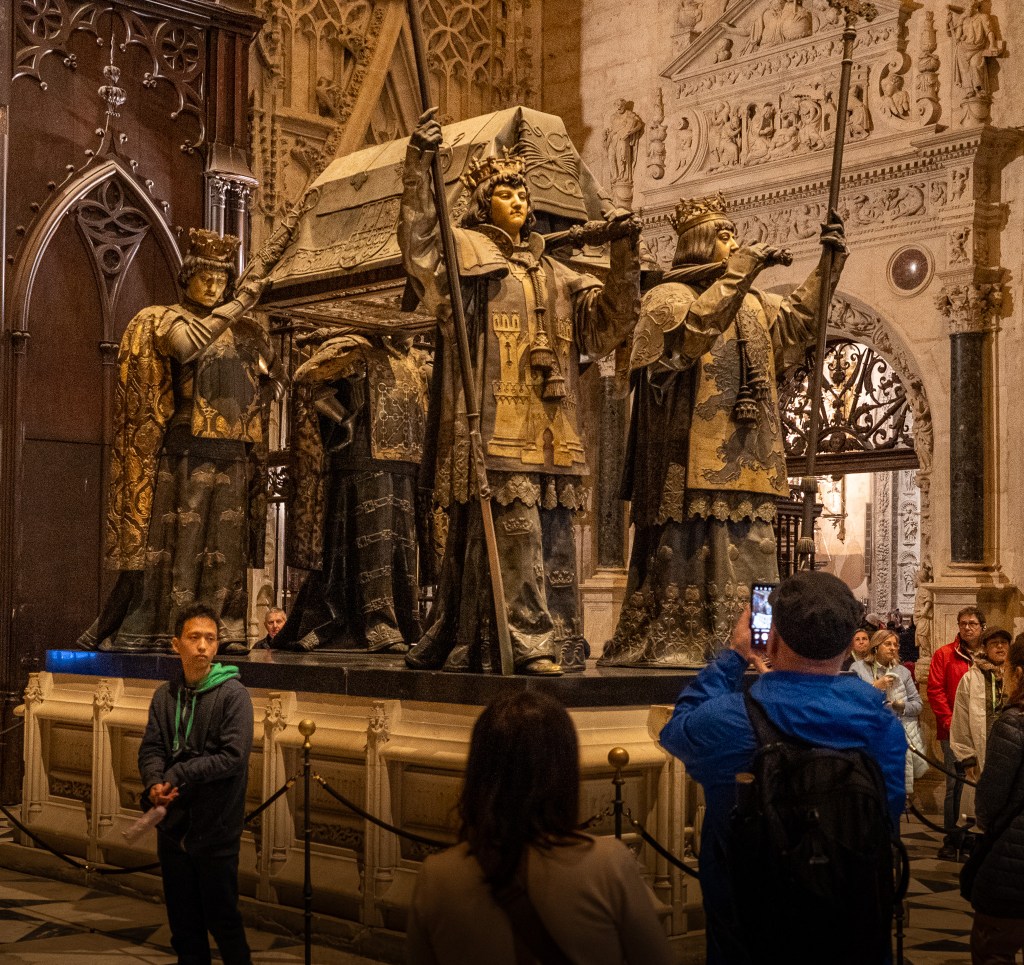
The cathedral contains the tomb of Christopher Columbus. The four pallbearers represent the four kingdoms of Spain from Columbus’s time-Castille, Navarre, Aragon and Leon.

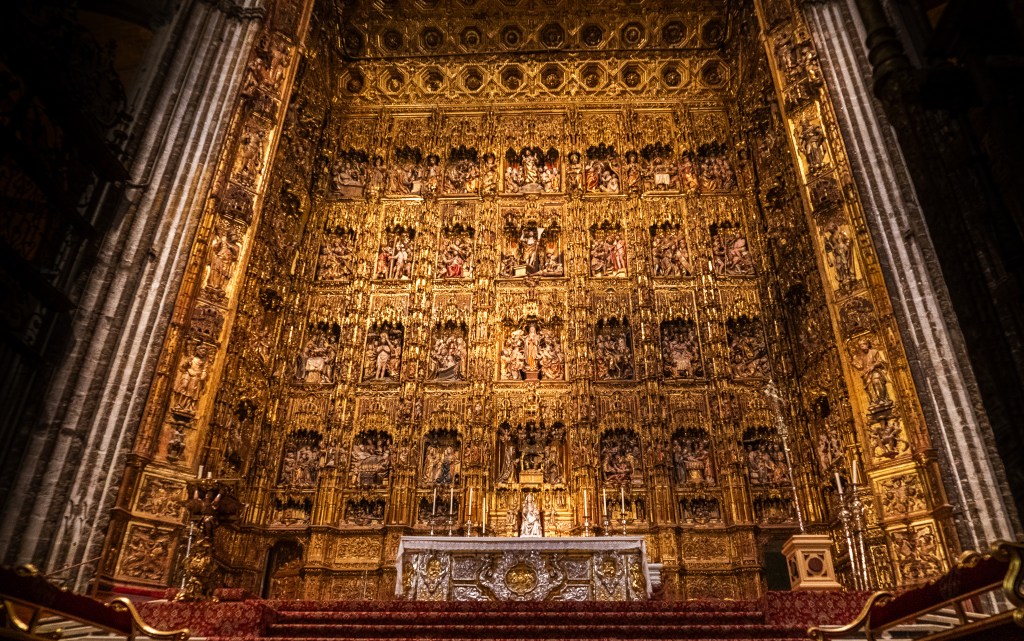
There are 80 chapels in Seville Cathedral. This is the Main Chapel. The altarpiece took 80 years to complete.

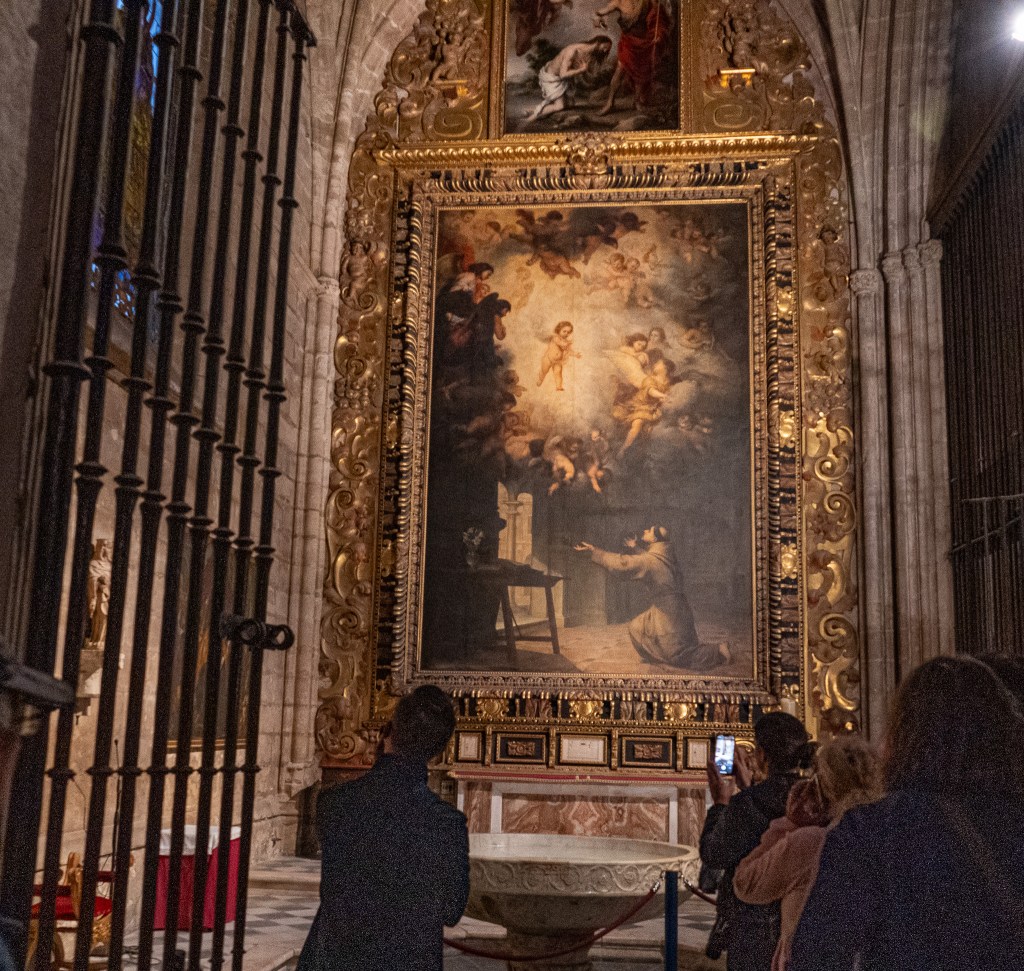
The works of art are numerous and captivating.

The scale of the cathedral is dramatic and the craftsmanship extraordinary.

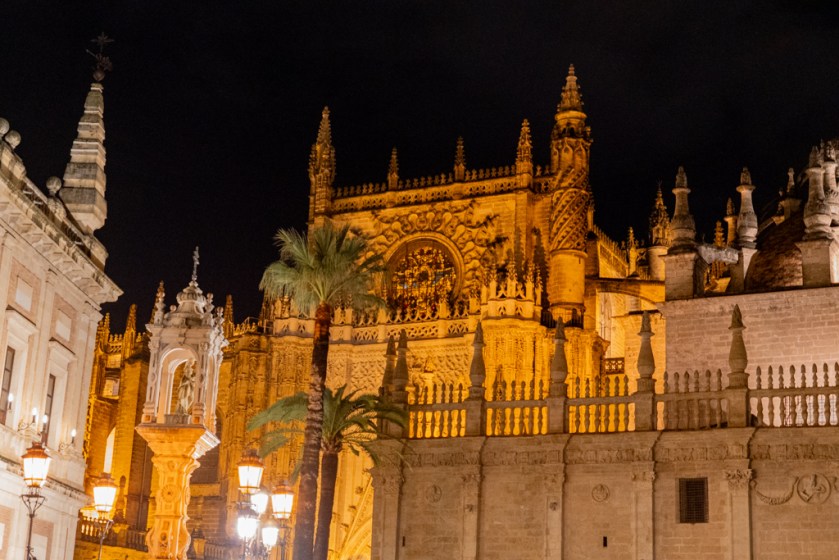
Seville Cathedral at night.

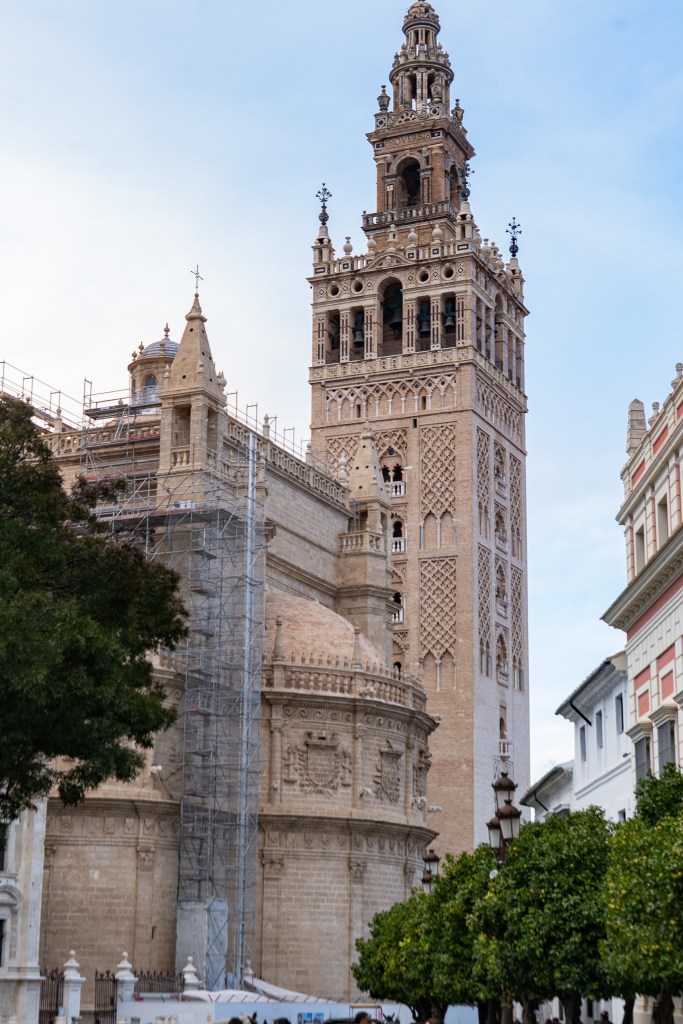
The Giralda Tower (La Giralda). Photo taken during a brief dry spell.

La Giralda is the bell tower of the cathedral. Originally a minaret for the Great Mosque, constructed in the 12th century, it is one of the most important examples of Moorish architecture in Spain. We climbed to the top for a view of the city but the weather conditions ensured it wasn’t the most pleasurable experience.

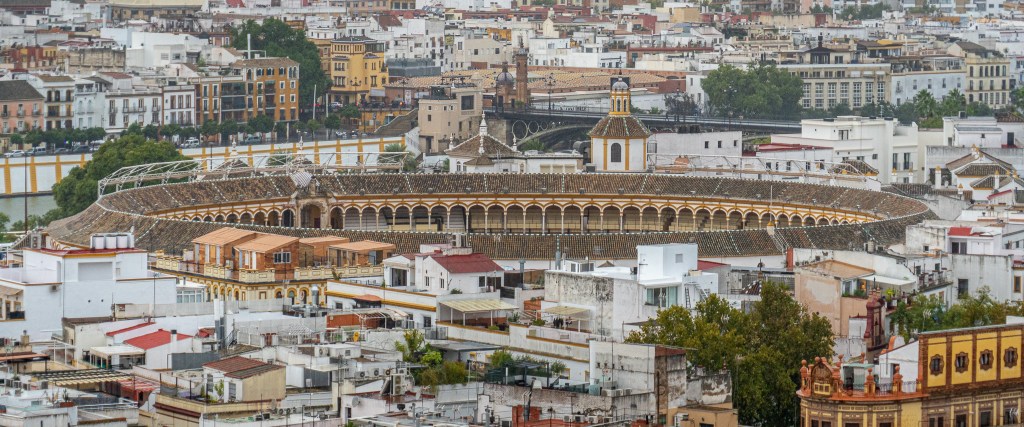
One of the few photos I was able to take from the top of the Giralda Tower. The Seville bullfighting ring.

Getting around Seville requires little effort.

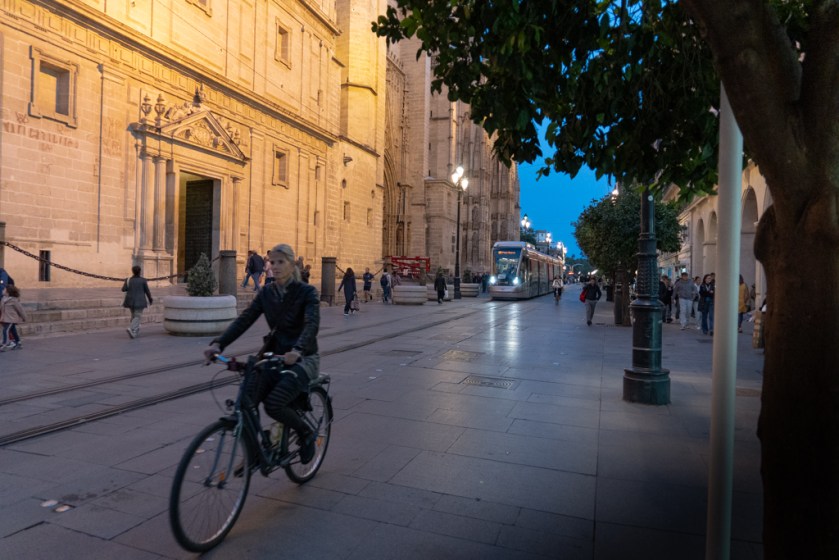
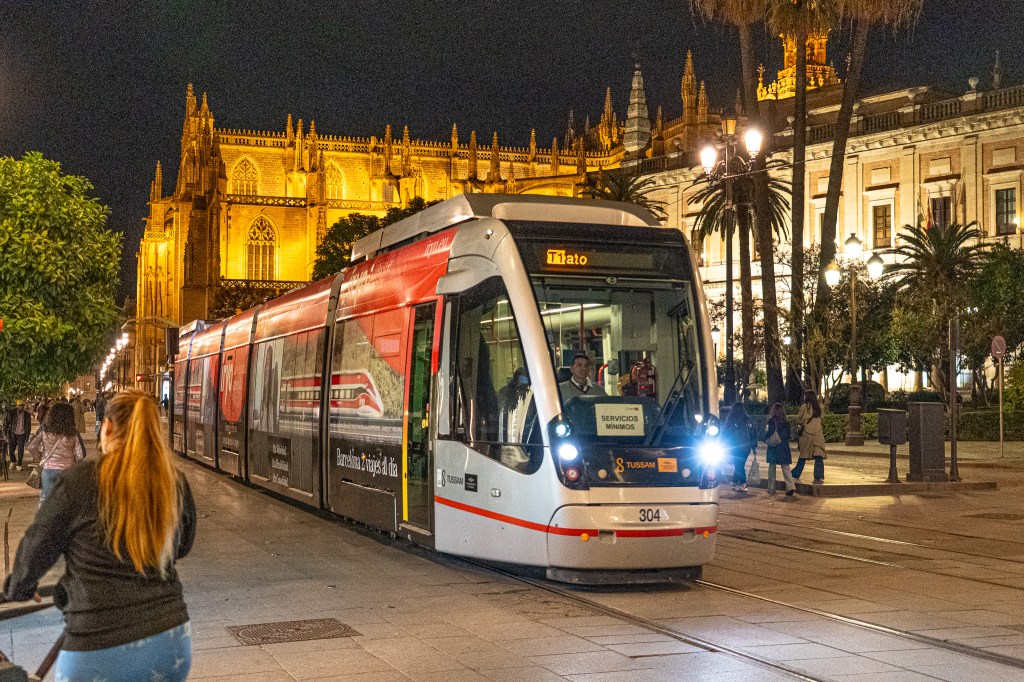
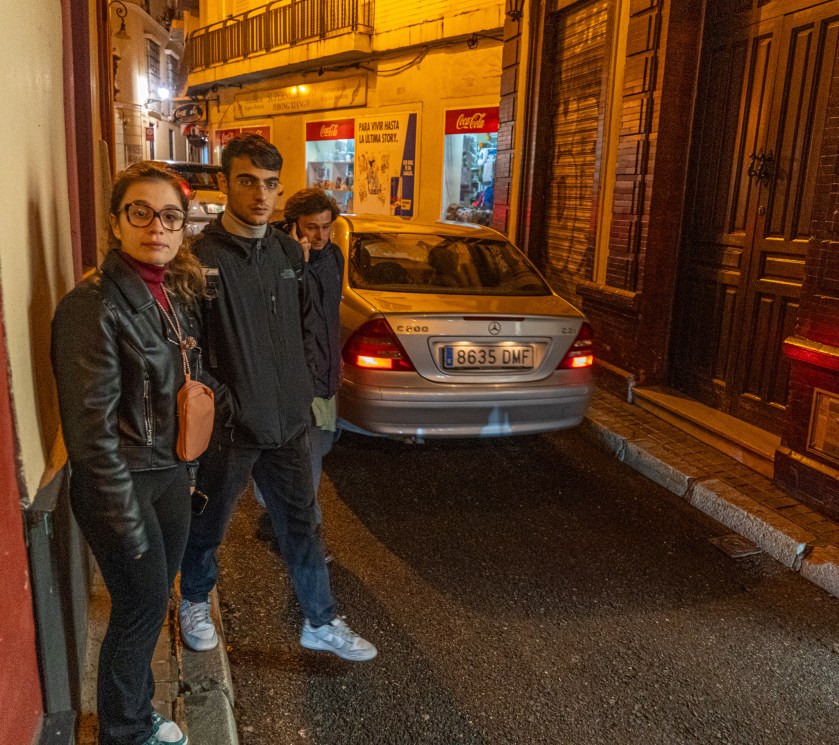
The centre of Seville is relatively flat but like lots of Spanish cities, the streets (even the very narrow ones) are a shared space. Trams, bicycles, cars and pedestrians are everywhere, so be aware of your surroundings.

You can’t please all the people all the time! Not sure if those are disapproving looks or merely curious ones..

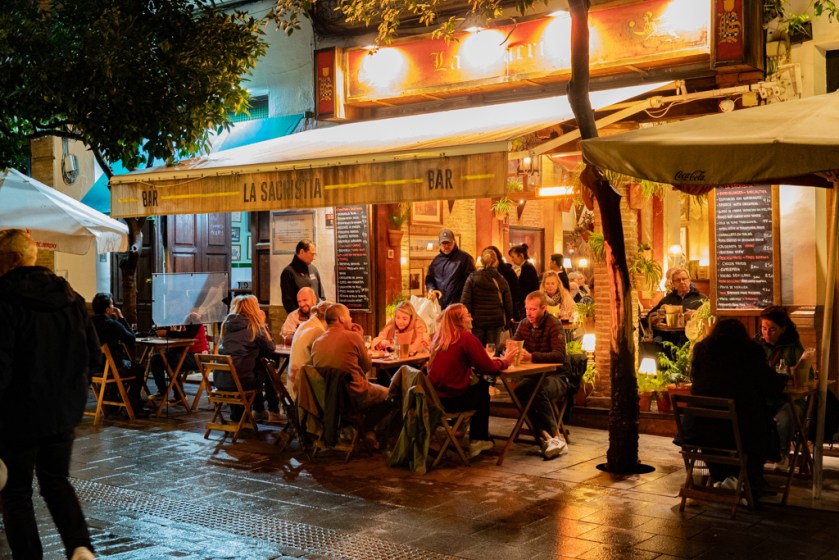
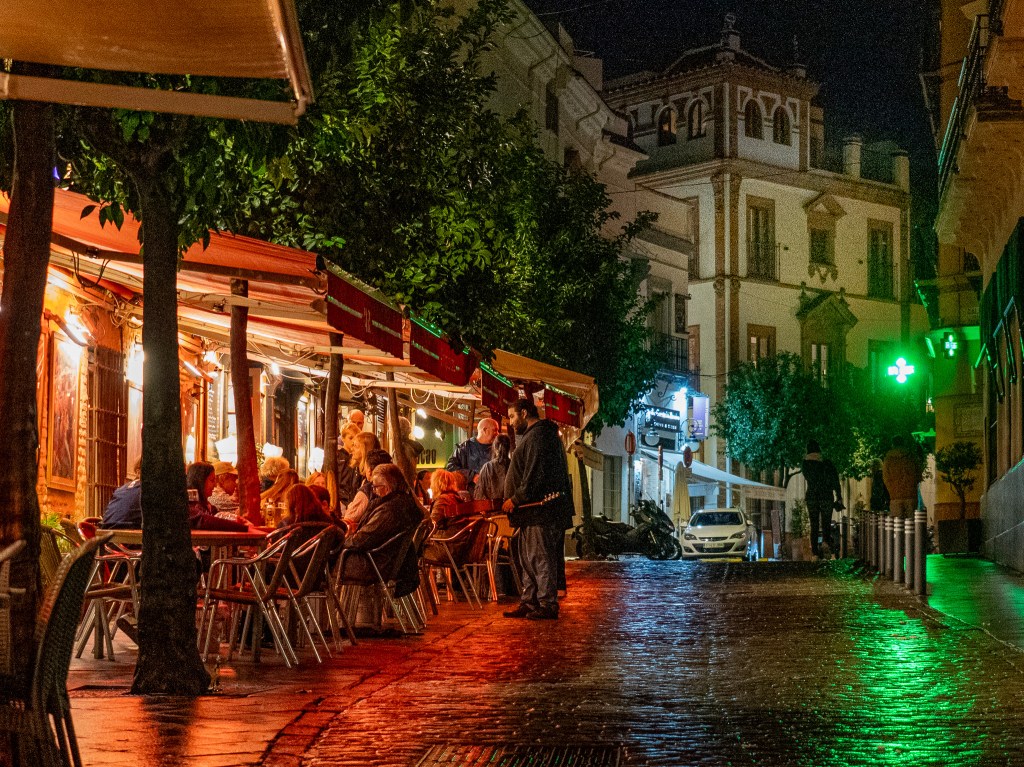
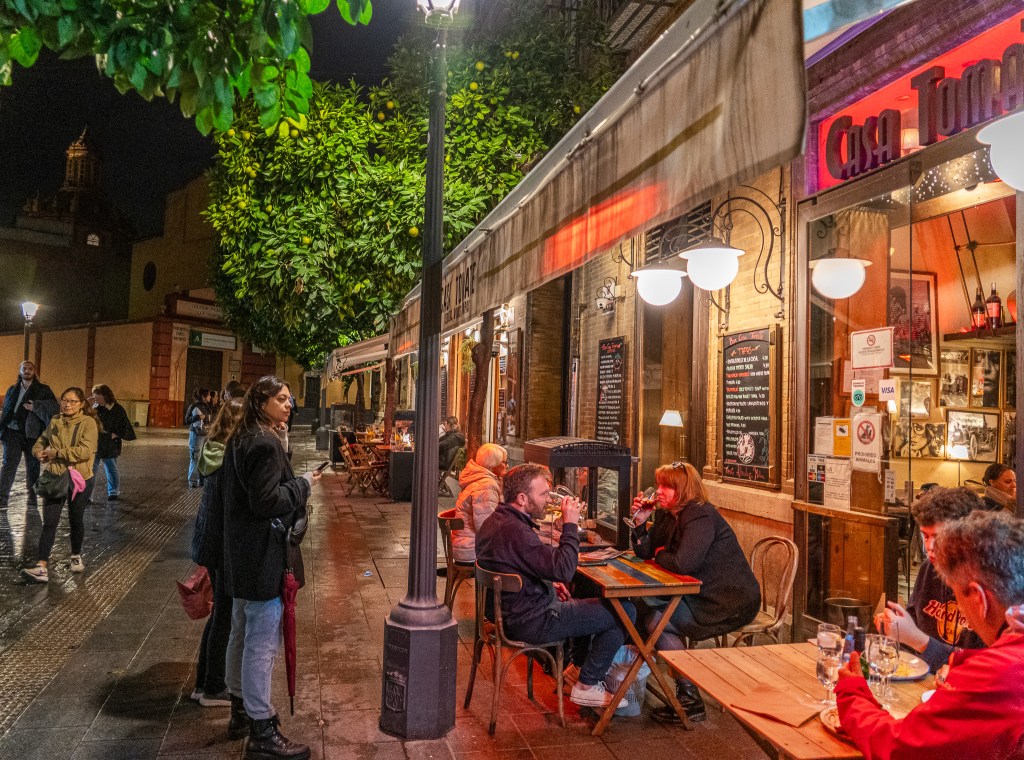
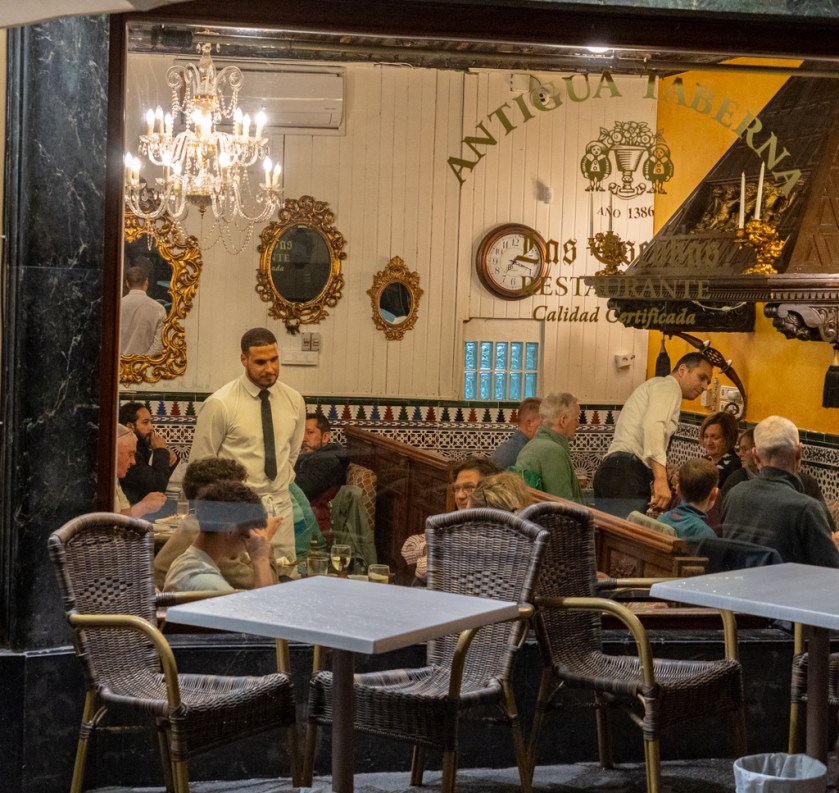
Despite the unrelenting rain, there was still a relaxed and enjoyable atmosphere in the evenings and the cafe culture was very much alive and kicking.

This street reminded me of the Montmartre area of Paris. The coloured lights reflecting off the wet cobbles added lots of character.

Love a bit of people-watching.

There was also the occasional quiet spot.

This scene reminded me of the Edward Hopper painting, ‘Nighthawks’

Sevillians are friendly and welcoming.

Eating out in Seville offers choice for every taste and budget. My favourite meal was ox tail at a bar/restaurant that had a bull theme (El Toro?)

Distasteful?

Not everyone would be comfortable surrounded by bulls mounted on the walls but bullfighting is an undeniable part of Seville’s history. I was surprised by how much these added to the authenticity of the place.

For those with a sweet tooth, an after dinner something was never far away.

I always judge the appeal of a city by my desire to revisit. I would definitely like to return to Seville. The weather curtailed our activities and there was so much more I wanted to see. The only respite from the rain took place on one evening. That’s when most of the photos were taken, with the exception of the Plaza de Espana where the cloistered walkway provided convenient cover. Hopefully when we see this beautiful city again, it will be in the sunshine and I won’t have to walk around with my camera secreted up my coat.

It’s easy when talking about a visit to a particular city, to forget to refer to the journey. On this occasion, the journey definitely deserves a mention. We left a relatively sunny and dry Costa Blanca and travelled by bus. As we headed south west, the countryside became increasingly green and lush as we traversed the agricultural heartland of Murcia. But the most spectacular, and surprising, leg of the journey came as we approached Granada. The landscape changed to a rocky scene and the bus started to climb steeply into the Sierra Nevada mountains. The snow capped peaks were an unexpected but awesome sight. There was also a notable drop in temperature. Then as we descended into Granada, the snow gave way to greenery again and the countryside was dotted with the distinctive villages of Andalusia, with their whitewashed walls and terracotta roofs. The journey, including a pit stop, took around 5 hours but the scenery made it seem shorter. And very memorable.

Norway. Land of the Midnight Sun

When the opportunity to cruise to the Arctic Circle arises, you need to grasp it. You know if you don’t, you will probably regret it. And when the cruise ship is leaving from the city you live in, meaning no flights or long drives? It’s a done deal. And so, we set sail from Belfast, stopping en route to pick up more passengers in Liverpool before heading north to Norway.

We sailed with Ambassador Cruise Line on board the ‘Ambition’. It is smaller than some of the modern giants and holds around 1,200 passengers. It lacked some of the glitz associated with the bigger ships but the cabins were very clean with ample space and the crew were friendly and attentive. The food was of a high standard with plenty of variety.

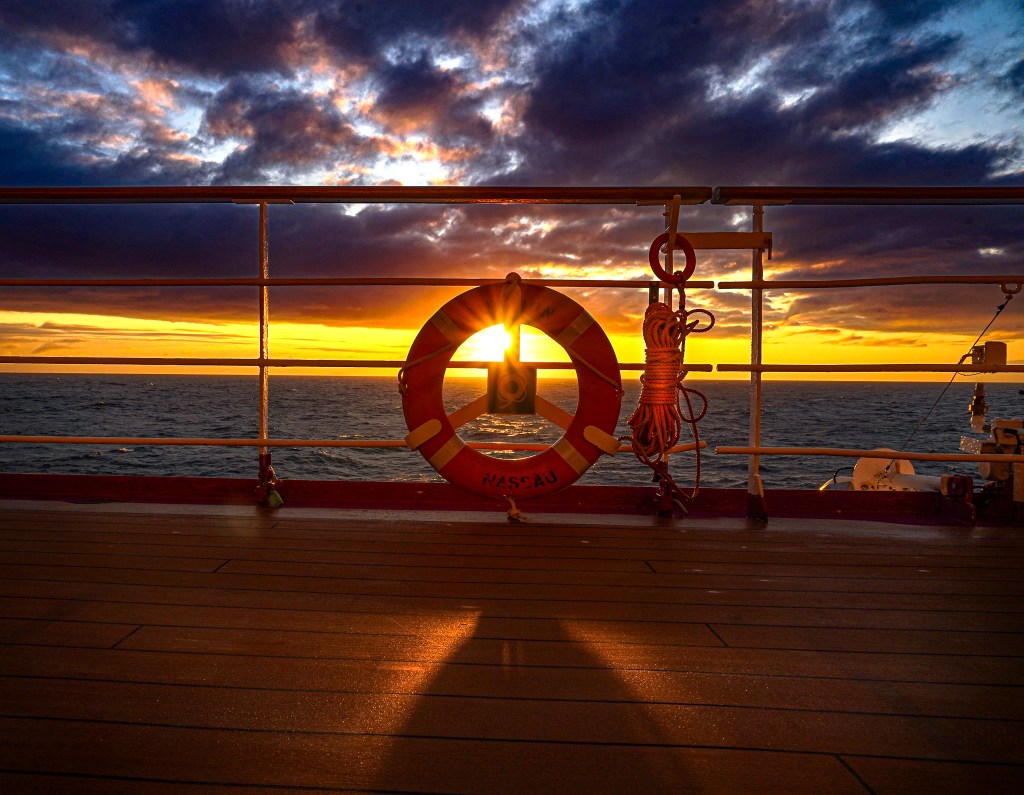
Sunset from the lower deck as we left the North Sea and entered the Norwegian Sea.

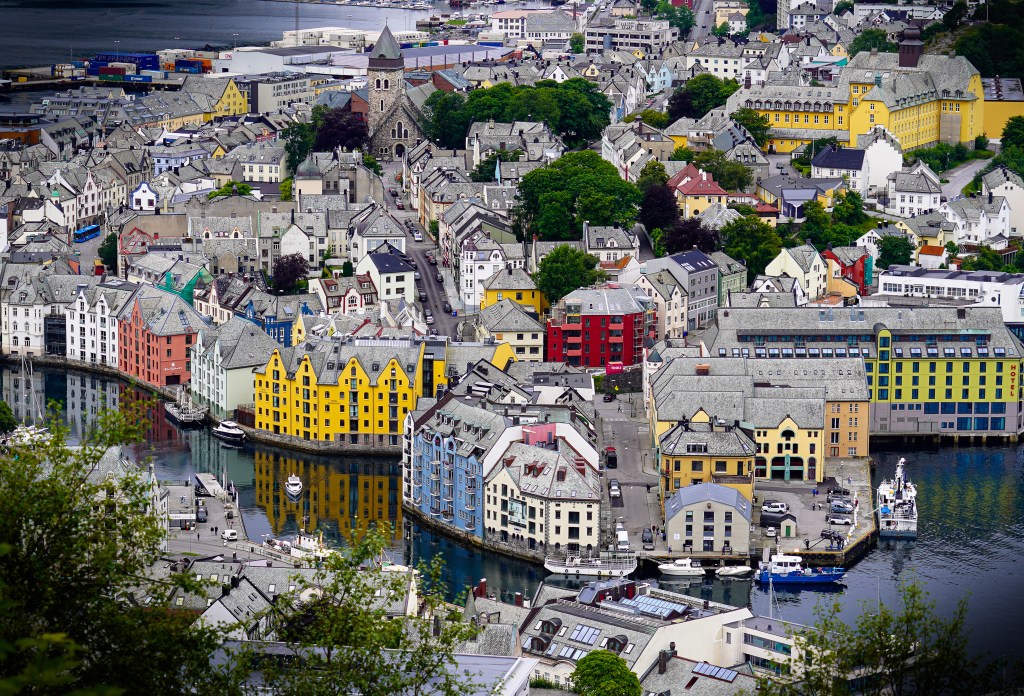
After two days at sea, we docked at Alesund on Norway’s west coast, around 400 km north of Bergen and 1,220 km from Liverpool. The town is colourful and picturesque. The houses and buildings are uniform in appearance because they were all built between 1904 and 1907, after the town was destroyed by a fire. The timber construction and high winds on the night of the fire, ensured total destruction. The town was rebuilt in brick, stone and mortar in the Art Noveau style.

Alesund. Photo taken from a vantage point above the town. A steep climb (418 steps) but worth it for this view.

Our next stop was Narvik, 1,200 km north of Alesund. The town was of strategic importance during World War II because of its coastal position and its rail link to Sweden. This rail link was our main reason for leaving the ship. Not for any historical reason but rather to view the striking scenery from the train that travels from Narvik to Abisko in Sweden.

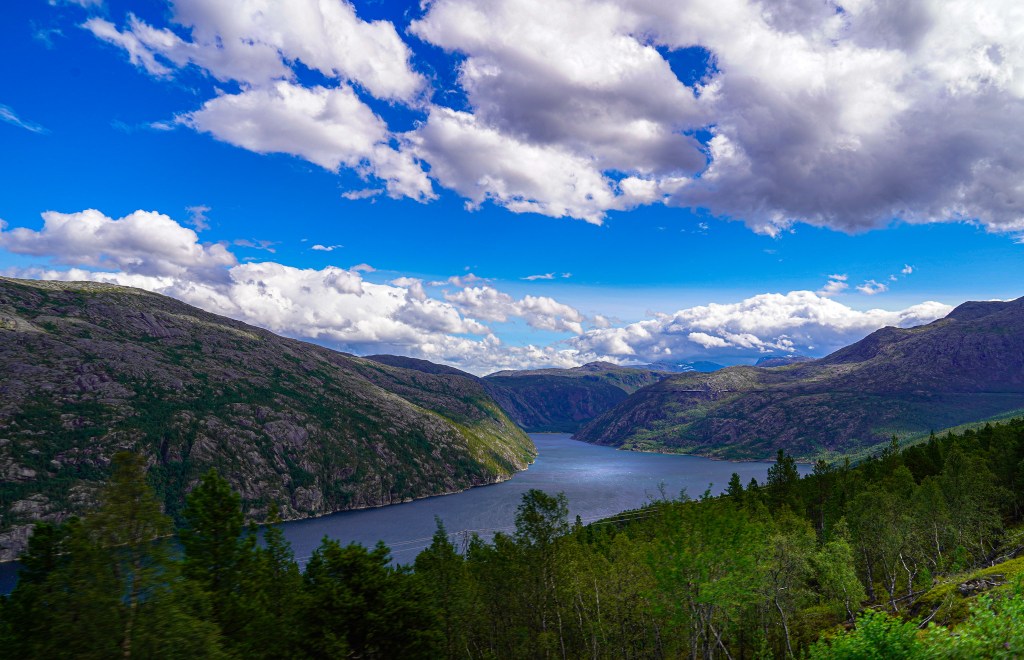
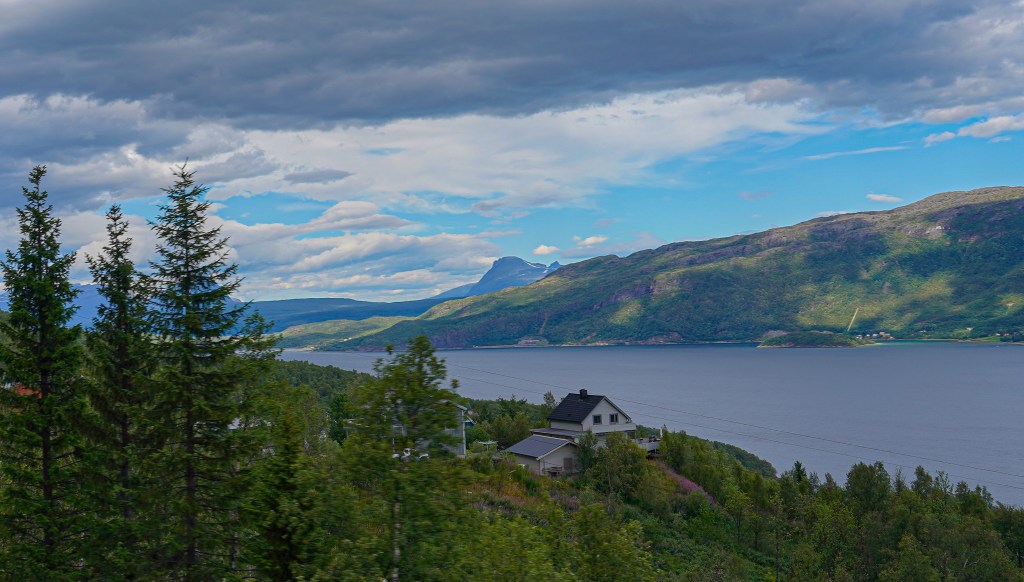
Rombaken Fjord. Not easy taking photos from a moving train but at least no one objected to me hanging out the window.

Rombaken Fjord. This shot reminded me of NW Donegal in Ireland. Both are likely the result of the same glacial processes that carved out landscapes 12,000 years ago.

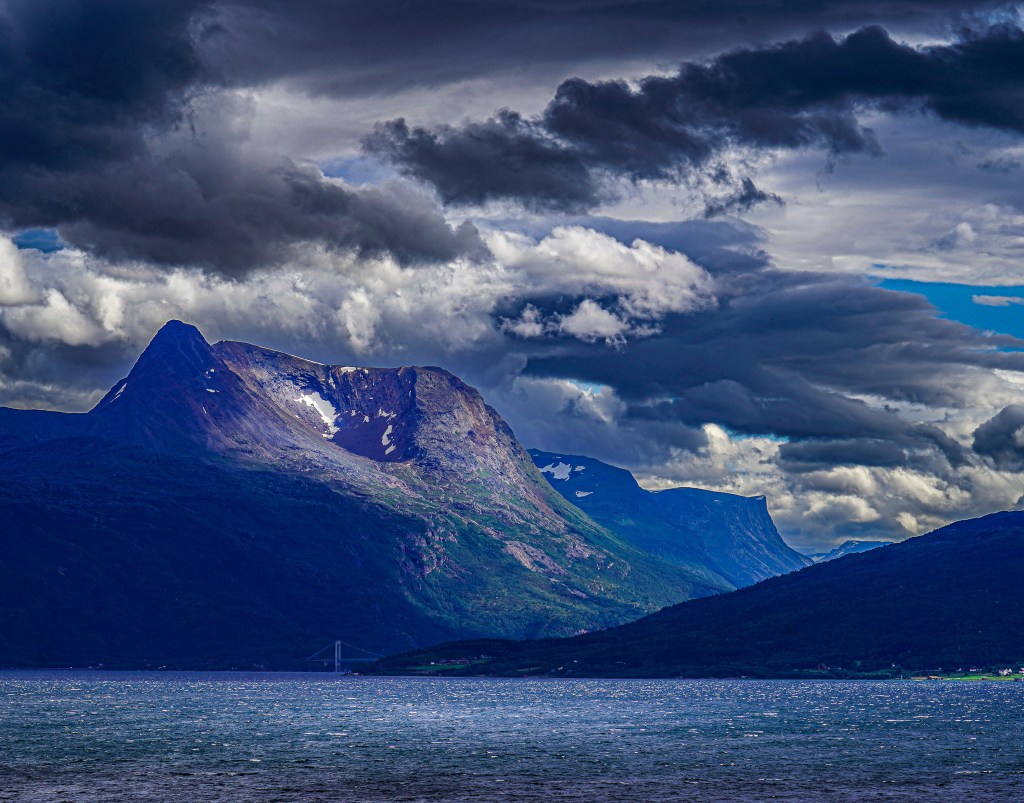
Dramatic skies over the fjord. The suspension bridge in the distance is dwarfed by the enormity of these majestic giants.

Tromso. Now we were inside the Arctic Circle. We had travelled 1,400 km from our first Norwegian port, Alesund and the days were getting decidedly longer. You don’t really know what to expect in the ‘Land of the Midnight Sun’. The further north you go, the brighter the nights, until it’s a kind of twilight around 1am. Then it starts getting bright again! A strange experience and one which makes sleep difficult. I worked shifts years ago and it brought it all back to me. Sleeping during daylight just isn’t natural. I should point out at this stage that our cruise took place in July.

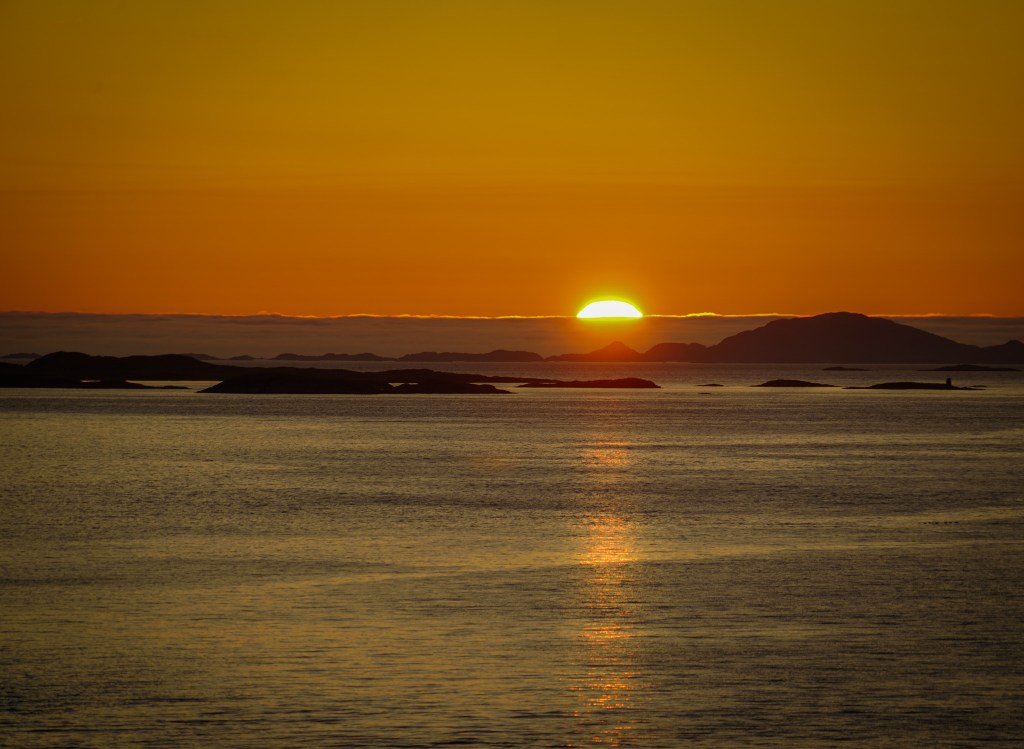
Midnight sun. Watching the sun almost set and then rise again can challenge your perception of reality!

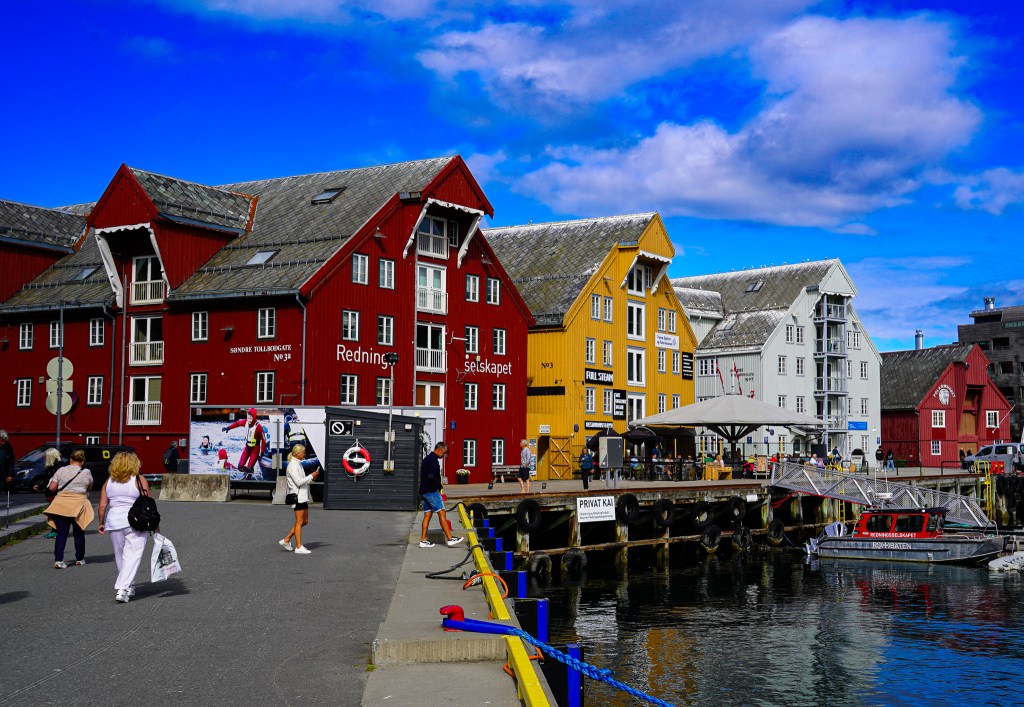
The colourful harbour at Tromso. It was a surprise to me that daytime temperatures inside the Arctic Circle could reach 20 degrees Celsius.

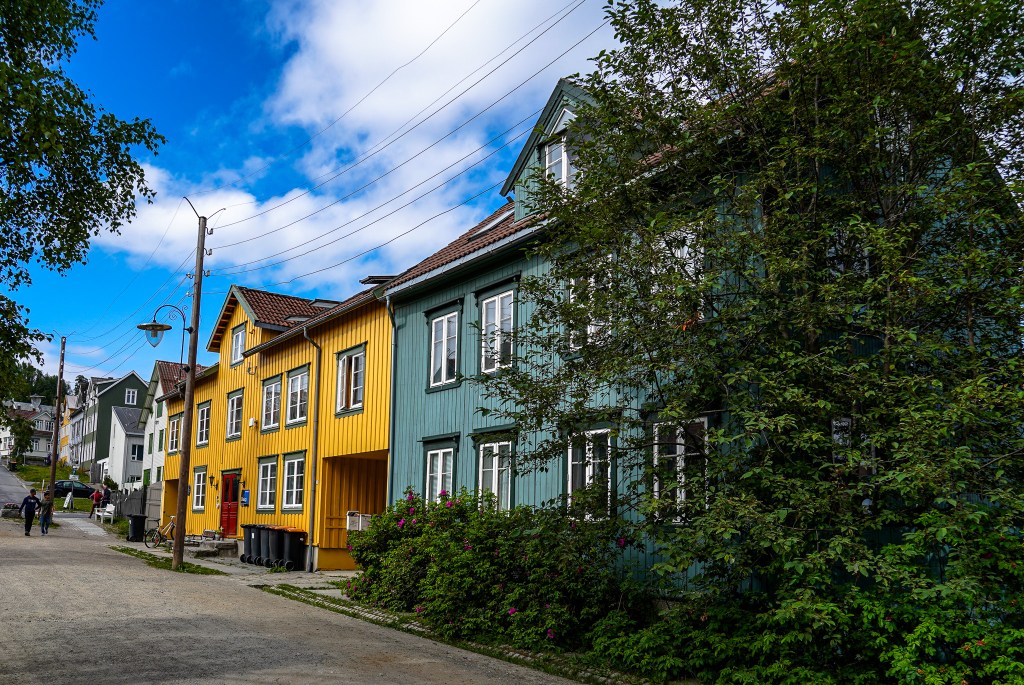
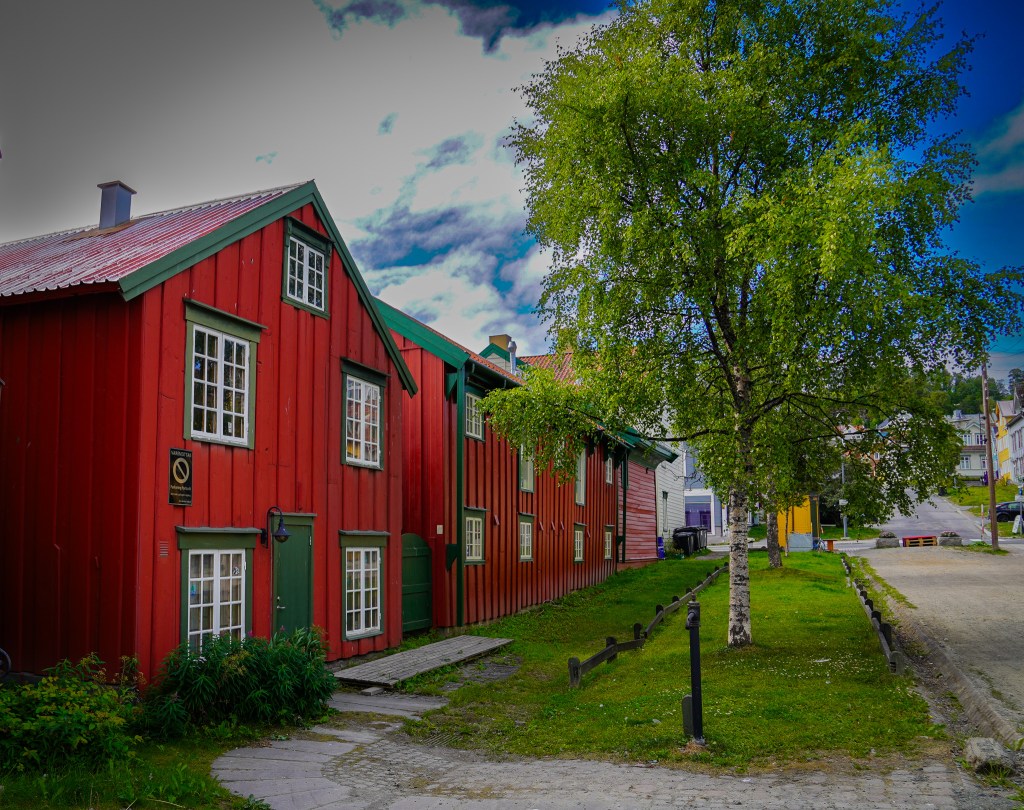
Distinctive colours give ordinary houses character.

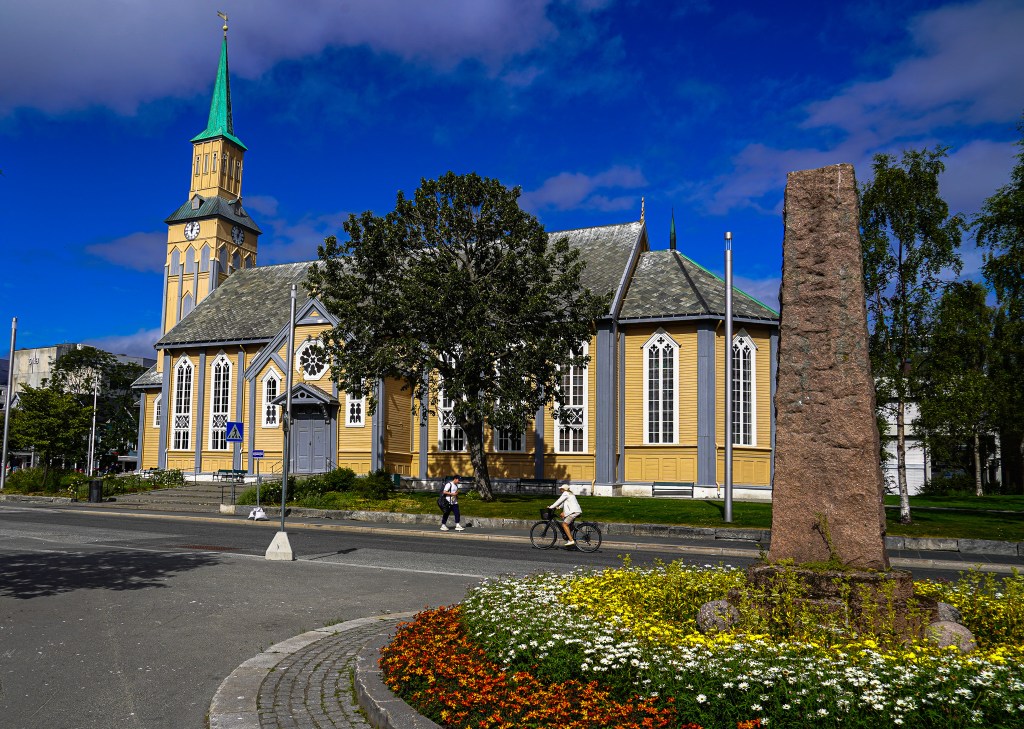
Tromso church.

Honningsvag. Our most northerly port. In fact, Honningsvag is the most northerly city in Europe and 1,900 km from Alesund. One thing to note about this place is that, although the sun may not set for weeks on end, it can be misty and fogbound due to its climate and topography. It has unexpectedly mild temperatures due to the North Atlantic Drift, which is a warm sea current that extends the Gulf Stream to these far reaches of Europe. This is also why the ocean here is ice free.

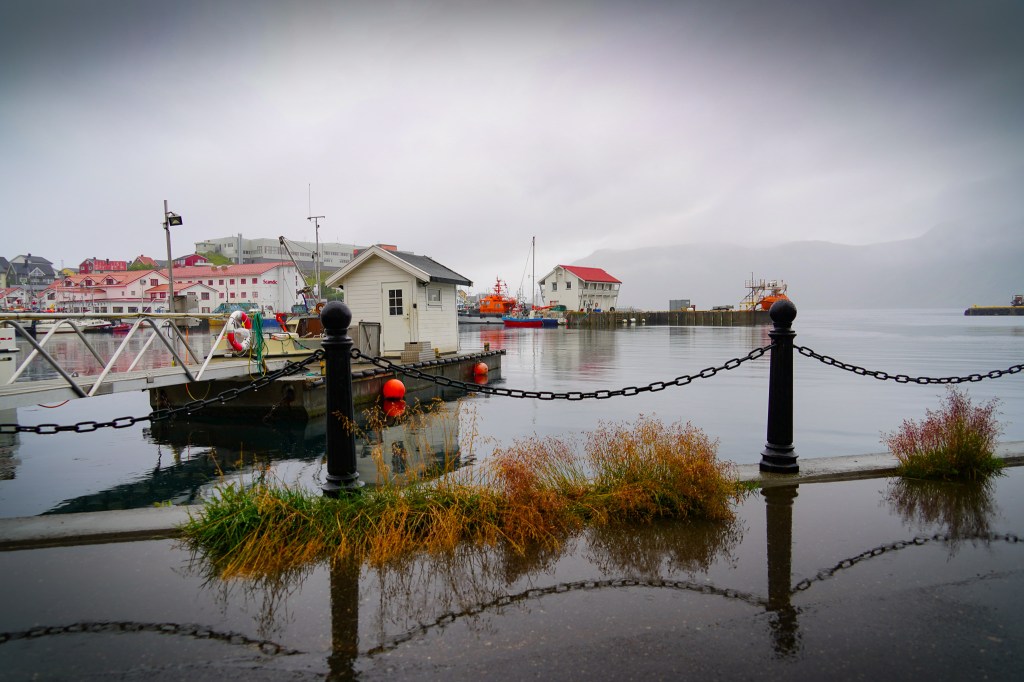
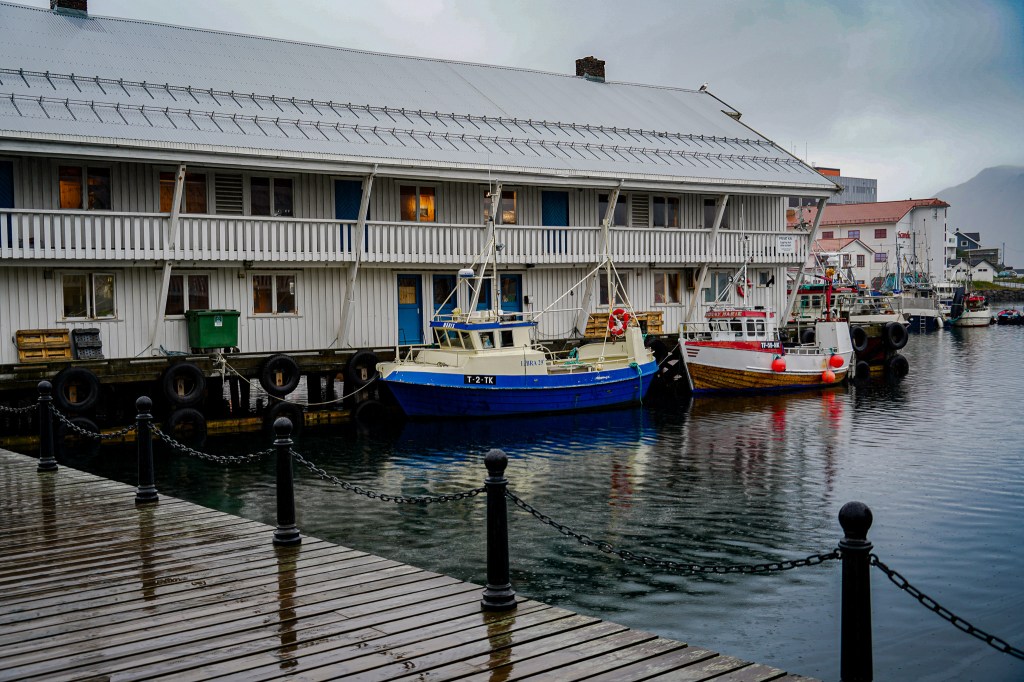
Honningsvag. I’ve never been able to decide why this is my favourite photo from the whole trip. It may have to do with the atmosphere created by the mist and the stillness that provided the reflections.

Even on a rainy day, Honningsvag has a distinct charm and a pace of life that we can only dream of.

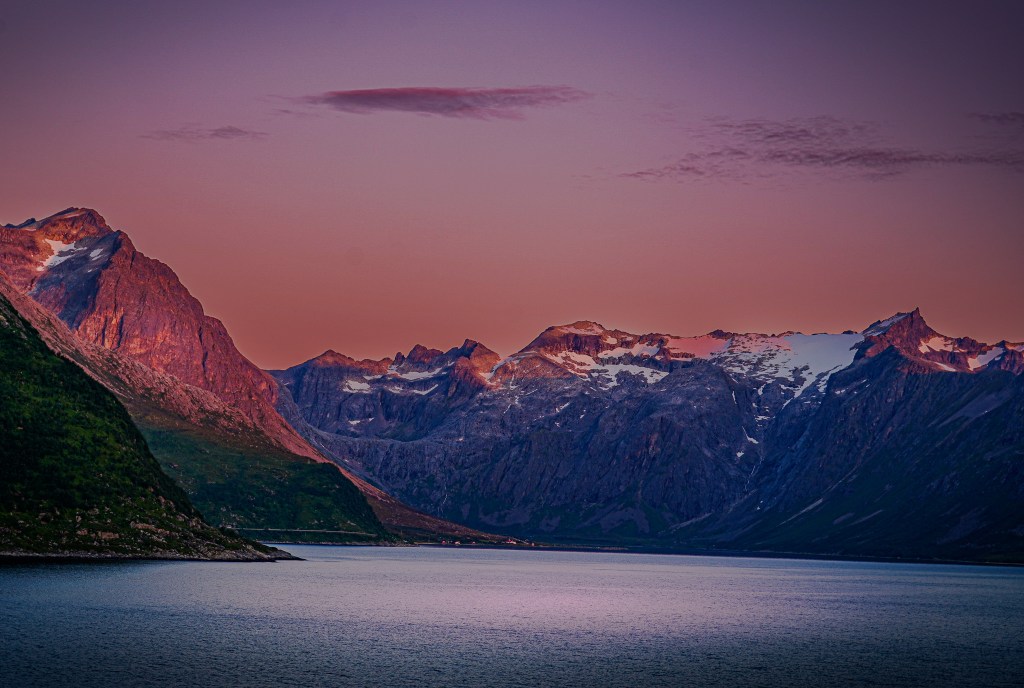
The low sun colouring the sky and highlighting the snow capped peaks of the fjord. The houses on the shore are just about visible.

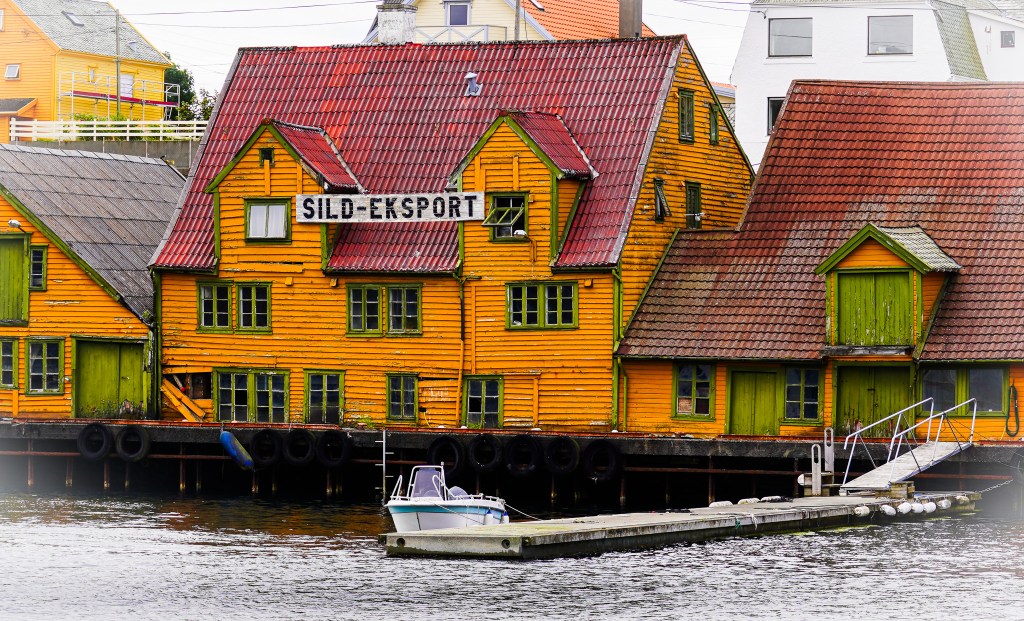
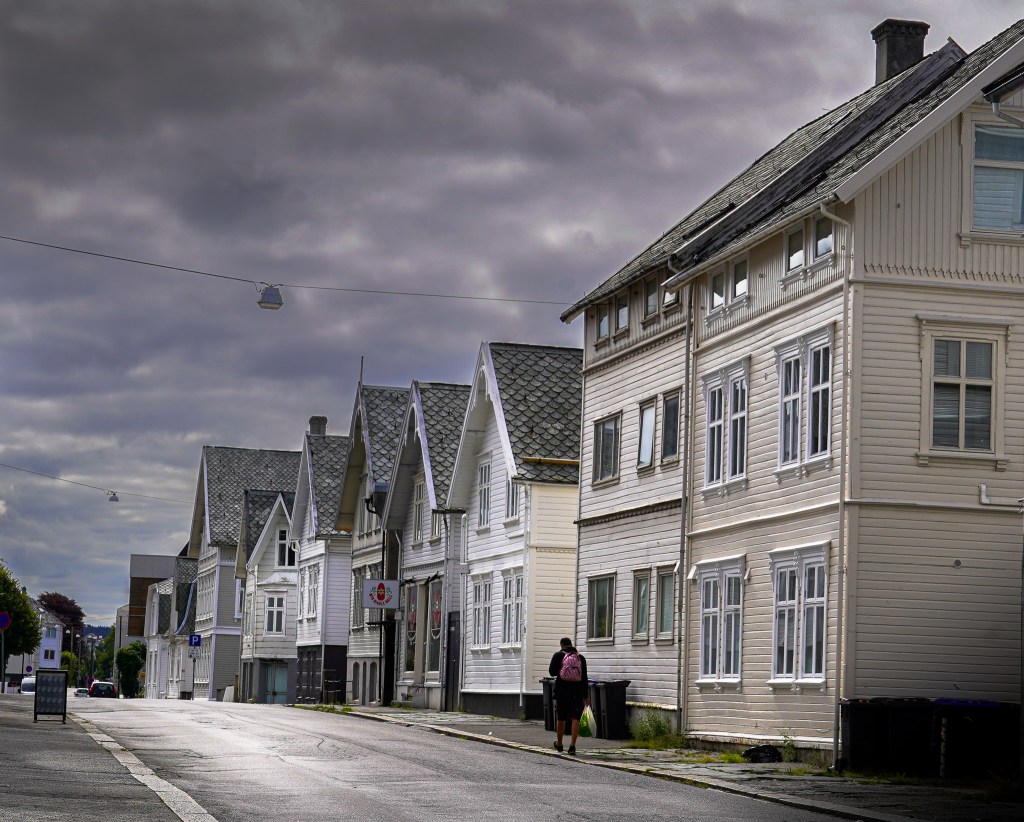
Haugesund was our last port of call. We docked here on the return journey home. It was our most southerly port, situated 550 km south of our first stop, Alesund. The town was lively and had more of a buzz than any of the other ports we called at.

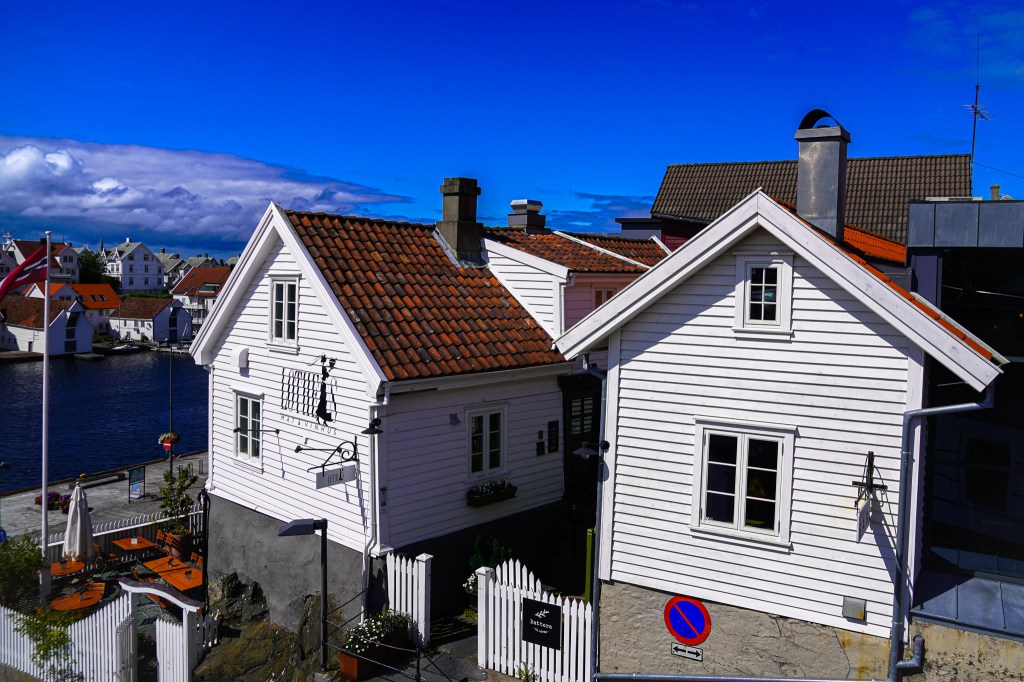
Massachusetts vibes in Haugesund.

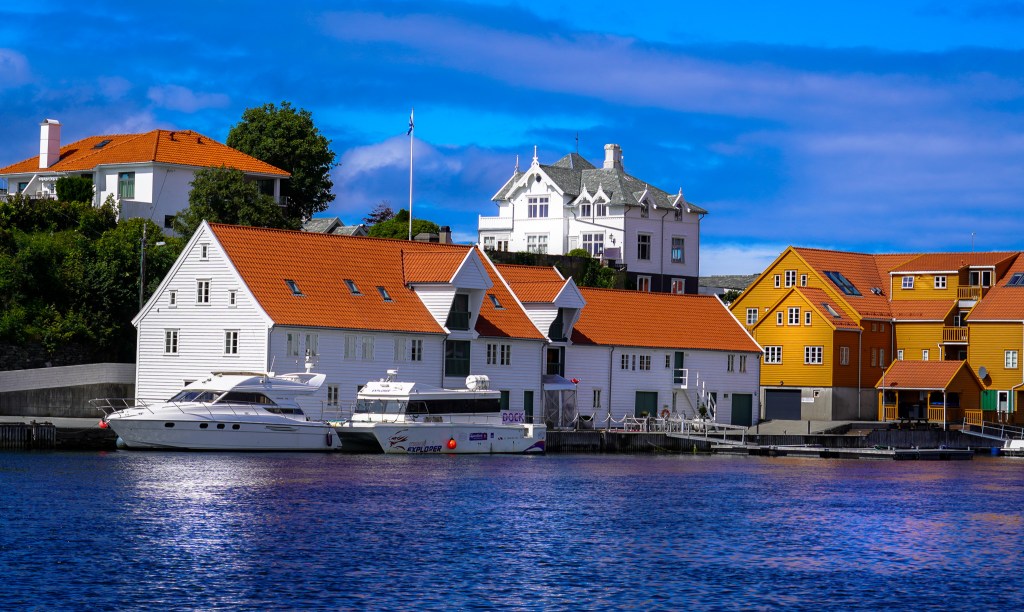
Terracotta rooftops and white clapboard houses give Haugesund a bright and uplifting feel.

Nostalgic remnants of another time in Haugesund’s history.

On the edge of town, the character prevails.

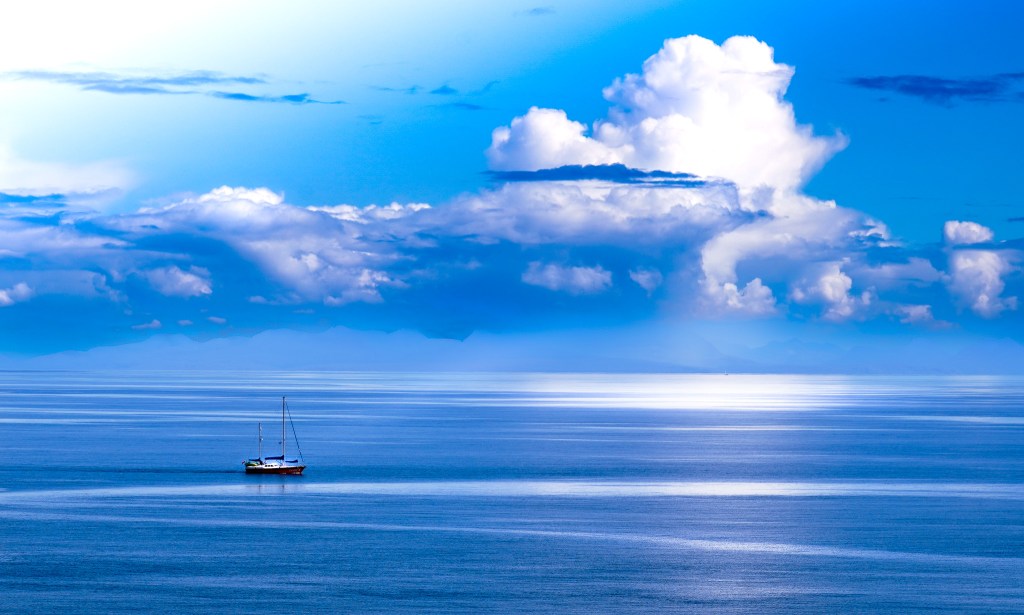
The last photo I took as we headed home. An appropriate symbol of a taste of life at sea.

Summary. It was two weeks long and we enjoyed every minute. I would never describe myself as a cruise fan but there are a lot of positive things to be said about them. For me, the main appeal is the opportunity to visit places that would simply be too expensive to visit, once flights, accommodation and meals are factored into the equation. I don’t know exactly how much it would cost to fly to Norway and visit 5 towns or cities and pay for accommodation and food in each of those places. At a guess I would say triple the cost of our cruise.

Tip. If you are travelling alone or as a couple, be aware that you may be dining with strangers. This can be an opportunity to make new friends and enjoy some stimulating conversation. Or, mealtimes may become the time of day that you dread most and end up sneaking to the burger bar to avoid your allocated dining partner who believes that everyone else really does want to hear their views on how to make a million pounds/dollars. Worse still, you could end up acting as a referee to that couple whose favourite pastime is hurling abuse at each other and dessert is a large portion of uncontrollable sobbing. Extreme examples, I admit but these things happen. We travelled with family/friends, so we avoided any of those scenarios. This advice applies to cruises in general. In relation to Norway as a country and a specific experience, I highly recommend it. The scenery is spectacular and the people are friendly with a strong social bias, so a warm welcome is pretty much guaranteed.

Valencia

Valencia is the name of the city, the name of the province and also the name of the autonomous community. This piece refers to the city of Valencia. It is the third most populated city in Spain after Madrid and Barcelona and sits on the eastern coast above the Costa Blanca.

A very brief history: Valencia was founded by the Romans in 138 BC. The Visigoths conquered the Iberian peninsula in the 5th century after the fall of the Roman Empire and established a kingdom in Spain. In 711 AD Spain was invaded by the Moors. They occupied the city and today their influence is still evident in the architecture and irrigation systems that have shaped the city and whole regions of Spain. The Christian conquest of Spain was a gradual process which ended in the 15th century with the fall of Granada.

Valencia is around a two and a half hour drive from our house but on this occasion we took the bus which added another couple of hours to the journey. The advantage though, was that we were able to take in the impressive scenery along the way. As the bus travelled north, the rocky outcrops of Benidorm and Calpe gave way to miles of lush green agricultural landscape. This transformation is illustrative of Spain’s variety. It is a complex and diverse country. Not only in geography but in its culture and traditions, not to mention its languages. It may come as a surprise to know that several languages are spoken in Spain. No doubt there are many people out there who will have differing opinions but as far as I can tell, the main ones are Spanish (Castilian Spanish), which is spoken my the majority of the population; Catalan, spoken in Catalonia and the Valencian Community (though the people who live in Valencia call it Valencian!), Galician, spoken in Northwestern Spain and is similar to Portuguese; and Euskara, spoken in the Basque Country. As with all things linguistic and cultural, there will always be different opinions and bias and occasions where contradictions occur. For example, we are based in Orihuela Costa which is part of the Valencian Community and people here speak Castilian Spanish. The only part of the Community of Valencia where this is the case. An anomaly, yes, but I’m sure it’s not the only one!

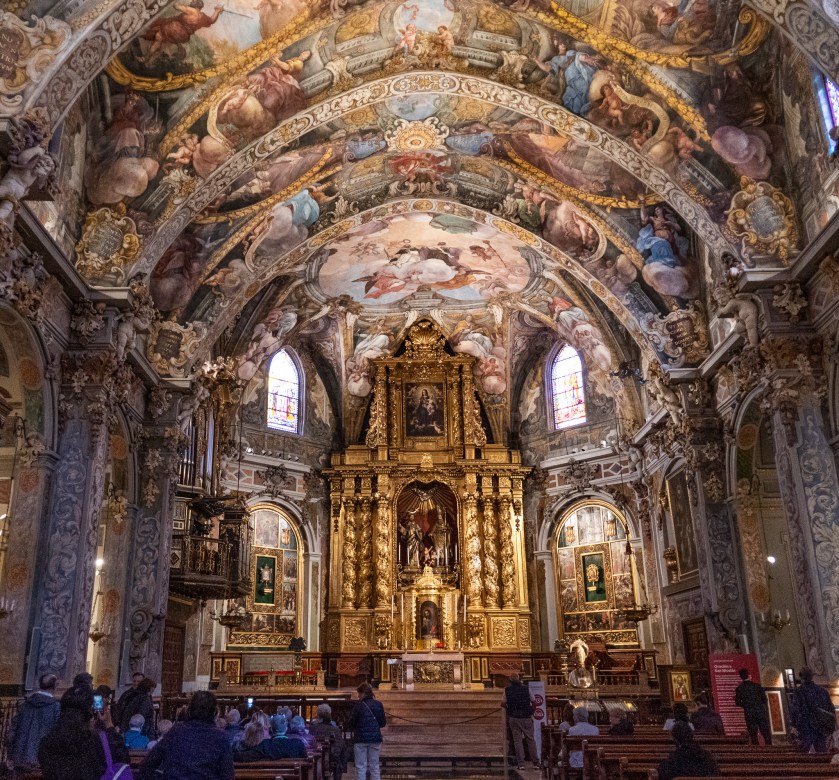
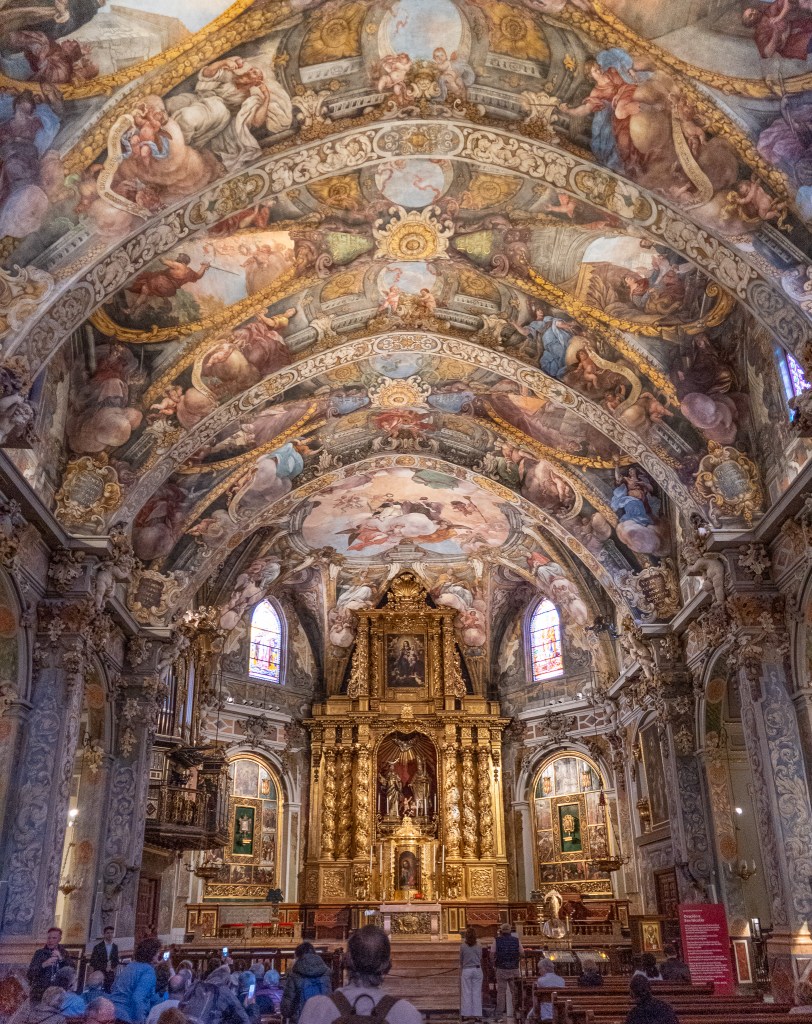
Because of the city of Valencia’s history, it’s unsurprising that there is a wealth of historic buildings and architecture to explore. One place in particular that I have wanted to see for a while is the Church of Saint Nicholas. Having seen several YouTube videos, I was struck by the contrast of the inconspicuous exterior with the ostentatious interior. And so, this was the first visit on the list. The YouTube videos were impressive but nothing equals seeing the frescoes with your own eyes.

‘The Sistine of Valencia’ is a well deserved moniker.

You really need to seek this place out because you will never just come across it by chance. The entrance is via a narrow side street and an unassuming door. After visiting old churches over the years, you never really get any big surprises but this is the exception. It is worth visiting for the outstanding frescoes alone. Although the church was founded in the 13th century, the frescoes were added in the 17th century. Over the next 300 years the detail became obscured by layers of soot from burning candles and incense. In 2016, renovations were completed and this amazing artwork is visible once again, in all its glory, for all to see. It is with good reason that this church is known as ‘the Sistine of Valencia’.

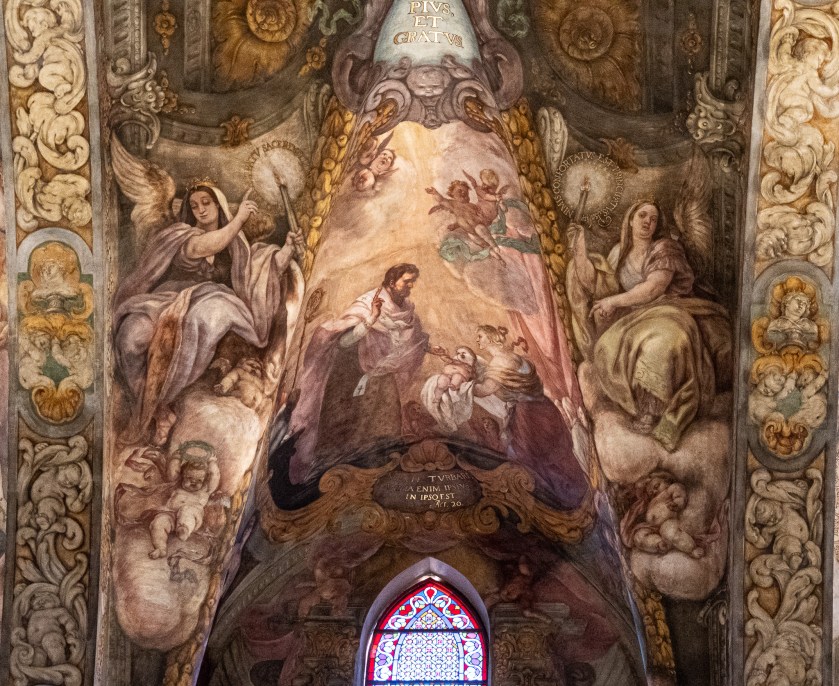
Close up of one of the lunettes. There are six on each side of the nave. Each lunette depicts a scene from the life of a saint in the center, ‘escorted’ on either side by angels, diverse according to their hierarchy. I didn’t know there was a hierarchy of angels!

The history of Saint Nicholas’s church (including the artists) is rich and detailed but not for this blog. For anyone who’s interested, it makes fascinating reading but my aim is to provide a cursory taste of what you can expect in this hidden gem.

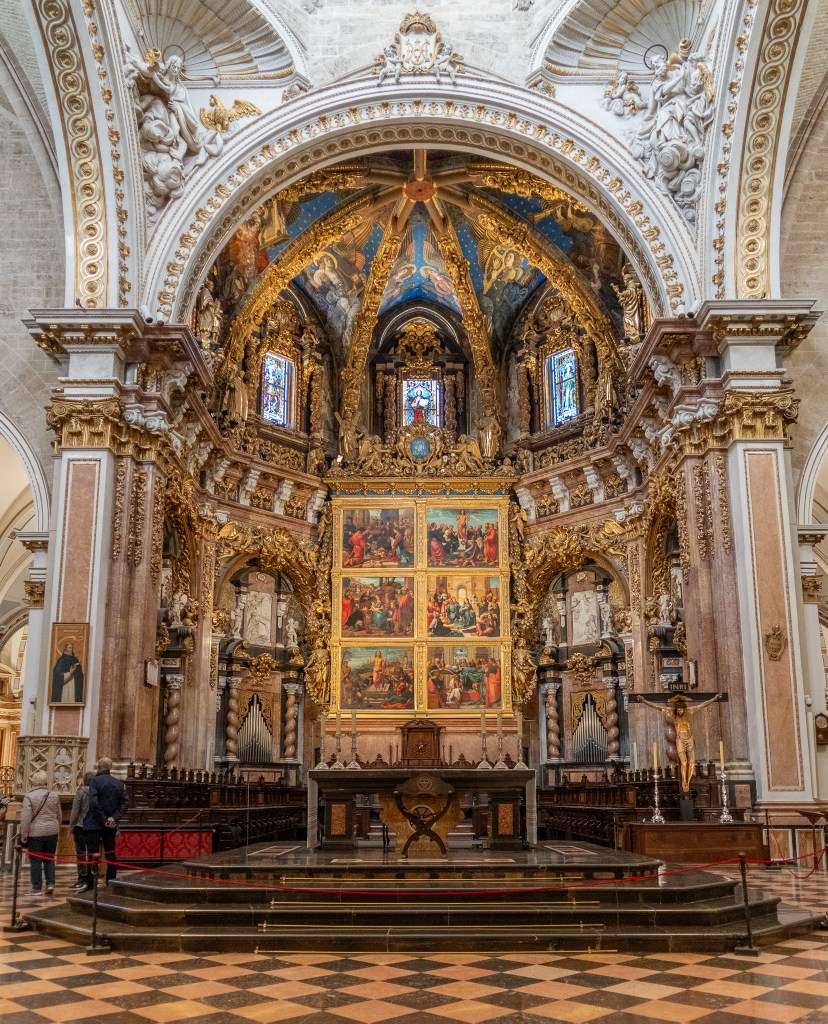
Valencia Cathedral, also known as St Mary’s Cathedral is another important religious building. While not as artistically ornate as the church of St Nicholas, it has a particular significance all of its own.

The main altar in Valencia Cathedral

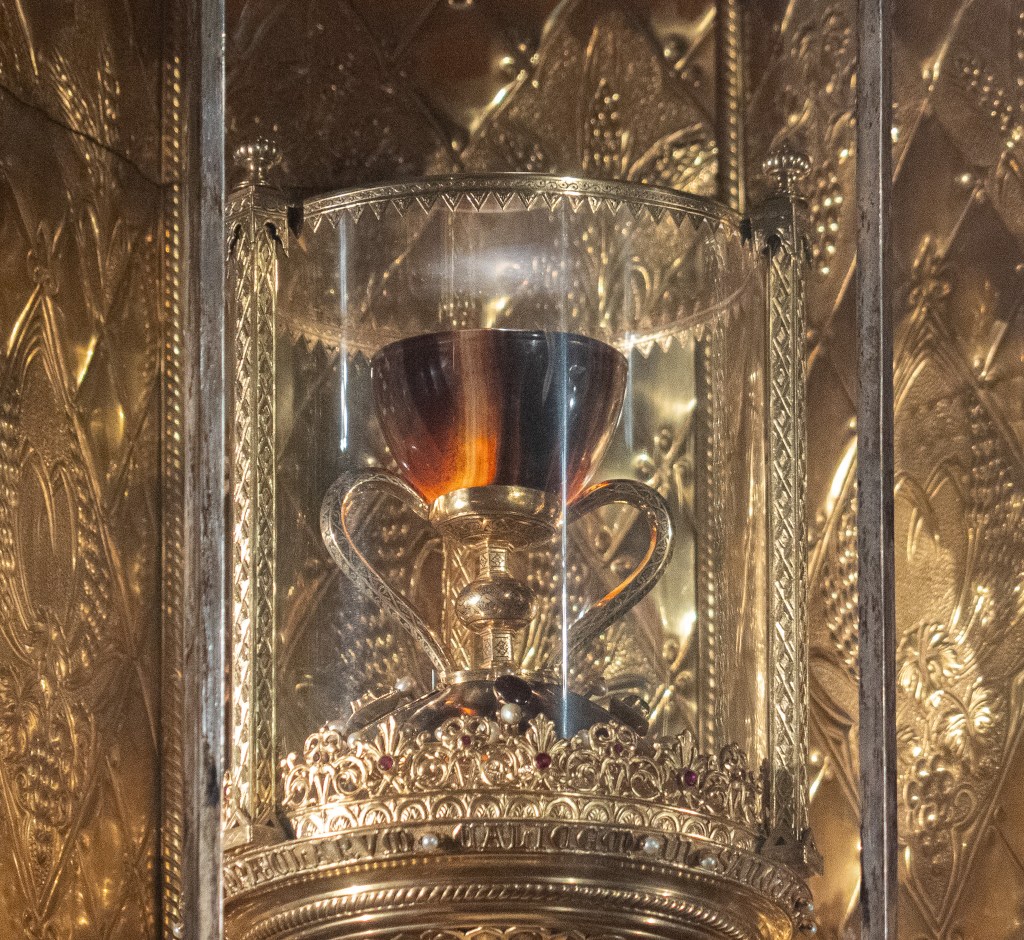
Among its many chapels, there is one that claims to hold a holy chalice, believed by many to be the true Holy Grail, the chalice that Jesus drank from at the Last Supper. Of all the claimants around the world, this chalice is considered the most plausible contender due to it being dated to the 1st century and its provenance. Its movements throughout the centuries has been well documented. It was given to this cathedral in 1436 by King Alfonso V of Aragon. It has been used by many popes, most recently by Pope John Paul II in 1982 and Benedict XVI in July 2006. Only the top portion is the true relic. An agate bowl shaped vessel, it is made from a mineral found in the region between Alexandria and Syria. The ornate handles and precious stones were added later. Whatever the true origin of this cup, there is no doubt that it has great historical significance and has been venerated for centuries as a true and valuable relic of the Passion of Jesus Christ

The Holy Chalice

21st Century Valencia

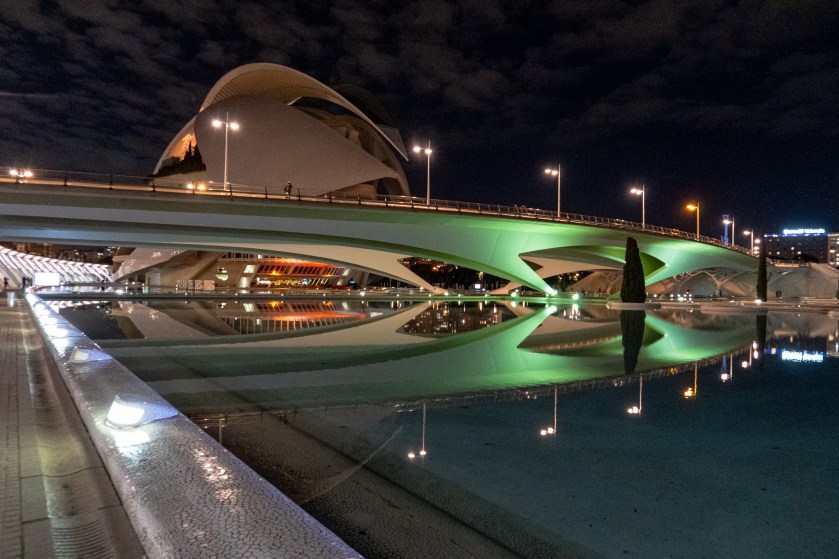
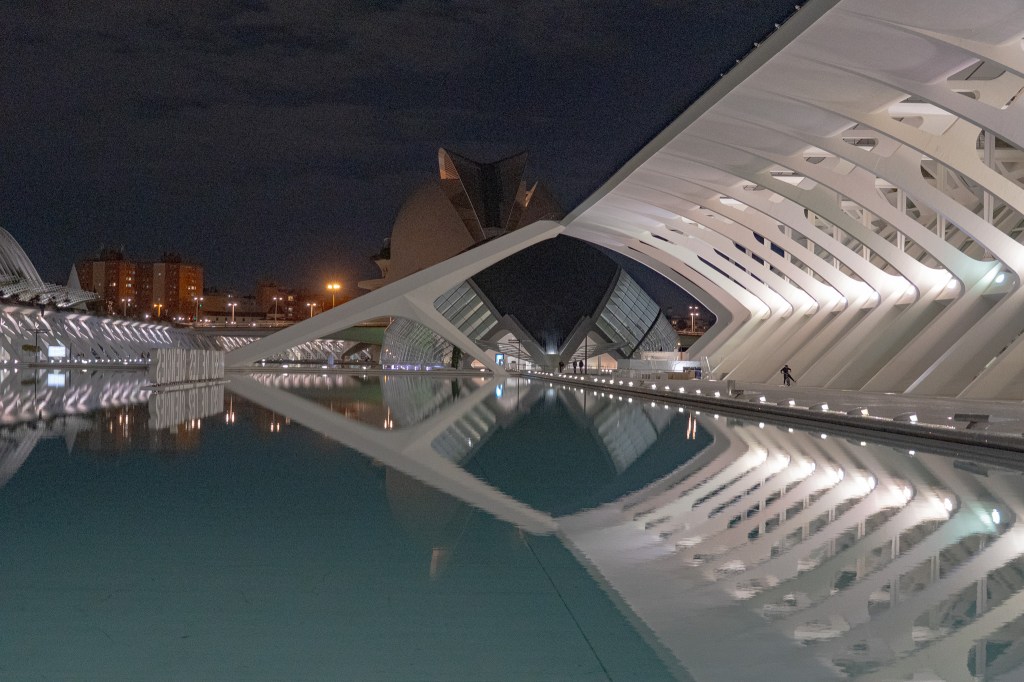
Valencia, like most cities, has two parts. An old, historic part and a new, modern part. And I don’t mind admitting that when it comes to architecture, my preference is for the ornate Gothic or Baroque over the streamlined futuristic structures. If anywhere could put my preferences to the test, it’s the ‘City of the Arts and Sciences’ (‘Ciutat de les Arts i les Ciencies’ in Valencian)

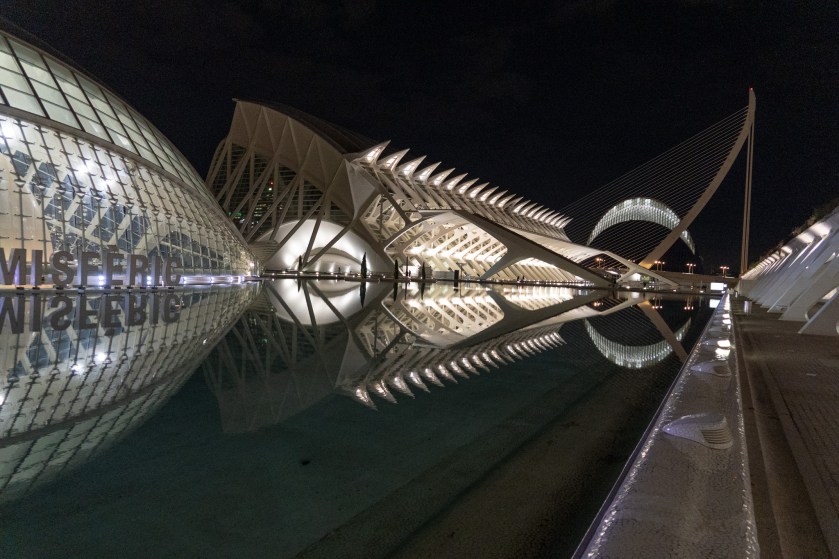
City of the Arts and Sciences

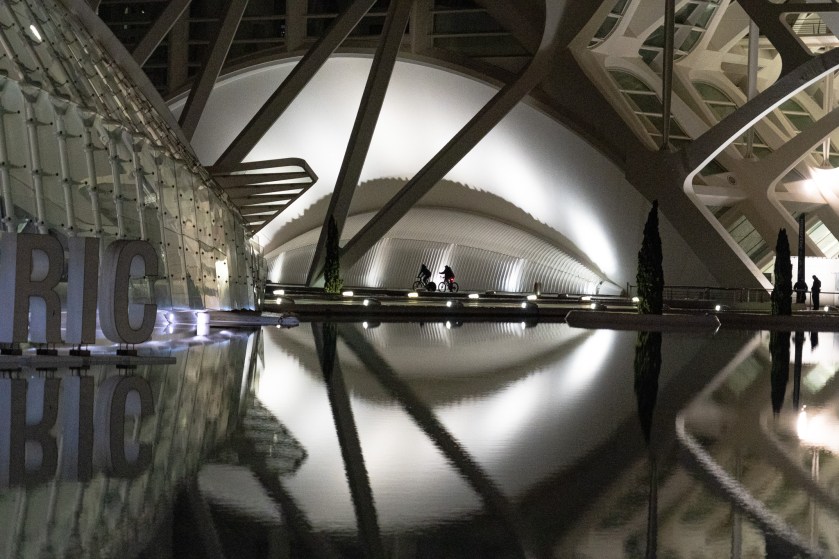
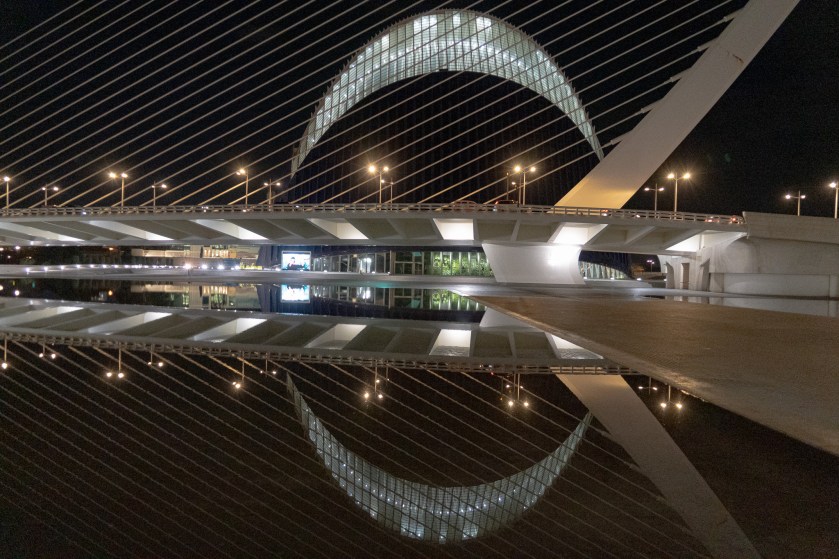
Reflections creating a whole other dimension

Museum of the Sciences leading to the ‘Hemisferic’

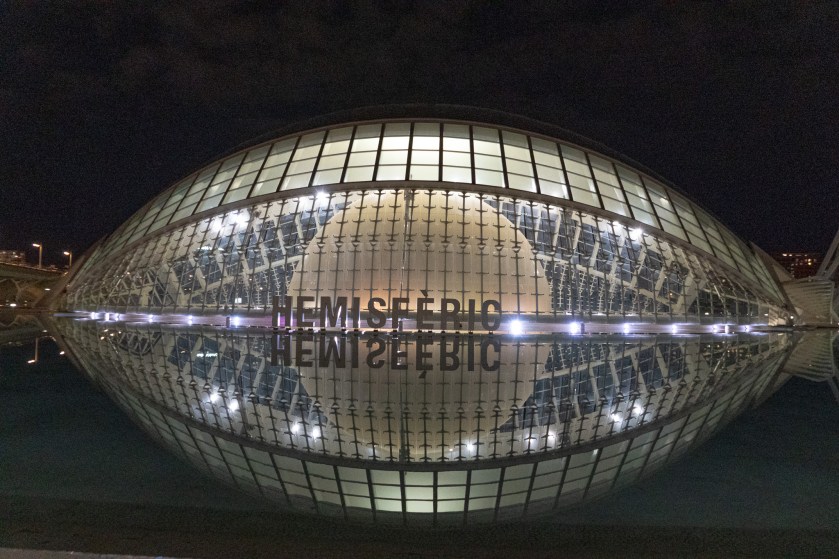
The ‘Hemisferic’ is an immersive experience with IMAX Dome format on a huge concave screen.

In the eye of the beholder

Symmetry

Due to a limited stay of two nights, a decision was taken to omit this place from our daytime itinerary. It is packed with attractions, including the ‘Oceanografic’ aquarium which is run by a foundation focused on research initiatives and species recovery. It would be easy to spend a couple of full days enjoying everything these places have to offer but the ticket costs could quickly add up! Visiting at night though, has its own rewards. It would be difficult to think of many places such as this where you could wander around, safely, late at night and be presented with such a display of light and reflections. I have seen daylight images of the above shots and they look like different structures. Without the nighttime reflections, it looks like the bottom halves are missing! So, for all you keen photographers, this is a must see if you come to Valencia. Day or night, I’m sure you won’t find a shortage of photo opportunities. As usual I didn’t have a tripod. I was happy enough with the shots I took but a few long exposures would have been nice!

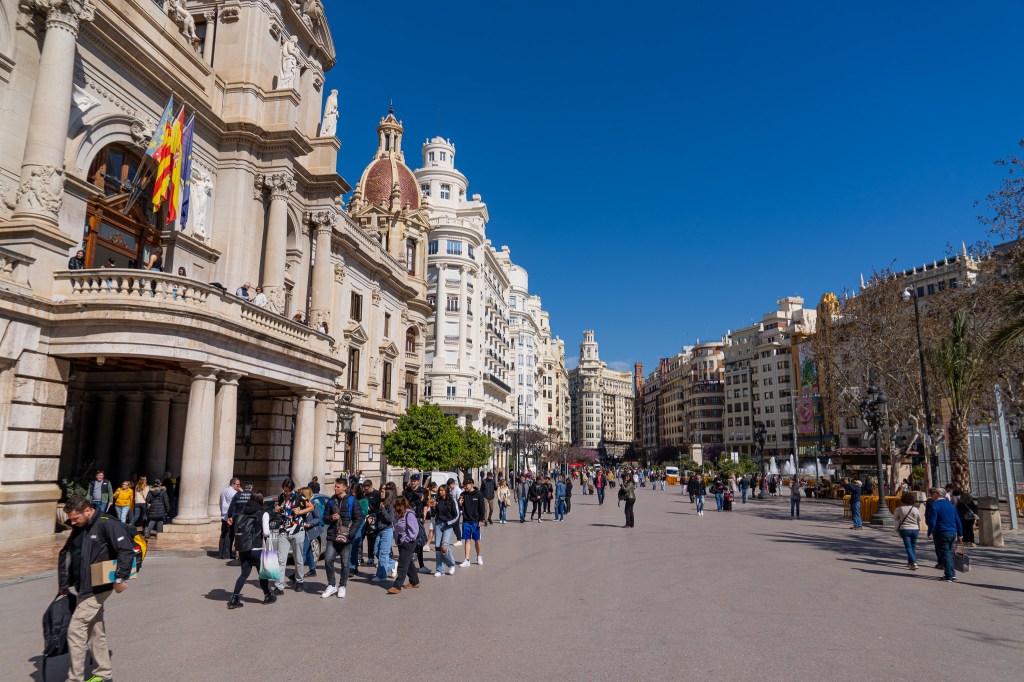
While all Valencia’s attractions make it a fascinating city to visit, one of the most enjoyable aspects for me was simply walking around the streets and soaking up the atmosphere. Valencia is a vibrant yet relaxed city. And while the age range of its inhabitants is wide, young people definitely seem to be in the majority. It also felt like a very safe place, day or night.

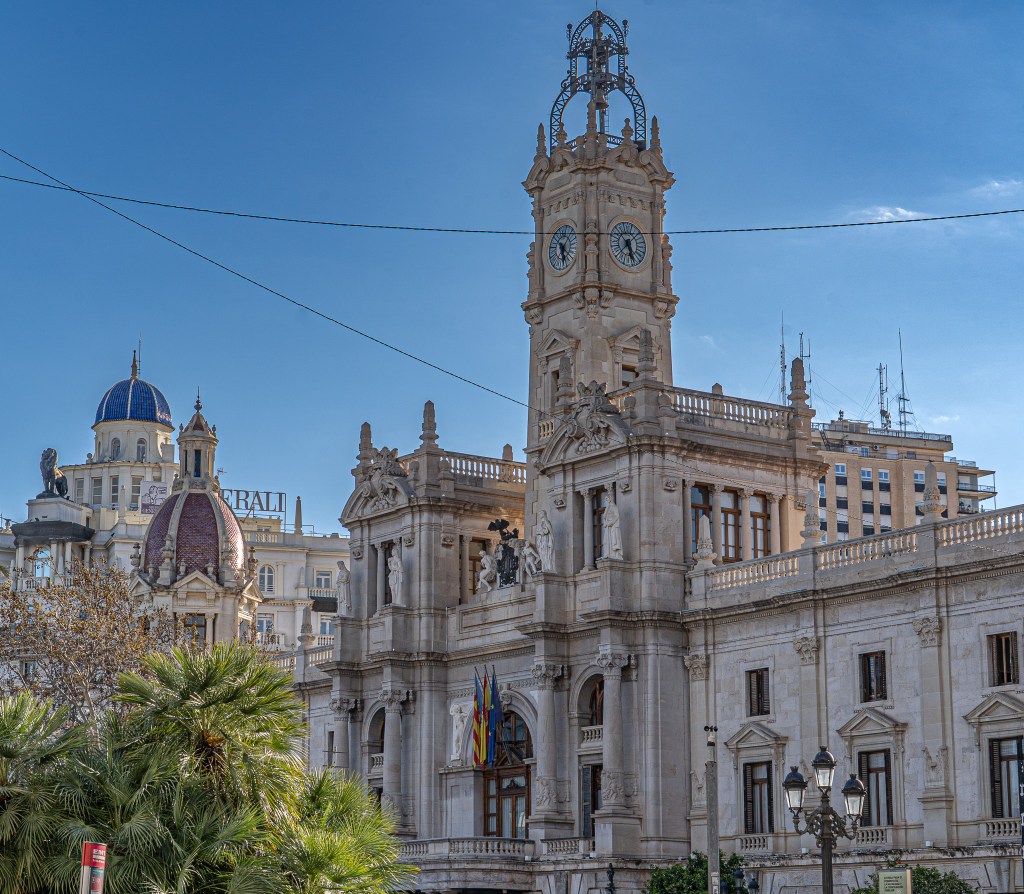
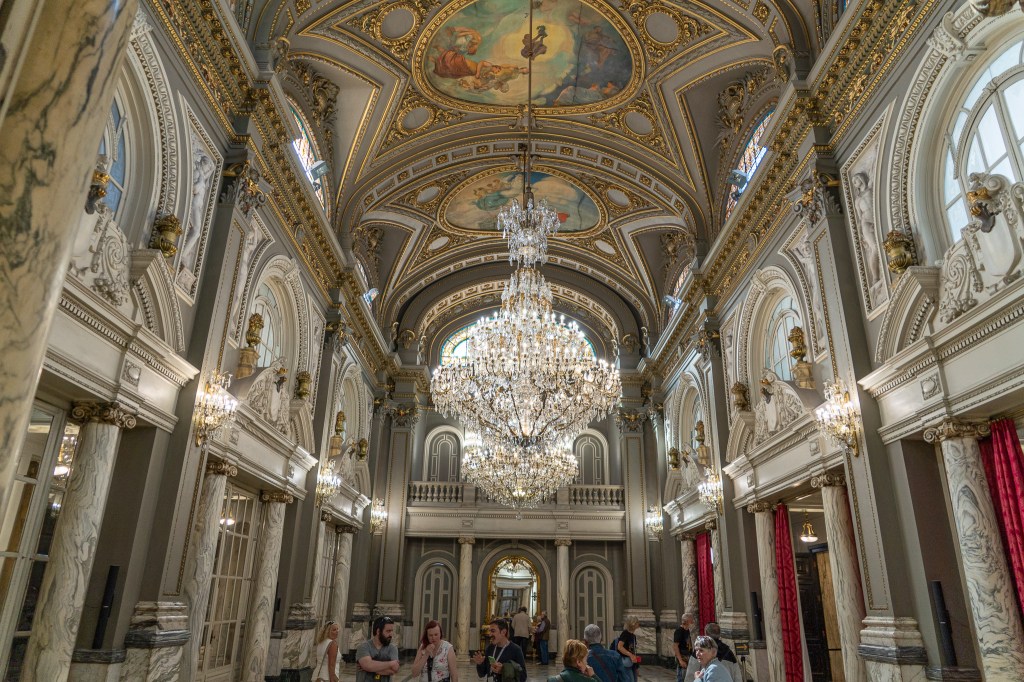
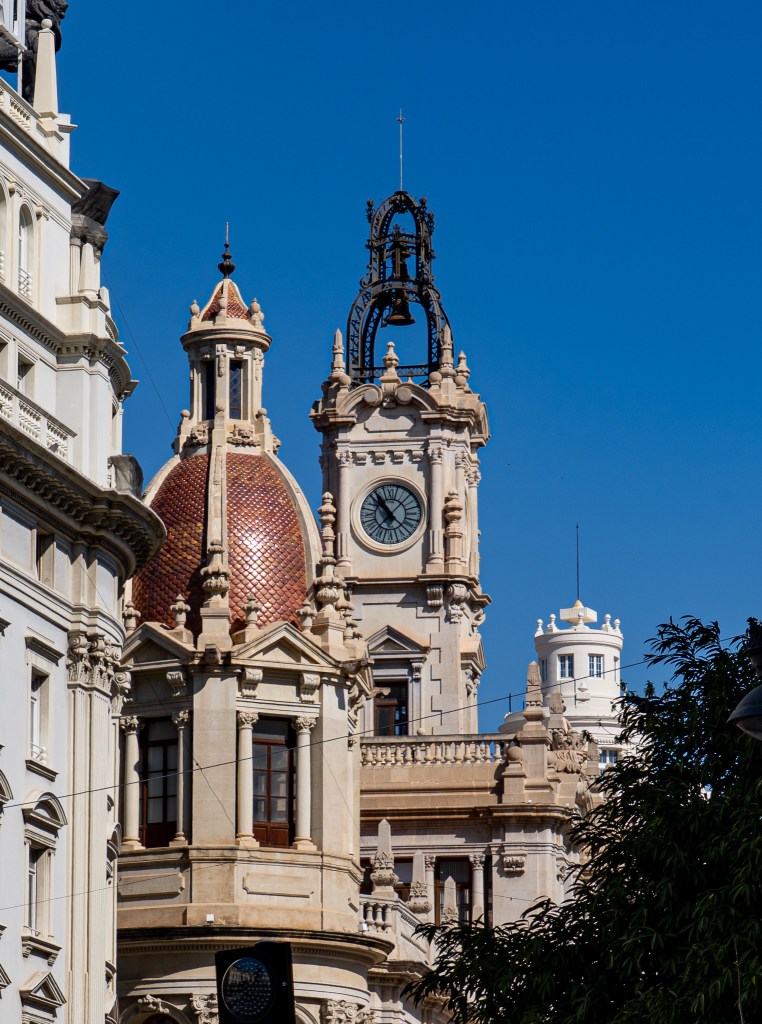
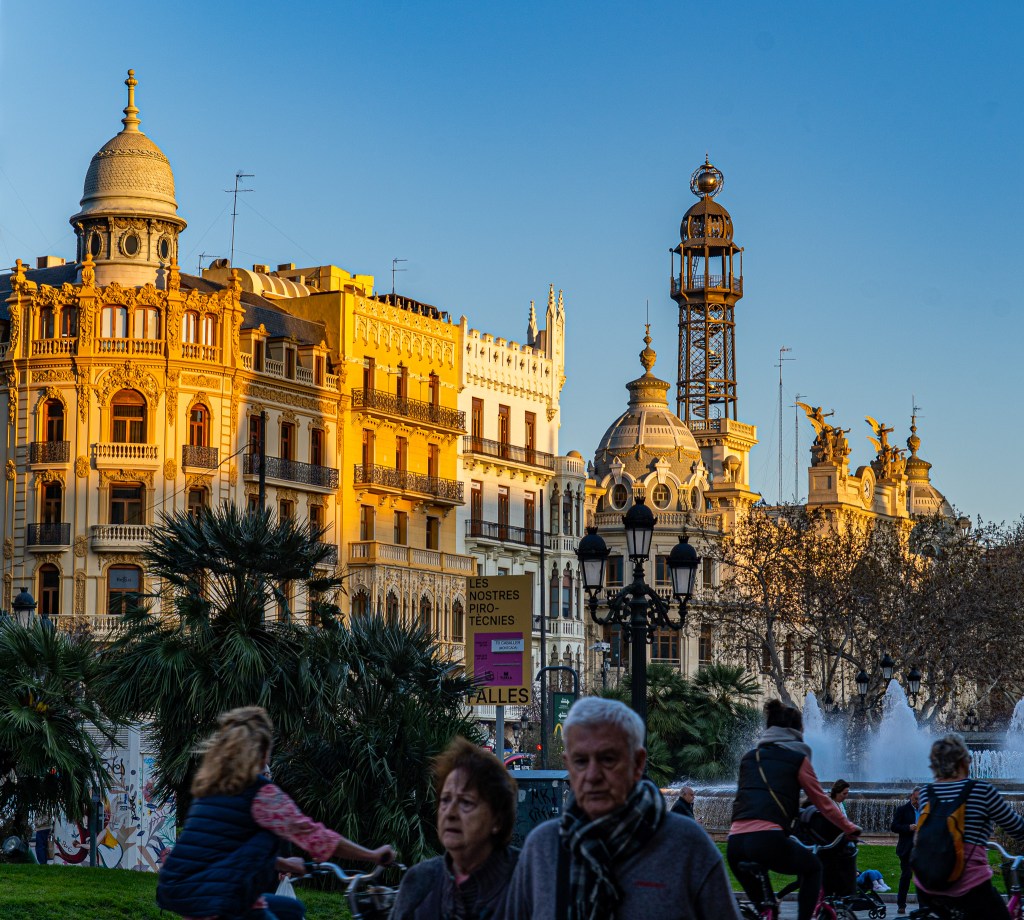
Valencia City Hall

City Hall. Free to visitors.

Traffic free zones make strolling around a relaxed affair.

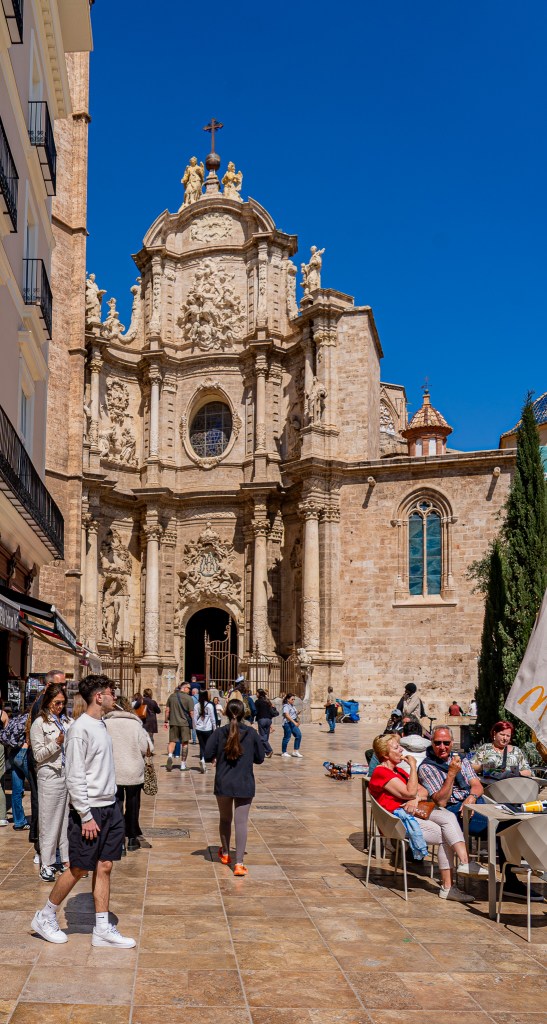
Entrance to the cathedral in Plaza de la Reina (translates to Queen’s Square)

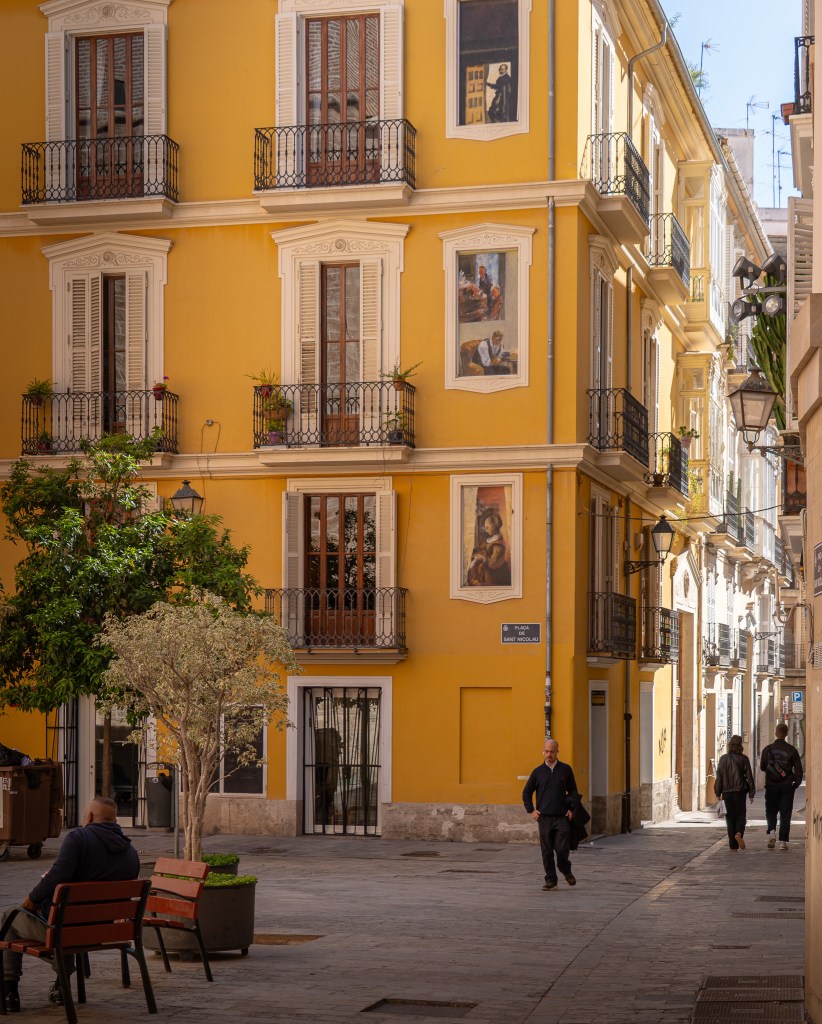
The architecture provides a constant treat for the eyes.

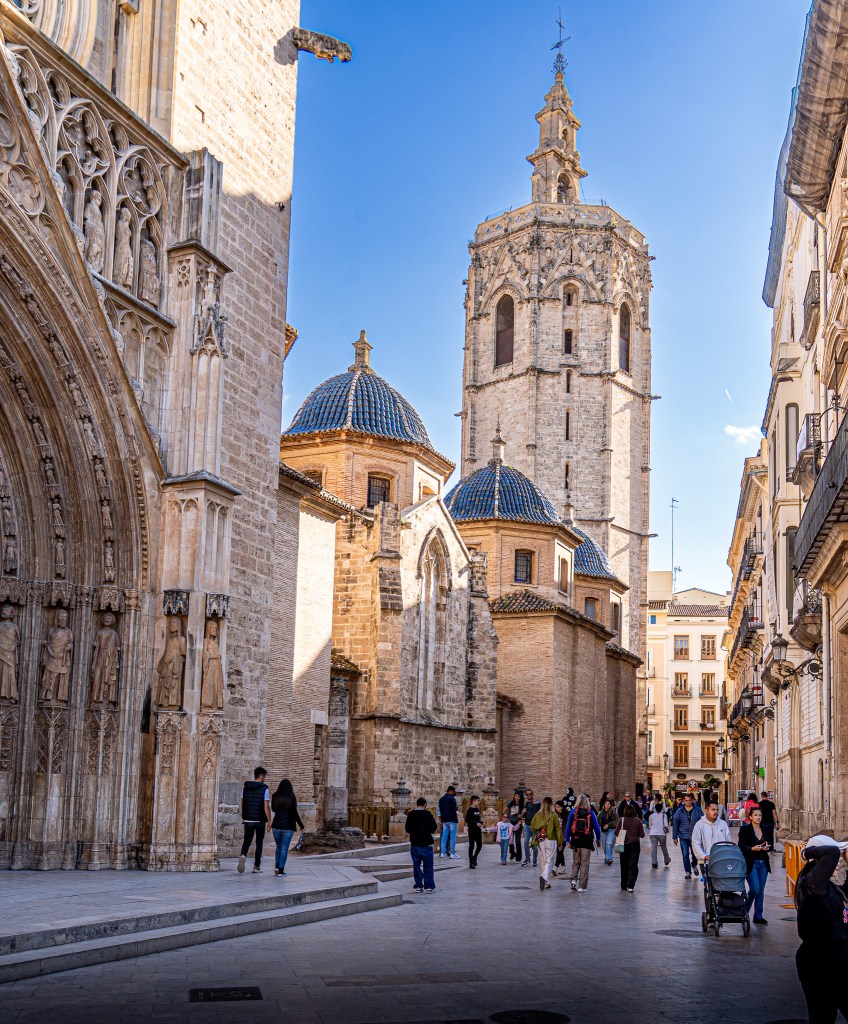
The Miguelete Tower and the domes of the individual chapels inside the cathedral.

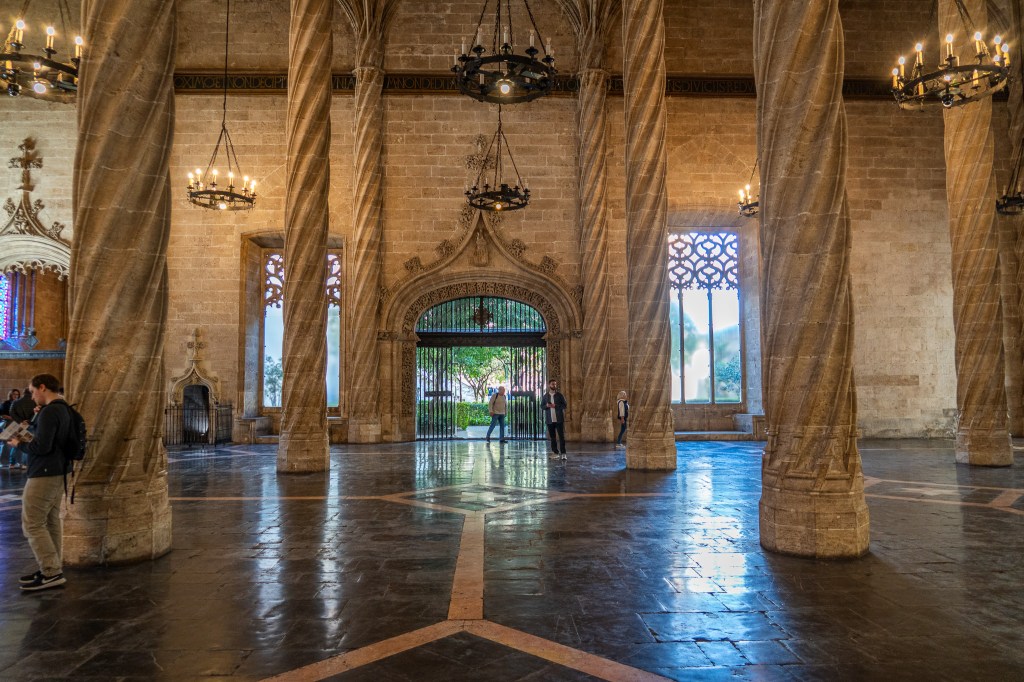
The Silk Exchange (Lonja de la Seda) built in the 15th century. Merchants worked out their contracts and completed their deals here.

The silk trade contributed greatly to Valencia’s prosperity. Around the four walls of the trading hall (above) is a Latin inscription that translates as, ‘I am an illustrious house built in fifteen years. Try and see, fellow citizens, how negotiation is such a good thing when there is no lie in speech, when it swears to the neighbour and does not deceive him, when it does not lend money with an interest charge for its use. The merchant who acts this way will prosper galore and at the end he will enjoy the eternal life.’ I like the sentiment of honesty in business. It’s as pertinent today as it always was. I wonder how many ‘merchants’ adhere to it.

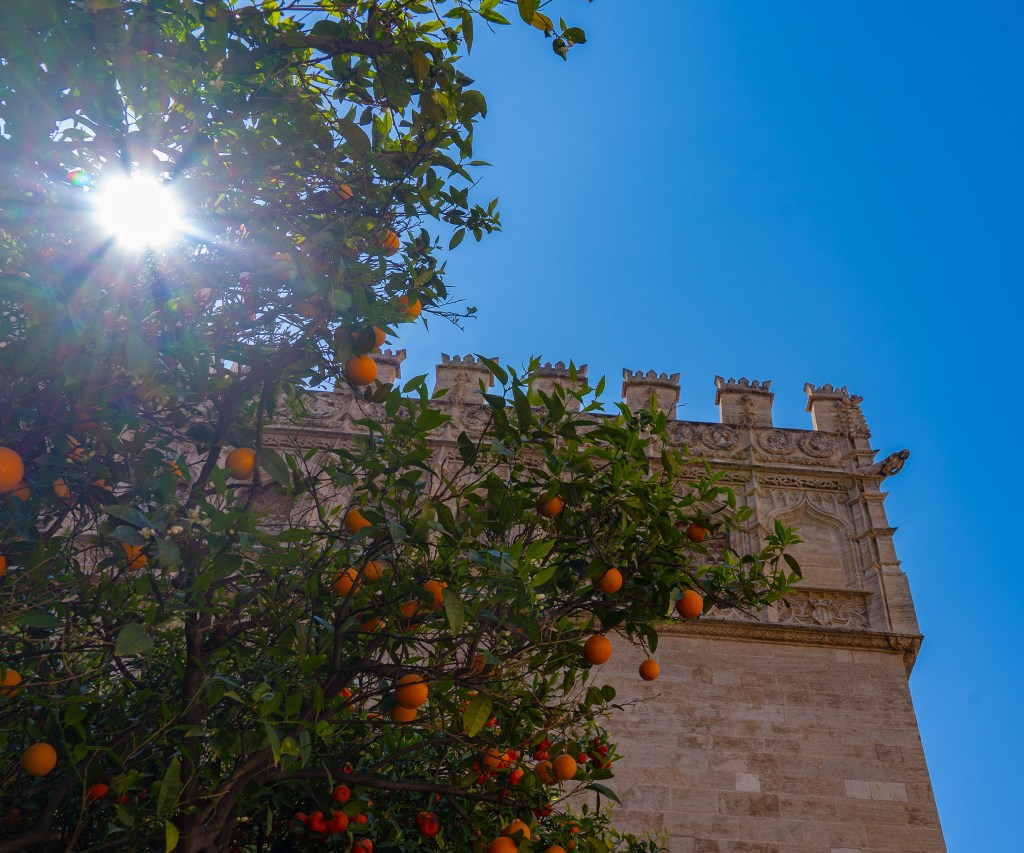
Orange Tree Courtyard of the Silk Exchange

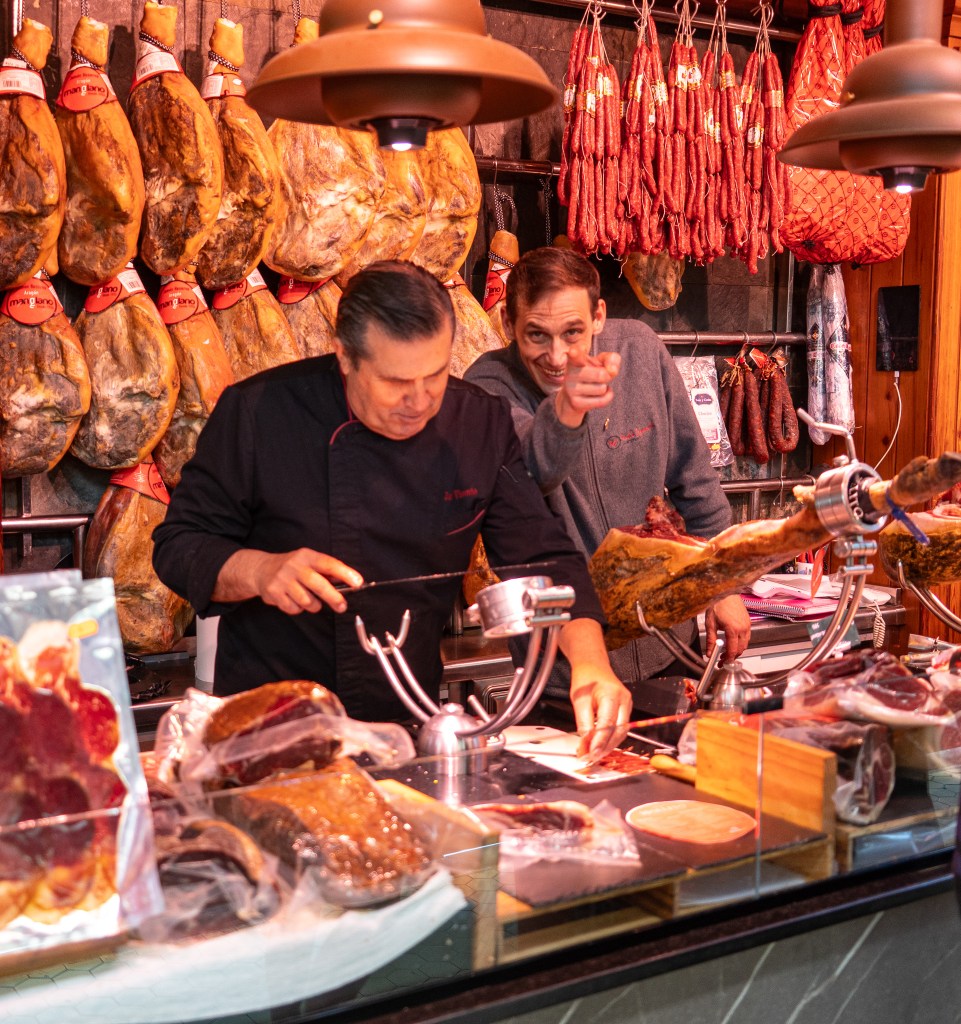
Valencia’s Mercado Central, where the choice of ham, fish, fruit and vegetables is endless.

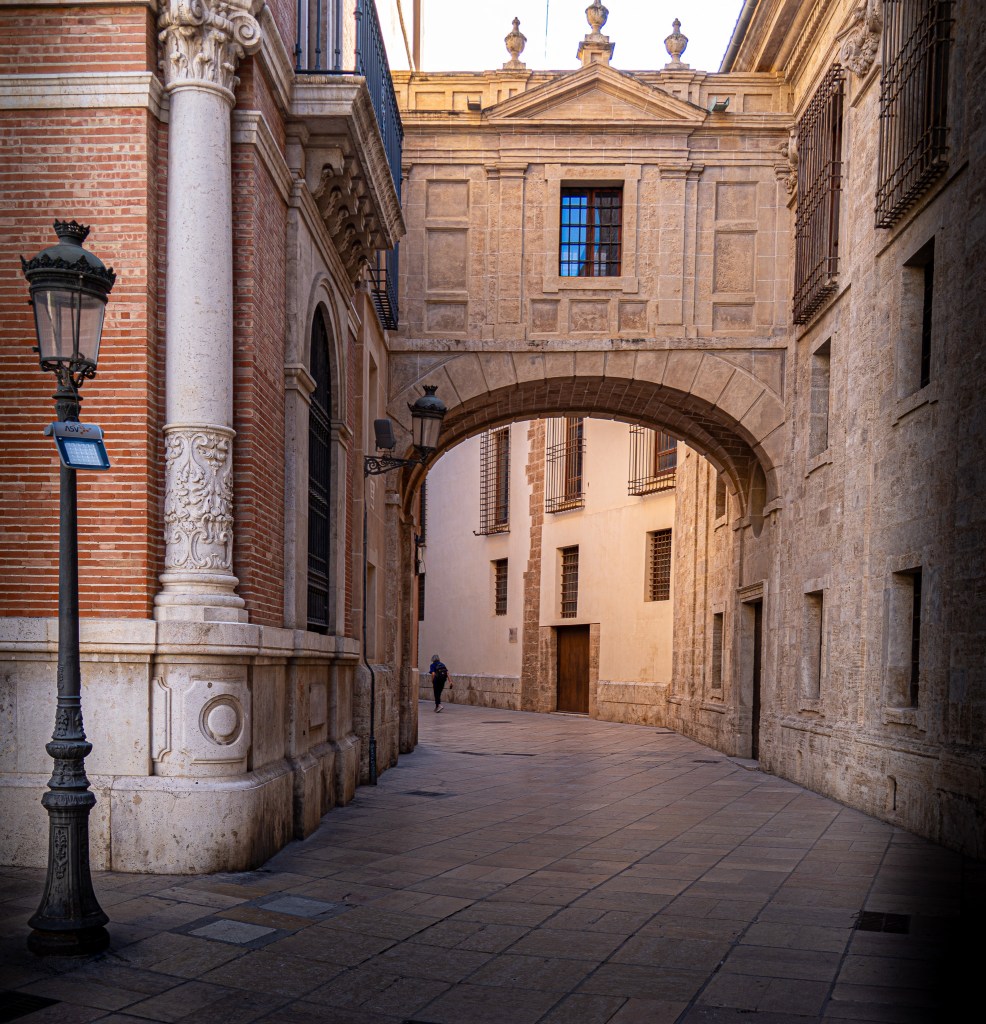
A city of carved stone, arches and alleyways.

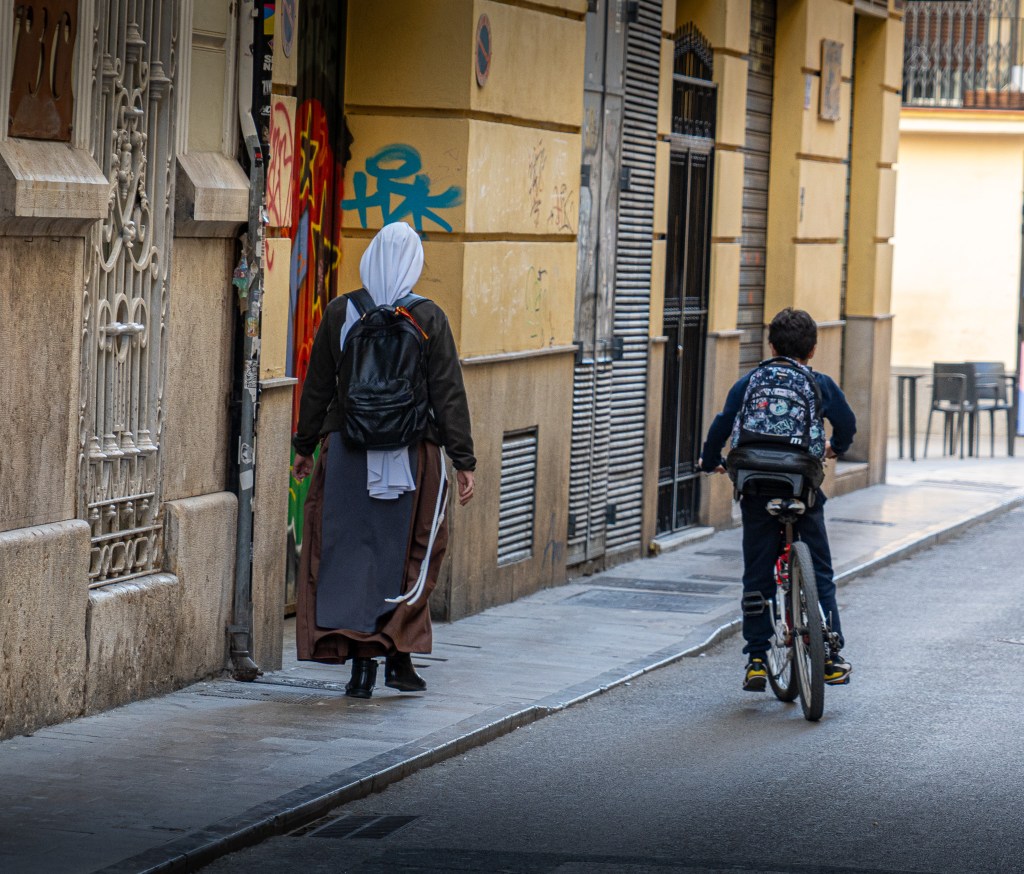
A young Franciscan nun and a schoolboy on a bike. Probably an unusual sight for many but here it’s just everyday life.

Every street seems to lead to another square.

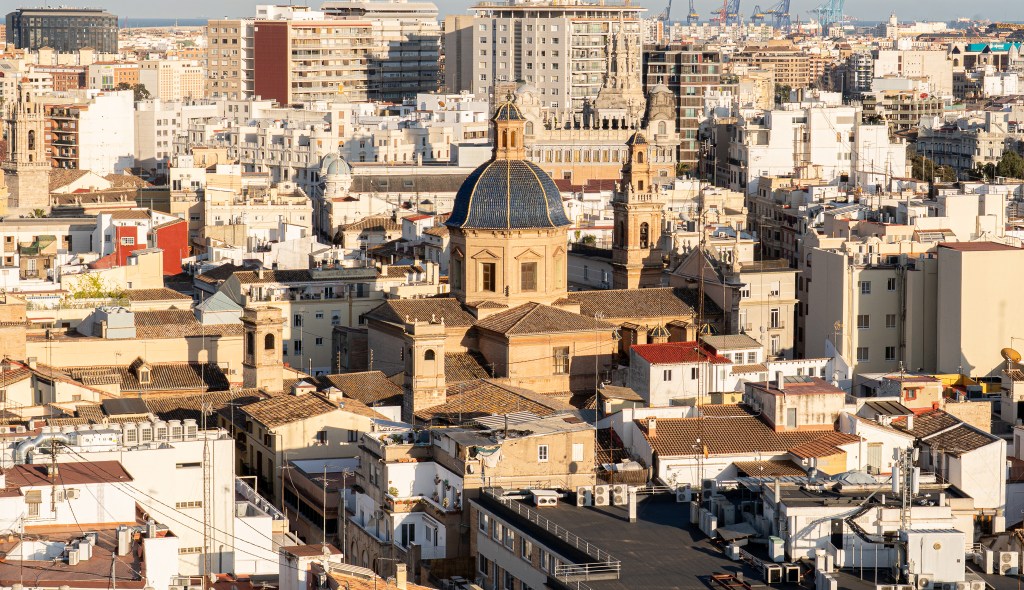
A roofscape taken from the Miguelete Tower

The sun setting on Valencia and the end of another trip to remember.

Tip. Even if you feel reasonably confident speaking Spanish or are just beginning to learn the language, be prepared for a challenge. The population speak Valencian here. It is sometimes similar to Spanish, sometimes bears no resemblance. I may be mistaken but I got the impression while trying to use my limited Spanish that some Valencians preferred to speak in English to me than Spanish. This is understandable when you consider that for forty years of the Franco dictatorship, Valencian was banned and only Spanish was permitted. People here are proud of their language and fervently defend their right to protect it and promote it. So, don’t take it personally if your efforts are not appreciated.

Altea

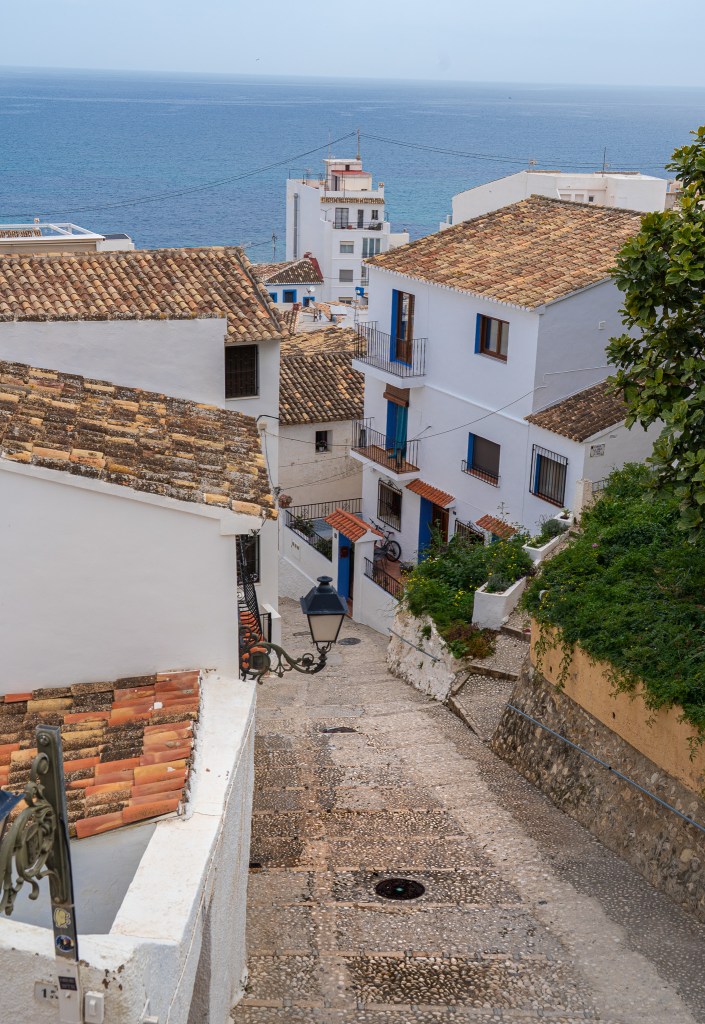
We all have our preconceived notions of Spain. The mention of it conjures up various images. Sunshine and sangria, beaches and bullfighting. Even civil war. For me, my first thought is of whitewashed villages with cobbled streets and wrought iron balconies.

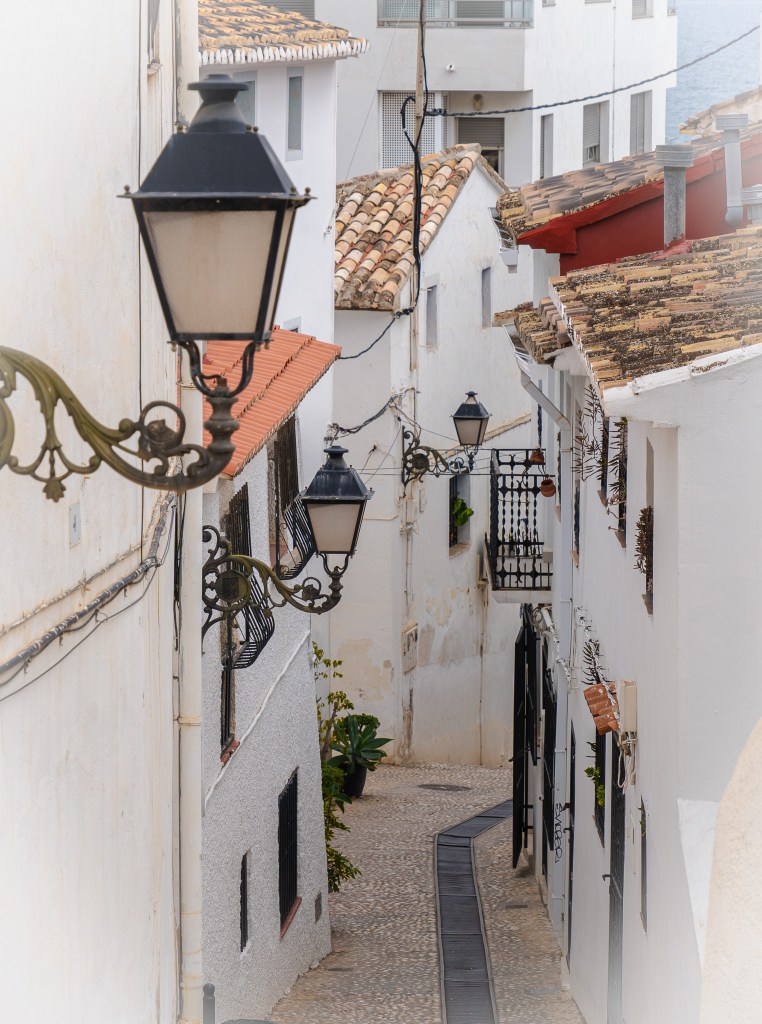
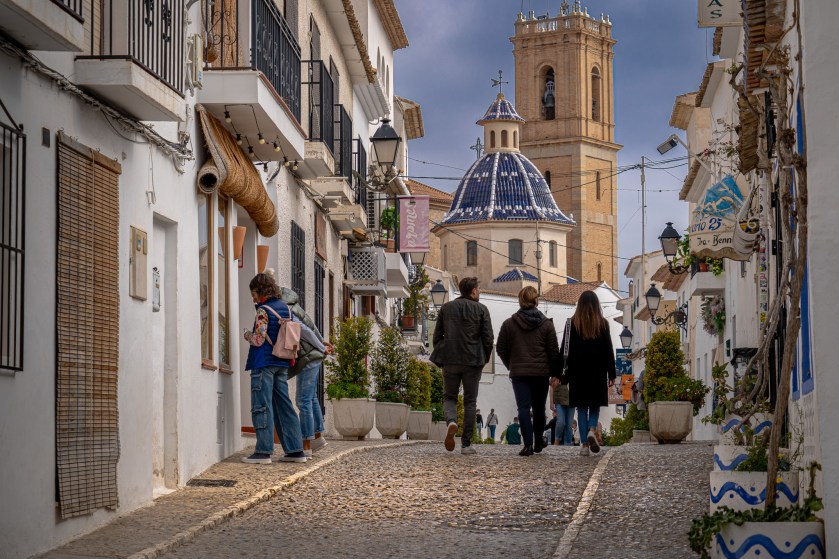
Altea is just such an example. The warren of narrow streets are an endless discovery. In the summer, they provide welcome shade. In the winter, they offer shelter from the winds coming in from the sea. The old town today is a tourist magnet. Its streets and squares populated with cafés and souvenir shops.

But when I walk around this ancient place, I imagine the merchants and fishermen. Hauling goods, fish and nets to and from the harbour. And I think it would be reasonable to assume that these streets also witnessed their fair share of upheaval as Spain transitioned through Roman, Muslim and Christian rule. Needless to say, its elevated position means it has views over the Mediterranean for those who simply want to take a deep breath and spend a minute smiling to themselves in quiet contemplation.

Tip: Visit in the off peak season. We visited in February. This will enable you to soak up the atmosphere and appreciate the authenticity of this historical gem. If you go in July or August, it will just be like any other overcrowded tourist attraction, swarming with overheated, malodorous, irate mobs.

The youtubers tend to exaggerate when talking about the steepness of the climb. Anyone with an average fitness level can walk from the coast to the square at the top of the old town in less than 30 minutes. Sensible shoes recommended.

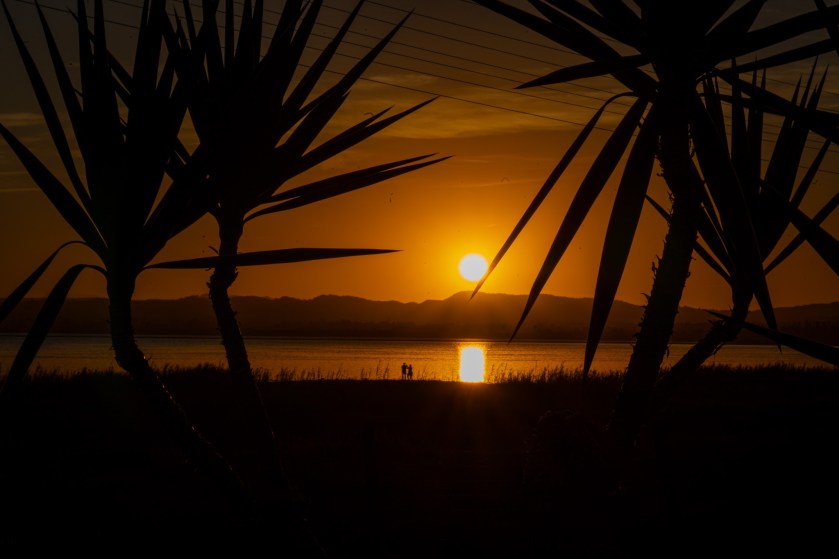
Sunsets and small people.

The ‘Pink Lake’ (Laguna Rosa) is famous for, well, being pink! But if you are there near the end of the day, you may be lucky enough to witness a scene like this. When I took the shot, I was so preoccupied framing the sun with the palm trees that I almost missed the couple standing at the water’s edge. The human brain being what it is, I recalled a scene from Father Ted. The one where Ted and Dougal are looking out the window. Ted is explaining to Dougal that the cows in the field aren’t small, they’re far away. If you have seen that episode you’ll appreciate the reference. If not, you’ll think I’m rambling. A good comedy sketch is timeless. Just like sunsets.

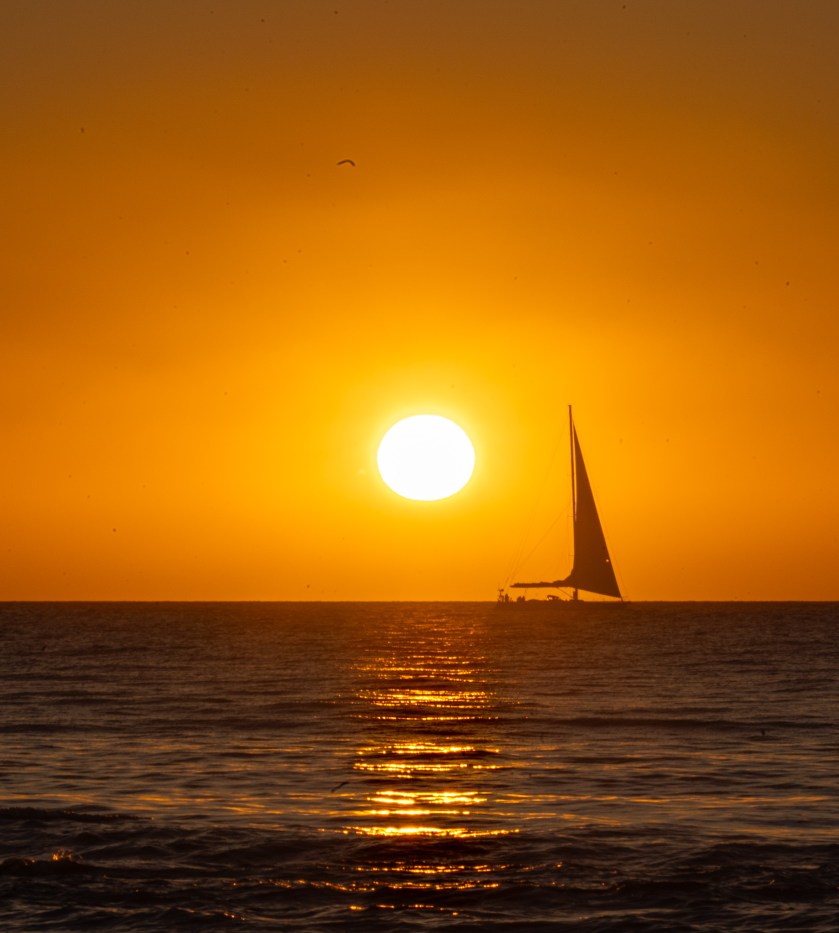
Dawn Sailing

My attraction to the sunrise is not just in its beauty. It is also in the allure of what might accompany it. Some are spectacular and some are mediocre. Sometimes they are invisible, shrouded by a veil of cloud. On this particular morning, my luck was in. I could see the sails of the yacht in the distance, just as the sun was beginning to appear. However, I was on an elevated walkway above Cala Capitan at an angle to the sun and looking down onto the water. I quickly made my way down to the beach until i was in line with the sun. This took about five minutes. Just in time to capture the yacht, silhouetted by the giant burning globe. There is a romanticism attached to sailing, especially when it comes to non sailors like me. We don’t appreciate the considerable effort and technical knowledge required to navigate one of these vessels. My navigational skills extend to a few days steering a cabin cruiser on the River Shannon and Lough Erne. And so, for a moment I found myself yearning to be onboard, witnessing the spectacle of the sun creeping above the horizon. Until I realised that it was the silhouetted yacht that made this photo a bit special.

New York

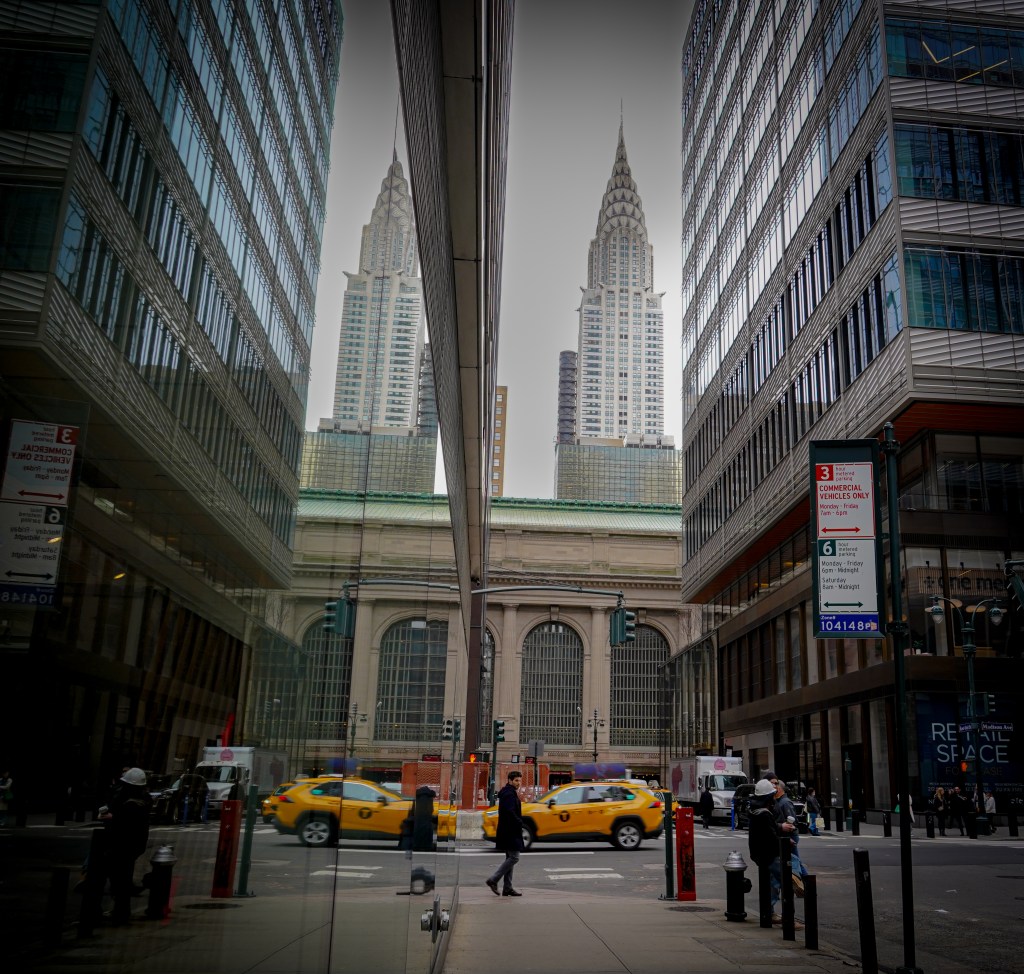
I had entered my 60th year when I saw New York for the first time. I had many preconceived notions about it – all based on TV shows, films and books. I imagined it to be densely populated, noisy and shabby in places and probably a bit overwhelming. And it was all these things. One thing that was unexpected was the sheer scale of the place and you can only appreciate this when you see it ‘in the flesh’. We stayed in mid town Manhattan and as a keen photographer, one of the first things I realised was that the towering skyscrapers meant limited ‘field of view’ (see photo below). I decided that the best photographic opportunities would be the ones taken from the outside looking in. In other words, from the river or an elevated vantage point but more on that later. You either love New York or you hate it. I can’t imagine anyone saying “it’s okay”. I returned a year later, so you know which category I am in.

Approaching Grand Central Terminal from East 43rd street with the Chrysler building taking centre stage.

Tip: If you’re a photographer, bring the widest angle lens you own. For me, this was 24mm but a 16mm lens could be useful.

Some New York (mainly Manhattan) trivia. Did you know?

  1. New York has five boroughs. They are (in alphabetical order) Bronx, Brooklyn, Manhattan, Queens and Staten Island.
  2. There are 21 bridges and 15 tunnels in and out of Manhattan.
  3. Manhattan is an island bounded by three rivers. The Hudson River, the East River and the Harlem River.
  4. Manhattan is subdivided into districts and some of their names hint at the historical concentrations of various businesses such as the Flower District, Garment District, Diamond District and Meat Packing District.
  5. Manhattan is easy to navigate, thanks to its grid system. Most of the borough follows a pattern of avenues running north/south and these are intersected by streets running east/west. Fifth Avenue is the dividing line between east and west. Simple but effective. Makes getting lost difficult!
  6. The average length of a city block in Manhattan, e.g., walking along 5th Avenue from 42nd to 43rd Street, is 264 feet. So, about 20 blocks per mile.
  7. Manhattan is one of the most densely populated areas in the world, with a population distribution of almost 73,000 residents per square mile.
  8. Some NYC acronyms. DUMBO-Down Under Manhattan Bridge Overpass. SoHo-South of Houston Street. Tribeca-Triangle Below Canal.

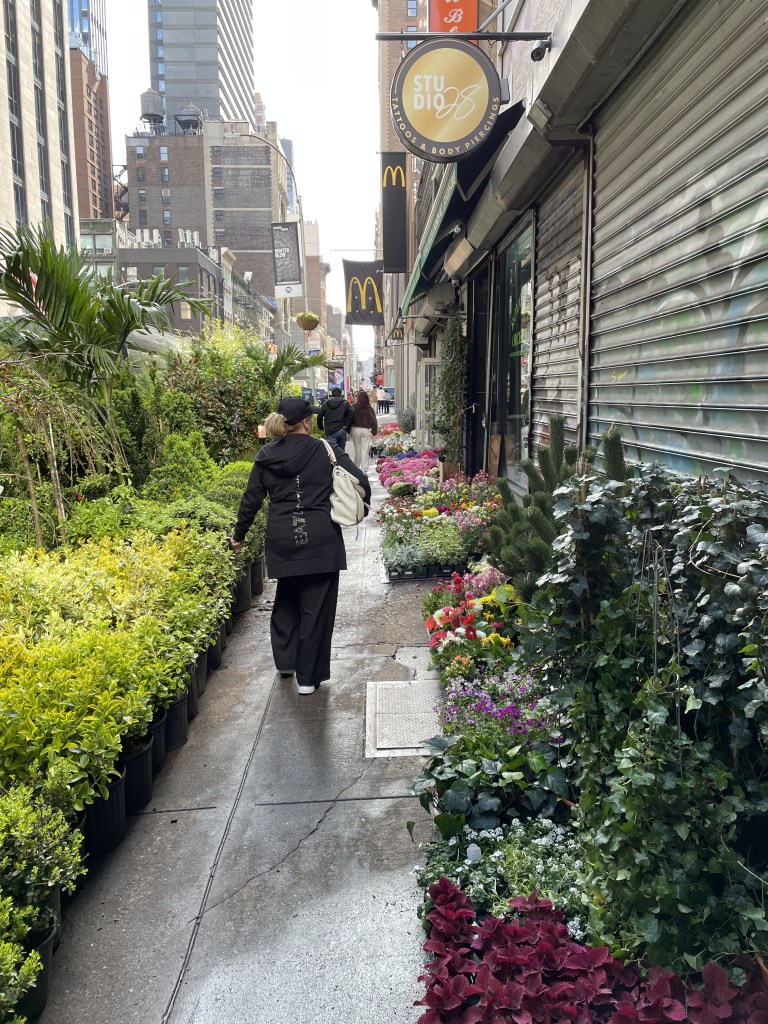
Flower District. An oasis in Midtown Manhattan.

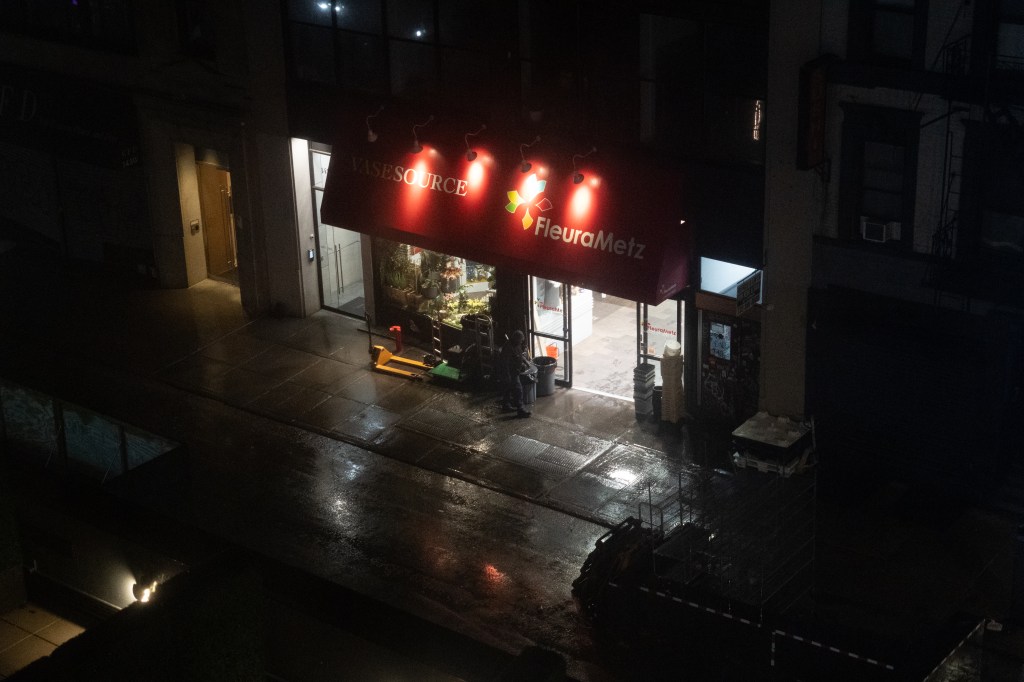
Before arriving at our hotel on West 28th Street, I had only paid brief attention to the part of the description that said ‘in the heart of the flower district’. It was, after all, New York. Flowers are not something I would have associated with that city. We arrived in the evening and the street was surprisingly quiet, despite its close proximity to 6th Avenue. I woke at 4.30am (it didn’t take much to rouse me because my body clock was still on home time, which was 9.30am and I would normally be well into the work of the day). I heard the sounds of a metal shutter being raised and the rattling of trolley wheels dropping from the kerb onto the road. Or as they would say in NYC, “from the sidewalk onto the street”. I went to the window and saw that it was raining. Looking down to the street I saw the source of the noise. A half raised shutter revealed a lighted interior and a group of workers loading trolleys with shrubs, plants and a wide variety of flowers but the surrounding darkness made it difficult to see much detail.

The flower seller’s day starts early at 4.30am

Then one by one, the shutters of adjacent shops began to rise, and more light spilled out onto the reflective surface of the wet street. Soon the area was a hive of activity, and the pavements (sorry, sidewalks) were transformed into verdant walkways. Walking along the street in daylight was a truly pleasurable experience. The bright colors and heady scents seemed incongruous with the concrete jungle, but the effect was therapeutic. The flower district has been in this location since the 1950s. Its history goes back to post-Civil War days, and its most famous predecessor was the Union Square Flower Market, which opened in 1891. The number of flower sellers is diminishing annually as they fall foul of increasingly high rents ($7,000 to $25,000 per month!) and post COVID19 inflation. In the 1950s, 60 sellers were operating here. Today there are less than 20. The reason for the early opening is that the shops act as wholesalers to the trade from 5:00 a.m., so the best time to visit would be after 9:00 a.m. While the daytime experience of the Flower District was enjoyable, the abiding memory for me will be waking at 4:30 a.m. and hearing West 28th Street come to life in the city that never sleeps.

Nature in the city.

Tip: Visit after 9.0am when the professional buyers have left and before midday when a lot of the blooms will have been sold.

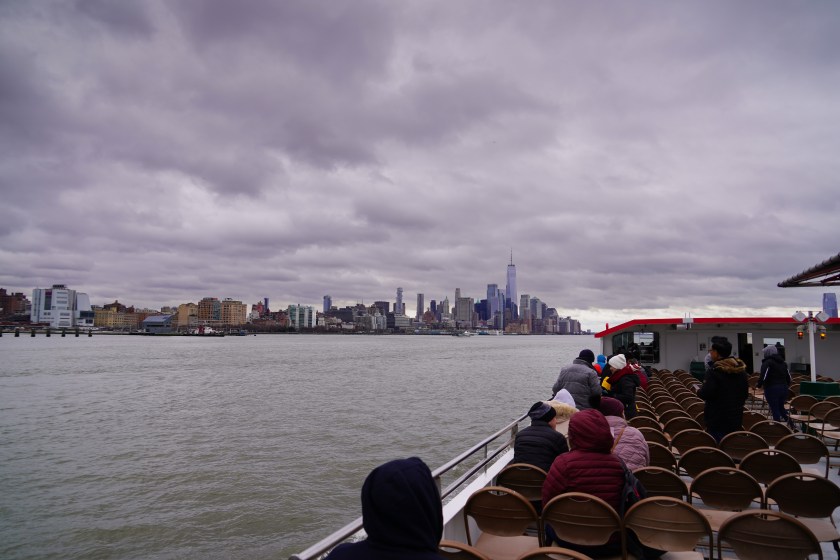
Circle Line Cruise. The best way to view Manhattan.

The multitude of sights to see in NYC and the ways in which to see them is endless and determined by personal choice. In my opinion, the Circle Line Cruise around Manhattan is a must. As I mentioned in my introduction, the best way to see Manhattan is from the outside looking in. If the impressive vantage point was all the tour had to offer, I would have been satisfied but it included much more. The guide (David), a native New Yorker, provided the story of the city’s fascinating history, from its native inhabitants, through to modern day. His narration was peppered with human stories and trivia that only a local would know and his portrayal of the city and it’s people was one of an eclectic mix of behaviours and mindsets. A place where nothing is unusual. To illustrate this point, he described how, while filming a scene in Times Square for Ghostbusters, the directors didn’t use extras. The sight of Bill Murray and Dan Aykroyd running through the streets in silver suits, carrying their ‘proton packs’ didn’t provoke much of a response from the seasoned New Yorkers who have seen it all!

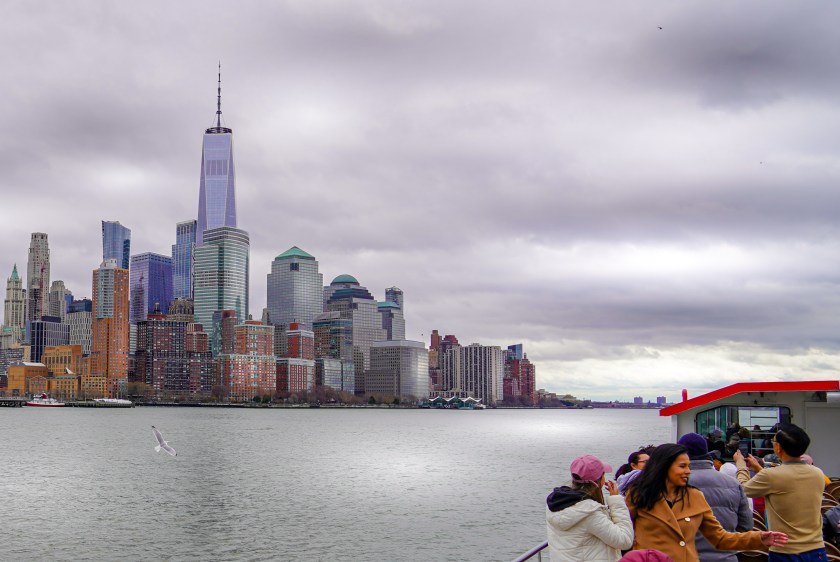
Cruising down the Hudson River with the financial district looming in the distance.

Tip: Sit on the left hand side for unobstructed views of Manhattan. If sitting outside in any season but summer, wrap up well. It’s always colder on the water.

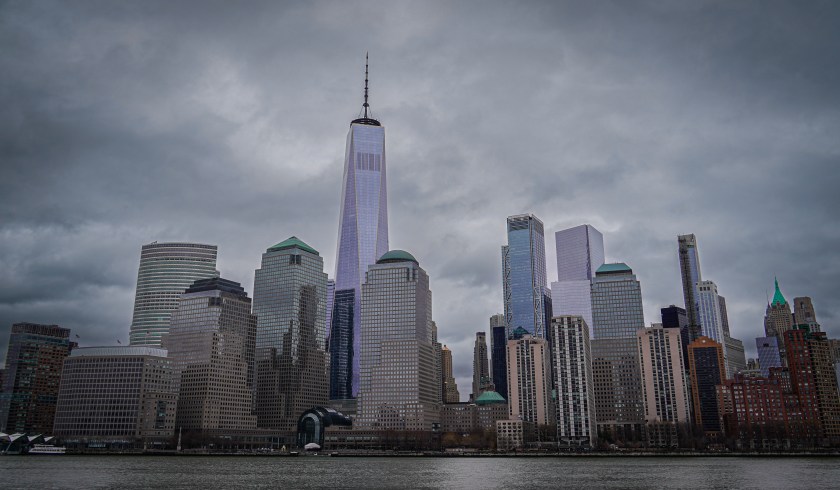
The One World Trade Center dominates the skyline in the Financial District in Lower Manhattan.

The gap where the Twin Towers stood, a solemn reminder of a dark day in New York’s history.

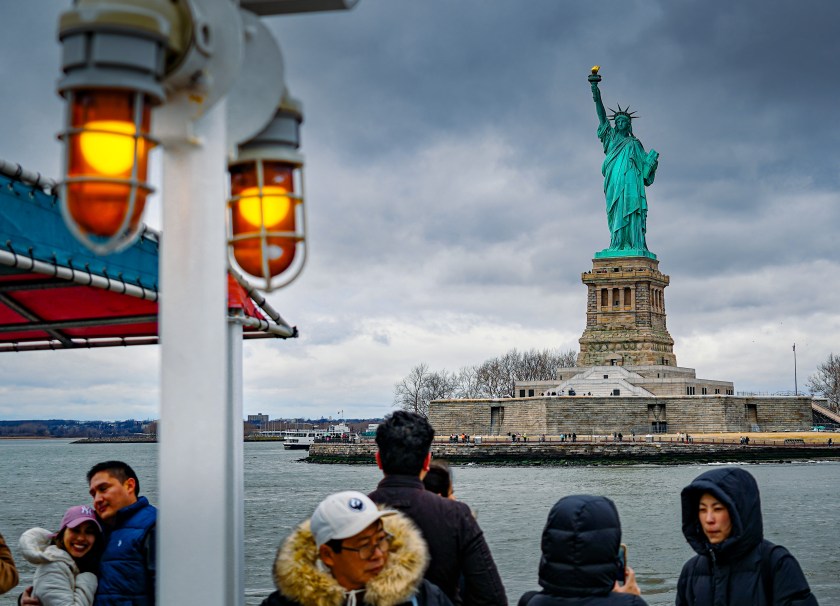
Before circling Manhattan, we took a short detour and sailed past Liberty Island for that obligatory photo of the Statue of Liberty.

The Statue of Liberty was a gift from France in 1885 to honour the alliance between the two countries during the American Revolution. She is made of copper which has been oxidised by the air over time, resulting in the green patina of copper oxide. The statue is struck by lightning, on average, 600 times every year.

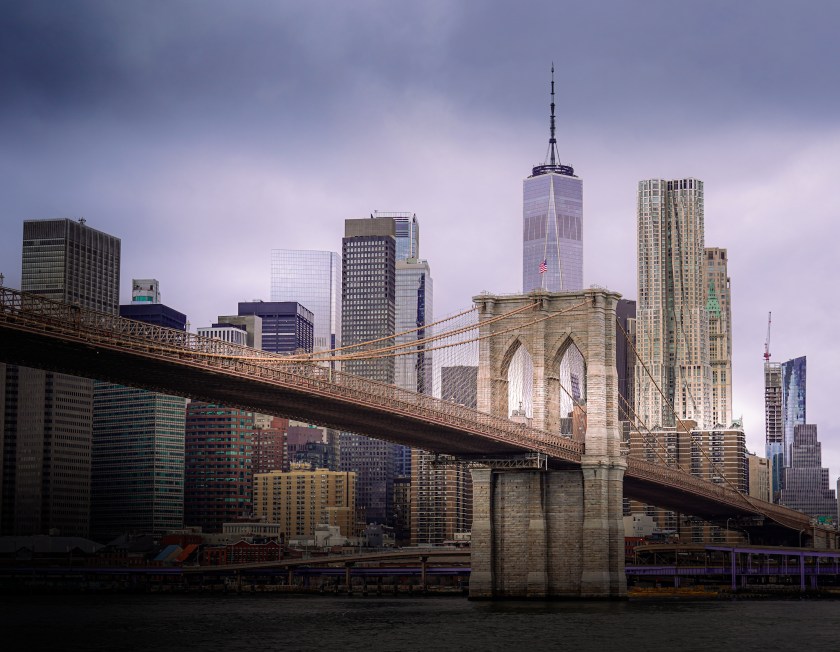
Brooklyn Bridge. The iconic first bridge over the East River, linking the boroughs of Manhattan and Brooklyn.

Tip: The best vantage points, in my limited experience, from which to photograph the Brooklyn Bridge are from a boat on the river, from the Manhattan Bridge or from Brooklyn Bridge Park in Brooklyn.

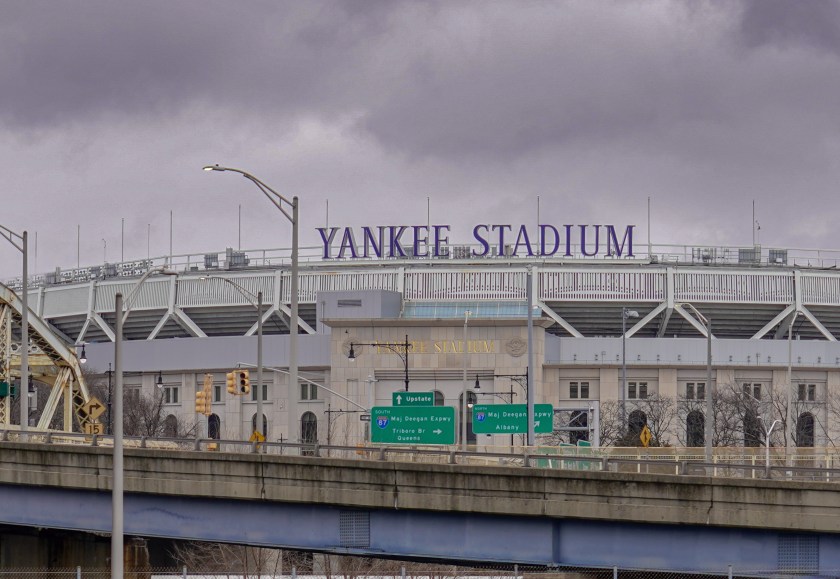
Sailing up the Harlem River, we passed the home stadium of the New York Yankees.

Yankee Stadium is situated in the Bronx and opened in 2009. It replaced the original that was built in 1923. Apparently during construction, one of the workers, a Boston Red Sox fan, buried a Red Sox jersey underneath the visitors’ dugout. He hoped this would bring the Yankees bad luck! However, his dastardly deed was reported by his colleagues and he was forced to dig it up again. The Bronx is the only one of NYC’s boroughs that is part of the USA mainland.

The George Washington Bridge (GWB) on the Hudson River.

Connecting Washington Heights in Manhattan to Fort Lee in New Jersey, the GWB is the busiest motor vehicle bridge in the world. Over 100 million vehicles cross this bridge every year. Opened in 1931, it is the only suspension bridge in the world with 14 vehicular lanes.

Back at our starting point at Pier 83 at West 42nd St and 12th Avenue

As we approached the dock from which we had departed over 2.5 hours previously, the sun was low in the sky and the clouds were taking on a pink hue. For the last hour, I had been the only person on the outer deck. It was bitterly cold but I hadn’t come all this way to miss whatever photo opportunities came my way. I shook from head to toe and my hands were numb and painful but it was worth it. A unique experience, viewing the most interesting and most famous city in the world from the water. An experience made all the more enjoyable by the fascinating, informative and entertaining commentary from our guide who was as unique as NYC itself. Thanks David!

On the Edge. A bird’s eye view from the Edge observation deck.

For a completely different view of Manhattan, there are various ‘observation decks’ scattered around the borough. These include the Empire State Building, One World Observatory, Top of the Rock and Summit One Vanderbilt but my personal choice was Edge (not sure why it’s not called the Edge). When you have limited time in NYC and have decided to only do one observation deck, your choice will not be an easy one. I picked Edge because of its riverside location on the banks of the Hudson, its views of Midtown and Lower Manhattan and its status as the highest observation deck in the Western Hemisphere. It was difficult to envisage what the view would be like from such a place but it didn’t take long to find out. The high speed elevator took us from ground floor to the 100th floor in 52 seconds! Stepping out of the elevator, we were confronted by sight that will probably be one of my most enduring memories. Looking down at the Empire State Building!
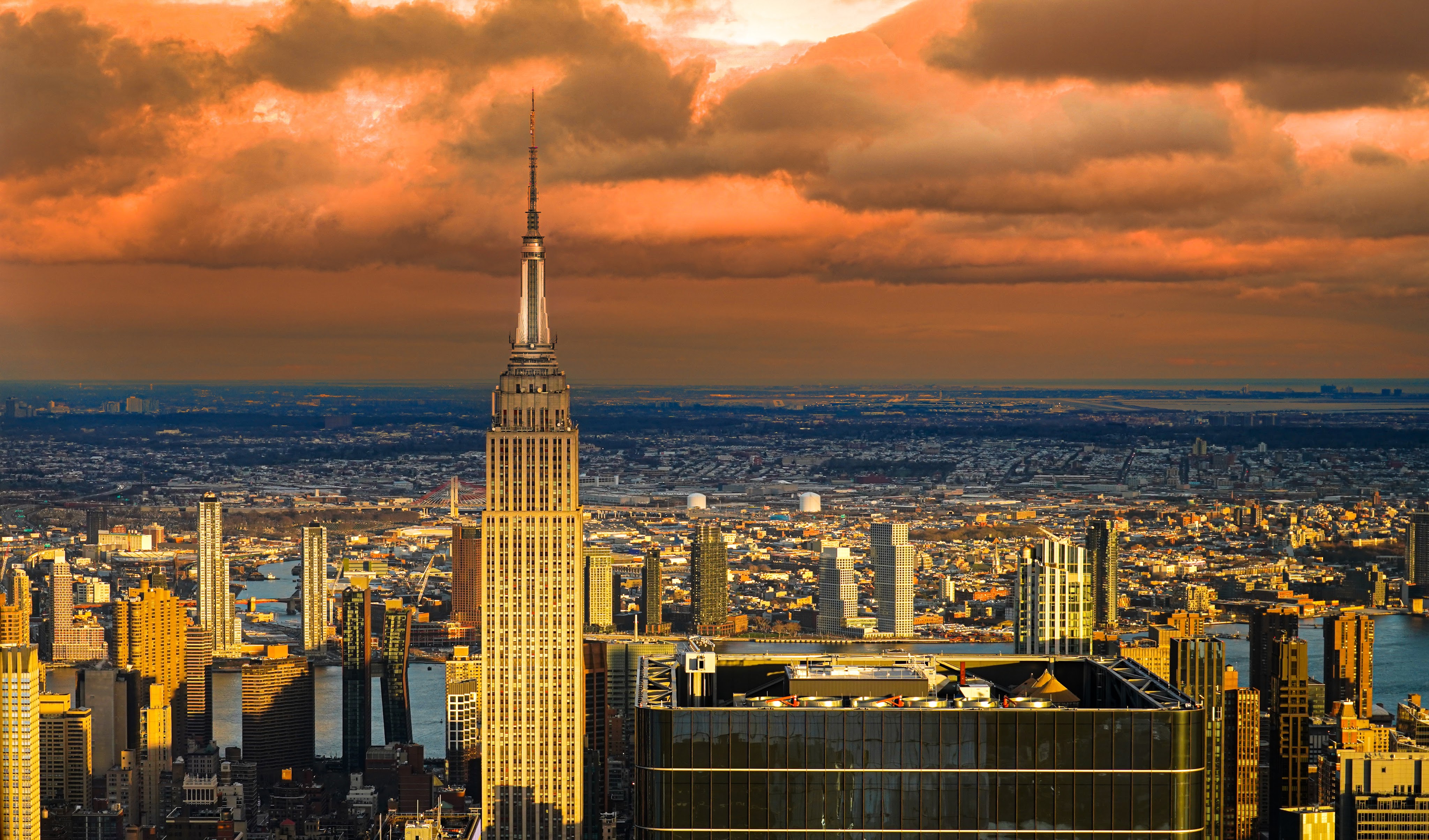
Looking down at what used to be the tallest building in the world.

Construction of the Empire State Building began on St Patrick’s Day (17th March), 1930. It opened on 1st May the following year. Impressive schedule by any standards. It’s name comes from the nickname for the state of New York (the ‘Empire State’) and when it was completed was the tallest building in the world. I don’t think it’s an exaggeration to describe it as the most famous building in the world. It is large enough to warrant its own zip code (10118), similar to 43 other buildings in NYC. Its observatories on the 80th, 86th and 102nd floors helped make it the number 1 attraction in the world in Tripadvisor’s 2024 Traveller’s Choice Awards. But, just like the Brooklyn Bridge, if you want to photograph it, you don’t want to be on it. Standing there gazing at it, glowing in the setting sun, I admit to being a bit starstruck.

As darkness fell a short time later, the magnitude of the building was evident as its illuminated peak towered above the city. The glass wall around the observation deck affected the quality of the images but that didn’t lessen the enjoyment of the occasion.

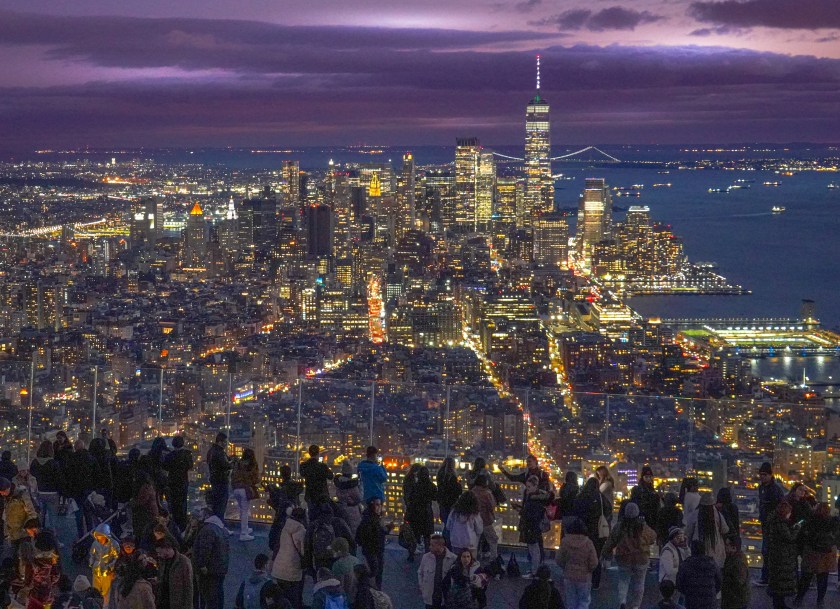
Of course it wasn’t all about the Empire State Building. The views looking south towards the financial district were impressive in their own right. The beautiful sunset over the Hudson River was an added bonus.

View from Edge looking towards the Financial District, with One World Trade Center reaching skyward and the Hudson river on the right. Beyond the southern tip of Manhattan, you can see the illuminations on the Verrazano suspension bridge (also referred to as The Narrows Bridge) which connects the boroughs of Staten Island and Brooklyn.

I often wonder how much I would remember about places I’ve visited, if it wasn’t for the photographs. The details would be scant. But when I look at the photos, the memories are triggered and the details come flooding back. That’s the real beauty of photography and I suppose, the main motivation for this website. When I’m old and decrepit it will serve as a repository of all the life enhancing experiences I’ve been lucky enough to have had.

Tip. I recommend buying the tickets for Edge at the on site ticket office. We bought ours online with Viator and the scanner did not recognize the code. This led to a lengthy delay and we were eventually issued with new tickets. It’s also worth noting that you will still need to purchase in advance because it is highly unlikely that you will be able to visit the deck at the time of purchase. Numbers are strictly limited. This will mean two trips to Edge but in my opinion, well worth it.