
White Gold
Sir Thomas and Lady Dixon Park is its proper title but the residents of Belfast simply refer to it as Lady Dixon. While the park has a wide range of trees, shrubs and flowers, its most famous attraction is ‘Rose Week’. Roses of all varieties from all over Europe turn the park into a celebration of colour and scent. The rose garden itself, featuring some 20,000 rose bushes, was created almost sixty years ago but the Rose Week event began in 1975 and ran until 2020. In the post-COVID era it was rebranded as the Summer Rose Fair and now takes place over a weekend in July but many people still know it as ‘Rose week’. For the dedicated team of gardeners, however, preparations begin long before that.
Welcome to this insight into one of Belfast’s unique events.

Late May and already some of the early blooms have arrived. Each bed is meticulously edged with hand shears.
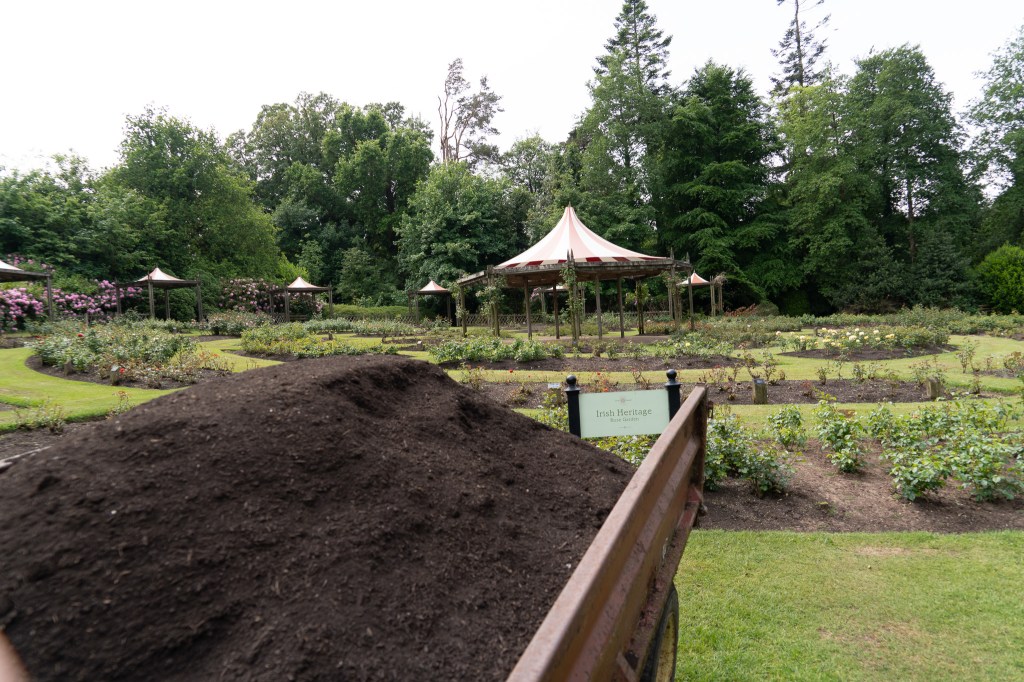
Trailer loads of mulch being delivered to one of the many rose gardens. The mulch acts as a weed suppressant and is manually shovelled by the gardeners into the beds.
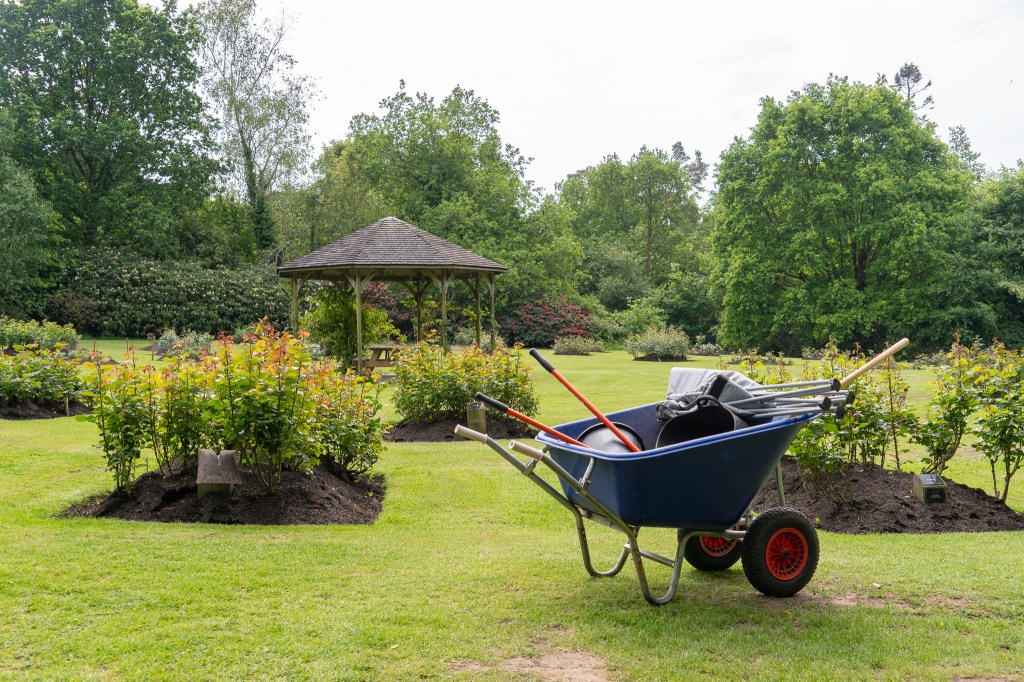
While mechanisation has made life easier for gardeners, the tools of the trade in the rose garden haven’t changed much over the decades. Here, elbow grease, skill, stamina and dedication are the main requirements.
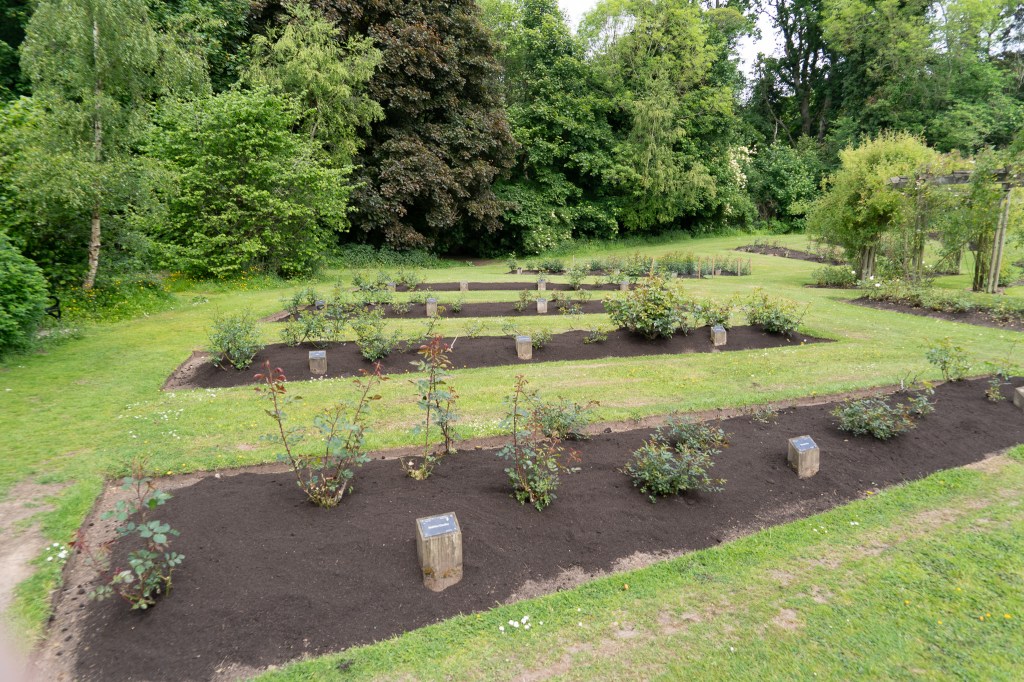
Mulching complete. The grass around the beds showing the wear and tear of work boots. Time for reseeding.
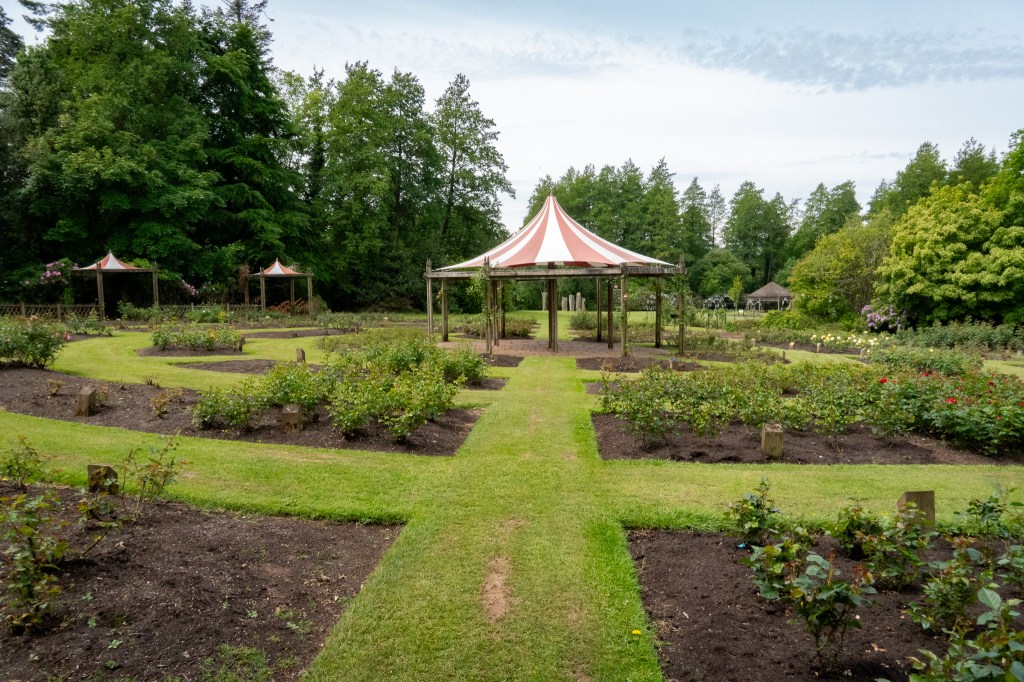
Soon the green foliage will be lost among a blanket of colour.
Rotation of beds. Visiting the rose gardens year after year, it appears to the untrained eye that the layout of the beds remains unchanged. However, every September 30 beds are seeded over with grass seed and 30 new ones created as part of a 5 year rotation scheme. This means that no roses are growing in the same soil for more than 5 years. This optimises nutrient availability and minimises risk from disease. This is a specialised job that requires exacting skills in measuring and marking out to ensure the symmetry of the gardens is unaffected.
Pest Control. A big part of summer maintenance is keeping on top of diseases and pests. While horticultural expertise is employed to tackle disease, there is a less obvious challenge for the team of gardeners who look after the roses. Rabbits!
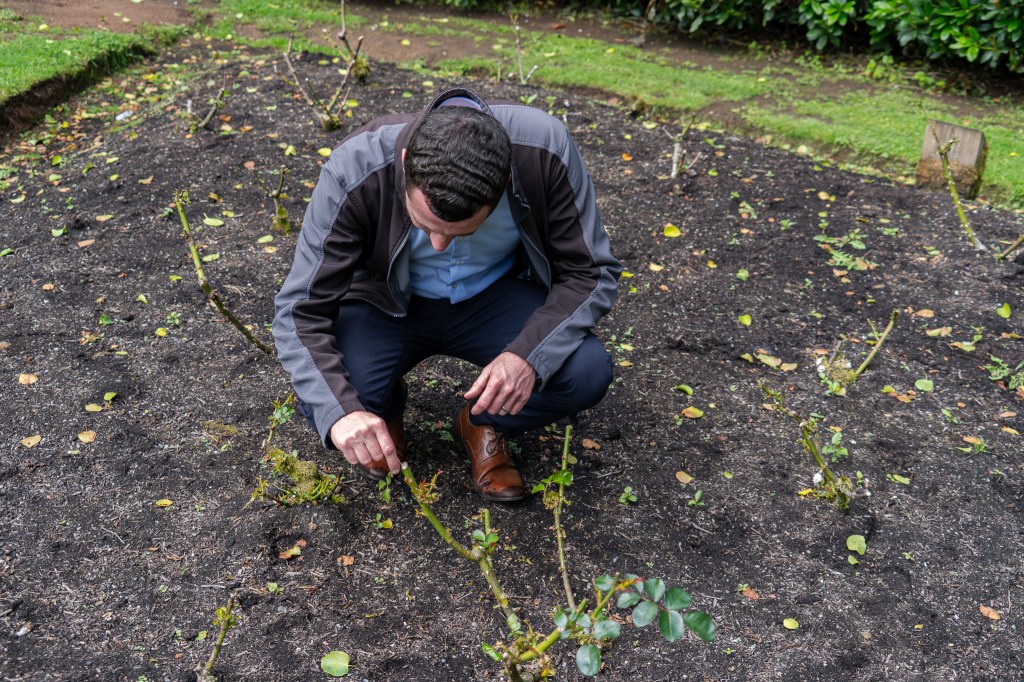
Diarmaid, the manager responsible for the rose gardens, surveys the scant remains of what would have been a bed of roses.
It seems the pesky bunnies love nothing more than a feast of fresh young leaves of the rose variety. Controlling the rabbit population is not an exact science and any methods that result in their demise could be controversial. It’s a considerable challenge because the hedges and shrubs that act as an effective wind break for the roses, also provide a convenient cover from where the rabbits launch their attacks.
Timing is everything. We are all too aware of the impact of climate change and how it affects plants and flowers. Early blooms caused by mild winters. Flowers killed by late frosts etc. Roses are no different and this is an ever present concern for the team at Lady Dixon. Their year’s work culminates in a single weekend in July. Imagine how demoralising it would be to have the roses bloom a month before Rose Fair and for the thousands of visitors to miss the spectacle. This year’s Rose Fair was brought forward by a fortnight and that decision paid off. While there will always be many early or late blooms, the gardens were in prime condition for the public to enjoy.
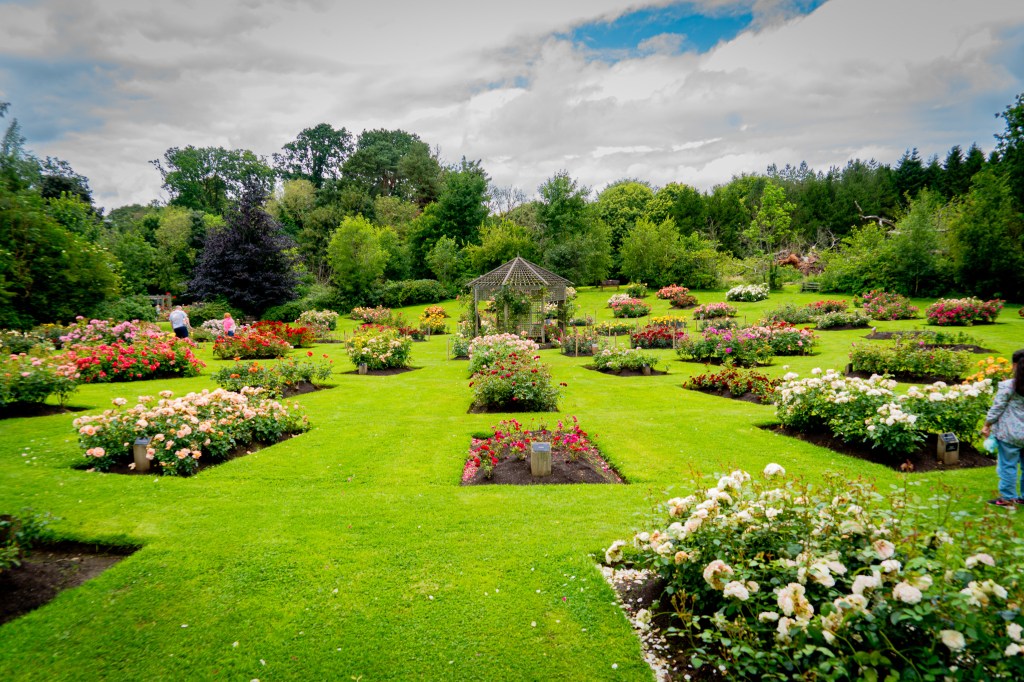
A treat for the senses. Vibrant colours and heady scents were the order of the day at the Rose Fair.
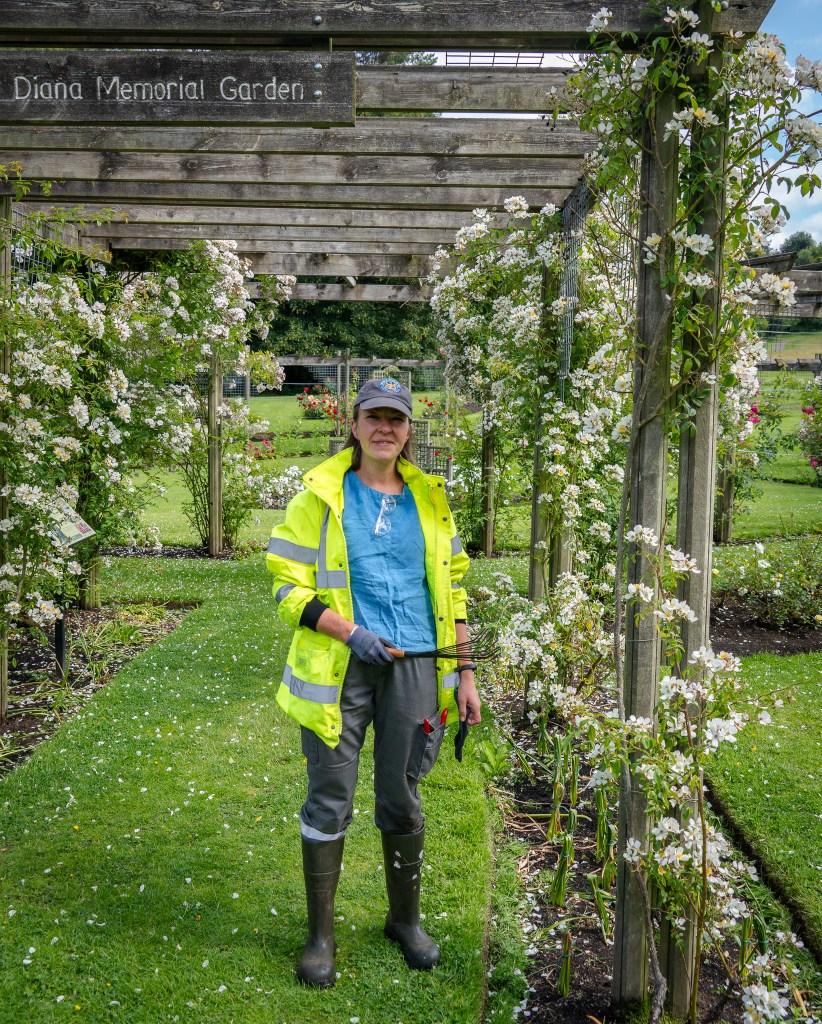
Michaela, who tends the Diana Memorial Garden. The rose arch was in full bloom two weeks before the Rose Fair but still looked great on the day. She has worked all over Europe and the UK but says this is her dream job.

Orlaith, getting to grips with the weeds a couple of weeks before the Rose Fair. It’s a relentless battle and one not always appreciated by us casual observers.

A carpet of petals adds to the sense of occasion.
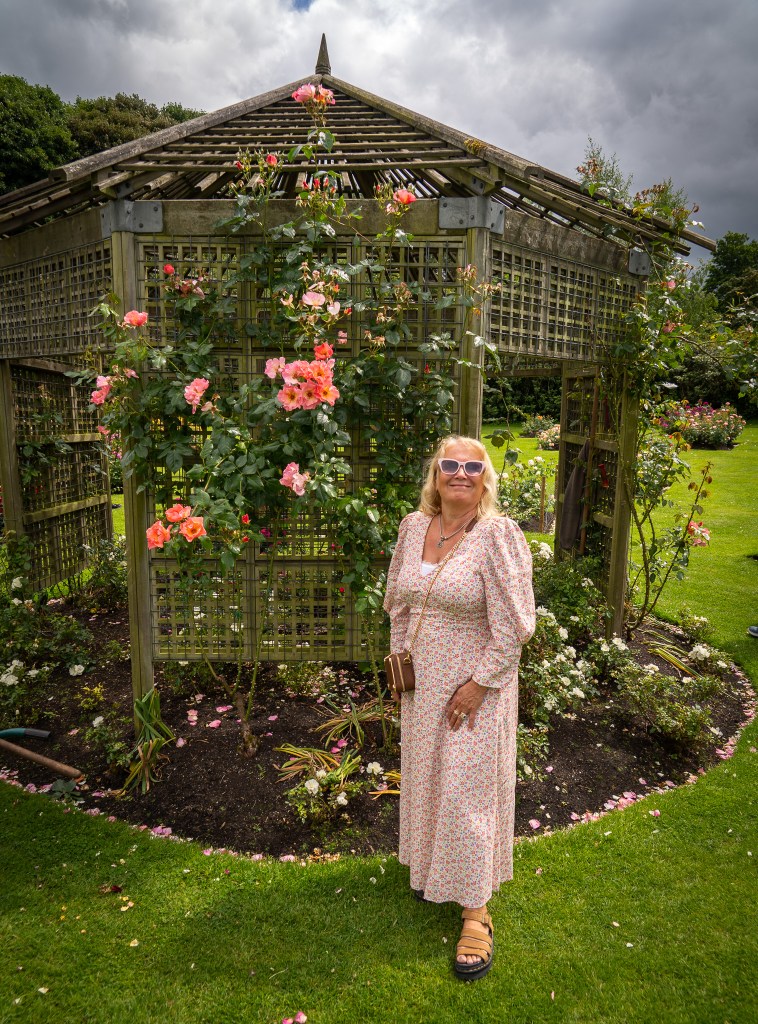
A Rosie among the roses. Enjoying Rose Fair and blending in nicely.
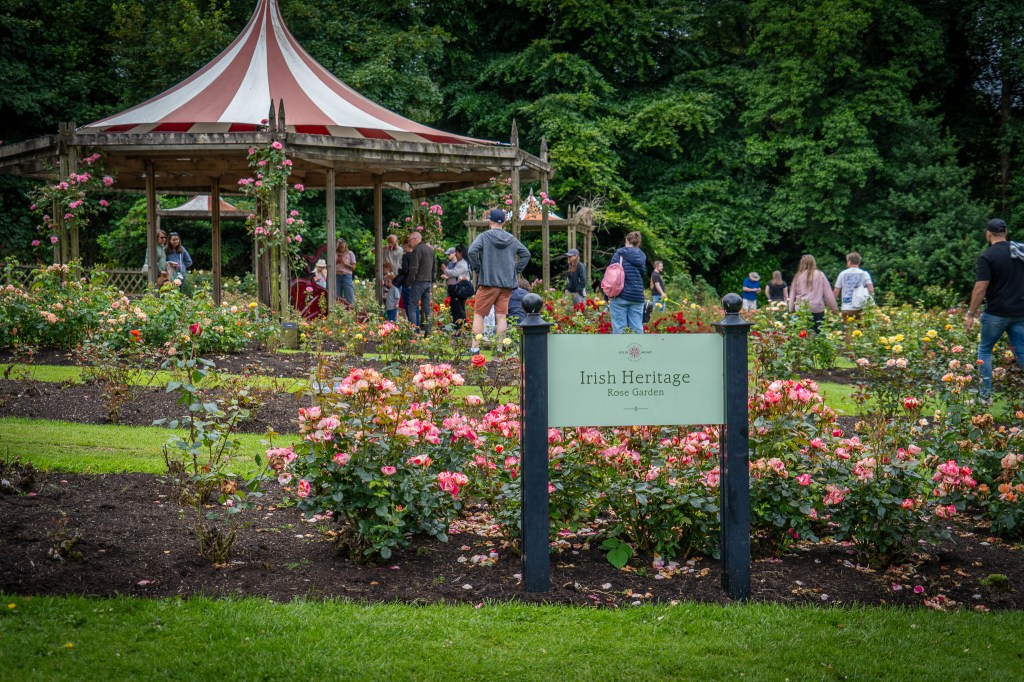

A bit of culture in the Irish Heritage Garden. There’s something about ‘Danny Boy’ when it’s played in such a setting.
A rose by any other name. I always considered roses old fashioned. Maybe that’s why in my latter years, I have developed an appreciation for them. Or maybe only a mature mind can truly ‘see’ them. For me, the complexity of their structure is what captures my attention initially, followed by their colour and scent. A few of my favourites (in addition to White Gold above)…
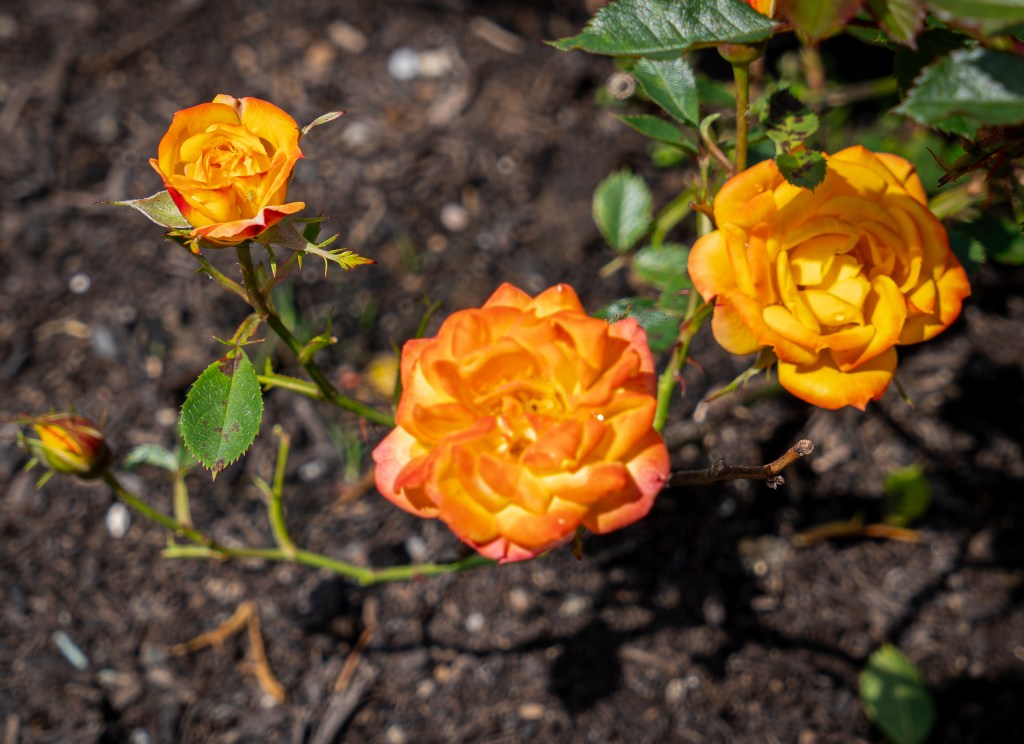
Irish Eyes, whose colours evolve as the petals develop.

Summer of Love, which reminded me of Clove Rock, the hard boiled sweets that kept a generation of dentists in a job.
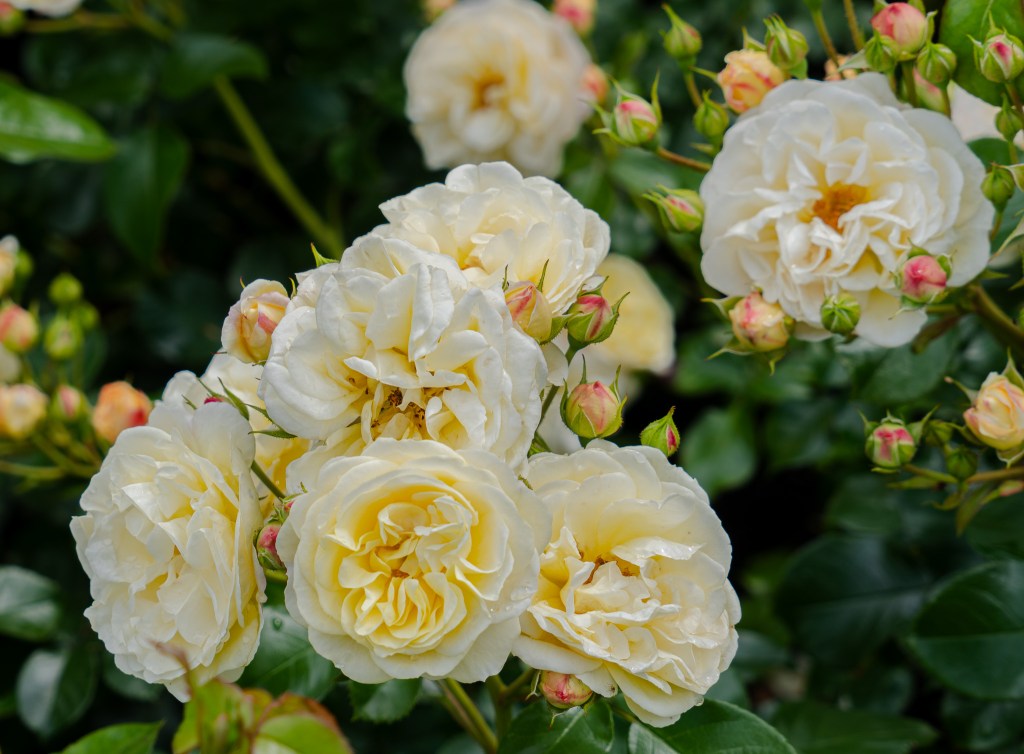
Light Fantastic. It just yells ‘Summer’.

Honey Bee Mine. A big hit this year with gardeners and visitors alike. And of course, bees!

The fragrant section is an assault on the senses and will evoke different memories for different people.
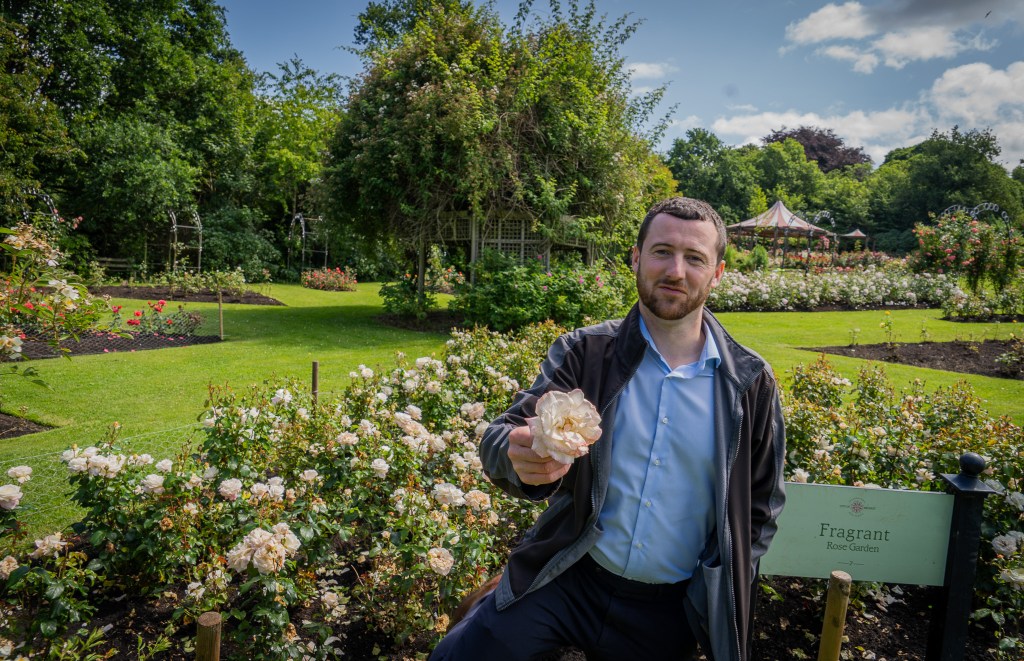
A rare photo of the main man, Diarmaid, serving up a fragrant treat. I’m not sure what the name of this rose was but i think its official score was 8.5 out of 10.
Diarmaid, 35 years old, began his horticultural career 19 years ago as an apprentice gardener. I asked him about any changes that he had noticed over the years and what he considers the main challenges ahead? He explained that many of the roses, especially from mainland Europe, are grown from cuttings instead of traditional propagation methods where buds are grafted onto an established root stock. The combination of the newer method and selective breeding to make roses disease resistant have had two regrettable consequences. The roses don’t live as long and their scent is diluted.
The Summer Rose Fair has reached a pivotal point in its history. Due to the impact of Brexit-related difficulties, such as increased compliance documentation for plant imports, there has been a dramatic decrease in the variety and quantity of roses coming from Europe. As Diarmaid explains, there are still European entries for the International Rose Trials, which are an integral part of the rose garden. Growers from all over Europe are still keen to achieve recognition and reward for their roses but they only send small numbers for the judges to consider. Post competition, they are reluctant to export in bulk.
In addition to the European issue, he explained that the supply of roses from domestic growers on the island of Ireland is in a precarious position. There is one major grower in the North and one in the South. Due to retirement and a lack of successors, this source of roses is also at risk of disappearing.
COVID arguably posed the biggest threat to the existence of the rose gardens. Staff absence and changes in working practices, as well as attitudes to work, presented unprecedented challenges. There is currently one gardener per rose garden but for a protracted period of months in 2020, the roses were tended by one gardener-Diarmaid. For him this meant pruning over 20,000 rose bushes with an average of 10 cuts per plant. Yes, 200,000 cuts! An impossible expectation and unsustainable situation and one which almost forced him to reconsider his career. His exceptional work ethic and pride in his job prevailed and he now manages a fantastic team who are dedicated to their craft and the preservation of the rose gardens. If the demise of the rose gardens at Lady Dixon is brought about by a lack of growers/suppliers, it will be an unfortunate outcome for him and his colleagues whose commitment and passion have maintained this jewel on the edge of Belfast that thousands of its citizens enjoy every year.
Thank you to all the team who took time to talk to me over the last few weeks. You are a credit to yourselves and the people of Belfast. And a special thanks to Diarmaid for sacrificing his lunch break to share his knowledge with me. If there are any inaccuracies in this piece, you can be sure they are a result of my poor listening skills. I should also declare at this stage that he probably felt that he didn’t have any choice but to cooperate. You see, I have known him for all of his 35 years because he is my son! Nice one, Bernard (private joke).

 Bleeding Dove