Girona

Time of visit. October 2025.

The city of Girona (also known as Gerona) is the province of Girona’s capital. Population, 106,000 (2024). It is located 60 miles northeast of Barcelona, which equates to 1 hour 20 minutes by car or just 40 minutes by high-speed train. The city has 2 main rivers; the Ter, which flows through the north of the city and the Onyar, which flows south to north. Girona’s strategic location, with France to the north and Barcelona to the south, accounts for its long and turbulent history, too detailed to recount here but if you’re interested, you can follow the link, https://en.wikipedia.org/wiki/Girona#History.

Girona. A city with grit, as well as a certain charm.

To be honest, as our bus pulled into the car park on the edge of town, my first glimpse of Girona left me underwhelmed. The eclectic mixture of architectural styles gave the impression of a place that had grown in fits and starts, with minimal thought given to continuity of profile. But I quickly reminded myself that this was no quaint village with a population of a couple of thousand souls. Today’s city is the sum of over 2,000 years of development, or to be more precise, turmoil, siege and conquest. Girona has seen no less than 25 sieges in its time. No wonder then, that what the visitor sees today is the result of buildings and structures built out of necessity for survival; the need to please future visitors with an attractive façade was not at the top of anyone’s list of priorities. Don’t get me wrong. Girona is home to some jaw dropping architecture and parts of the old town ooze character but in parts in seemed dark, almost ominous. Maybe some of my photos will translate my thoughts a bit more clearly.

Giant stone steps in unexpected places and dark archways punctuate the warren of narrow streets.

Brighter streets on the periphery. A girl in a red dress providing a striking contrast.

There is something intriguing about photographing strangers. Their anonymity creates mystery, despite just being ordinary people going about their daily business.

Climbing the steps through the almost oppressive atmosphere of the dark streets, something struck me. In autumn and winter, the sun sits lower in the sky and never reaches the narrow passages of Girona’s old town. There were reasons that towns were built in this way, the most obvious being defensive considerations. For example, a narrow street can’t accommodate attacking invaders on horseback. Having resolved some of my inner questions, we emerged into the sunny upper reaches of the old town and made our way up onto the city walls. Girona from this vantage point takes on a new persona. The spires of its cathedral and churches, the stone walls and tall, slender cypress trees swaying in the breeze give the city that romantic medieval look that appeals to the tourist in search of something inspiring. And to photographers in pursuit of a captivating shot!

A view from the city walls of the Catedral de Santa María.

The city walls provide a bird’s eye view of Girona but the climb can be challenging in parts.

Cyclists resting on the steps (90 in total) of Girona cathedral. The city is a favourite of cyclists and some famous proponents of the sport, such as Lance Armstrong, have lived there.

Crossing the river Onyar takes you to the flatter and more modern side of the city. The first thing you notice is the striking colours of the facade of the houses flanking the river. These are known as the ‘Onyar Houses’ and are synonymous with today’s Girona. The idea for the multicoloured scheme was devised by local artists Enric Ansesa and James J. Faixó. The palette of 29 colours represents the transition from the Franco dictatorship (which ended in 1975) to a brighter future. The restoration of the facades, including the addition of colour, was realised in 1982. One of the houses is known as Casa Maso, birthplace of the architect Rafael Masó í Valelentí.

The Onyar houses provide a colourful contrast to the rest of Girona. The vibrancy of the colours vary with the time of day and the position of the sun.

Crossing over one of several bridges took us to the most modern part of the city where the main attraction is the Plaza de la Independencia. The plaza is a porticoed square with a central monument dedicated to the defenders of the city during the sieges of 1808 and 1809 during the war for Spanish independence.

Plaza de la Independencia.

Girona is definitely worth a visit for a couple of hours but what you get out of it depends on what you are looking for. It is a working city with all the shops, businesses, offices etc. that you expect to find in any city. The historical architecture in the old town is impressive and the colourful houses standing on the banks of the Onyar are eye catching. If history is your thing, then you could probably spend days here. But there is an underlying feeling that you are in a place that has underinvested in catering for visitors. One small but important illustration of this is the lack of public toilets. We found only two and one of them was out of order. Yes, you can always go and buy a coffee and use the facilities while you’re there but it’s not an ideal solution. It may be that the city has prioritised expenditure elsewhere but there are definitely improvements to be made. I don’t want to end on a negative though. While we were slightly underwhelmed by Girona, it is important to consider the context. We visited 5 locations on this trip and places like Collioure, Pals and Cadaqués set a very high bar and left Girona in their shadow. Would I revisit? Probably not but glad I experienced it.
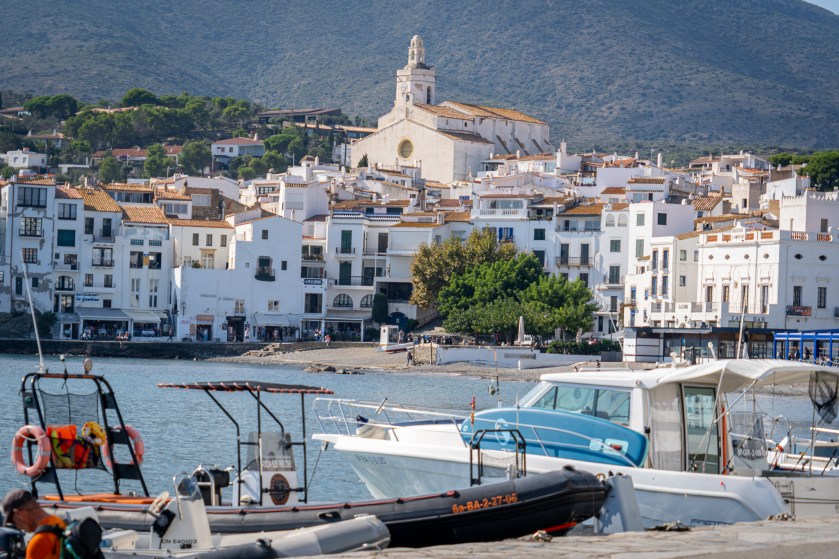
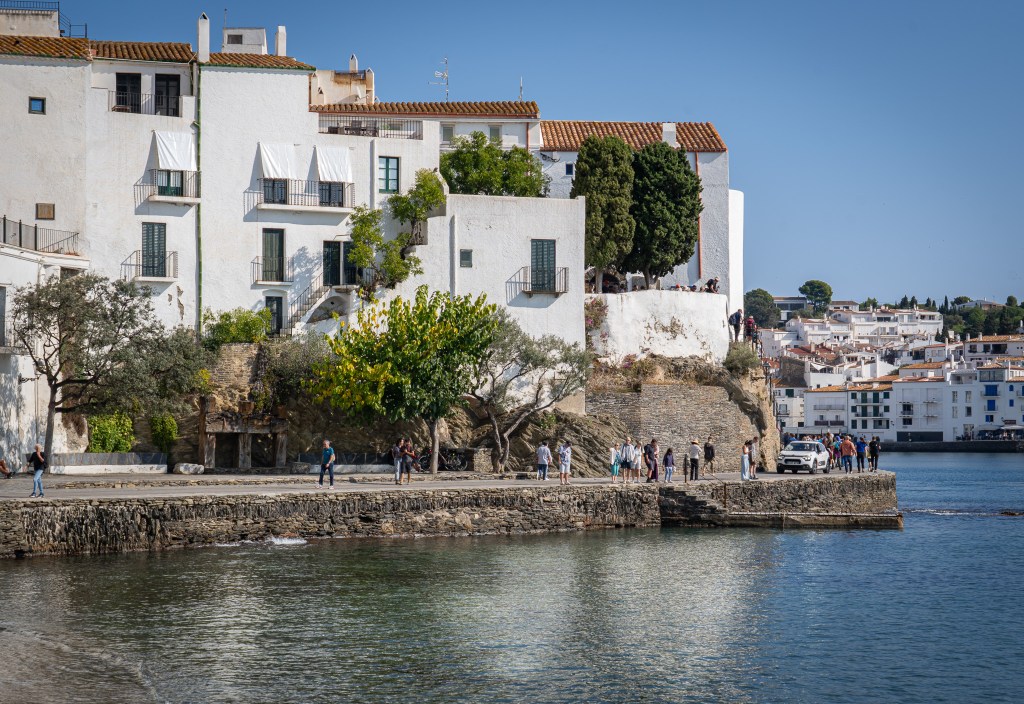
Cadaqués. The Gift of the Costa Brava.

Time of visit: October 2025

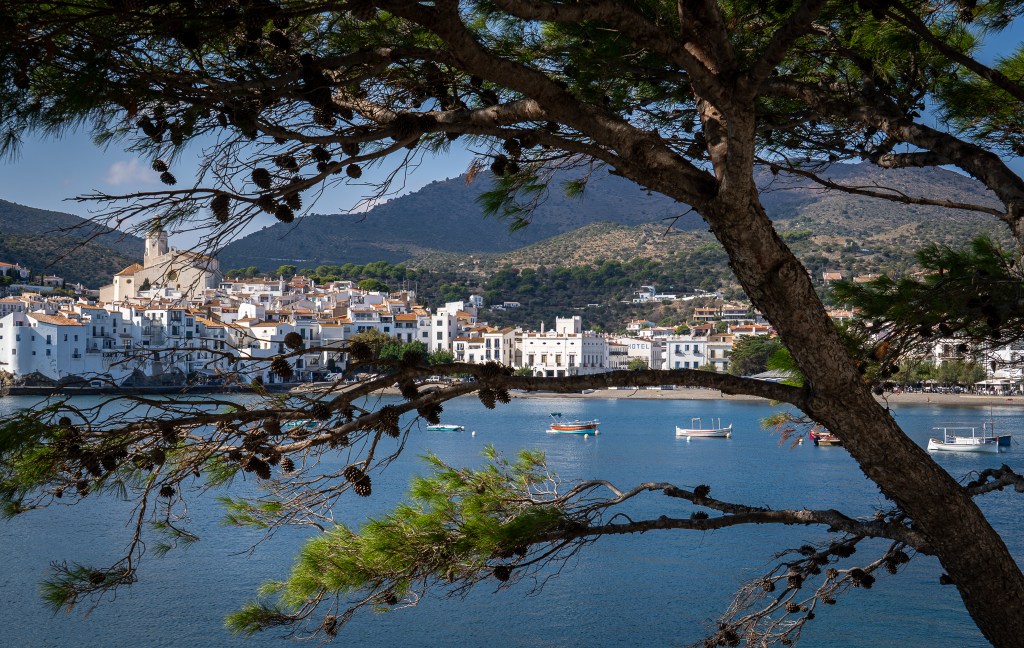
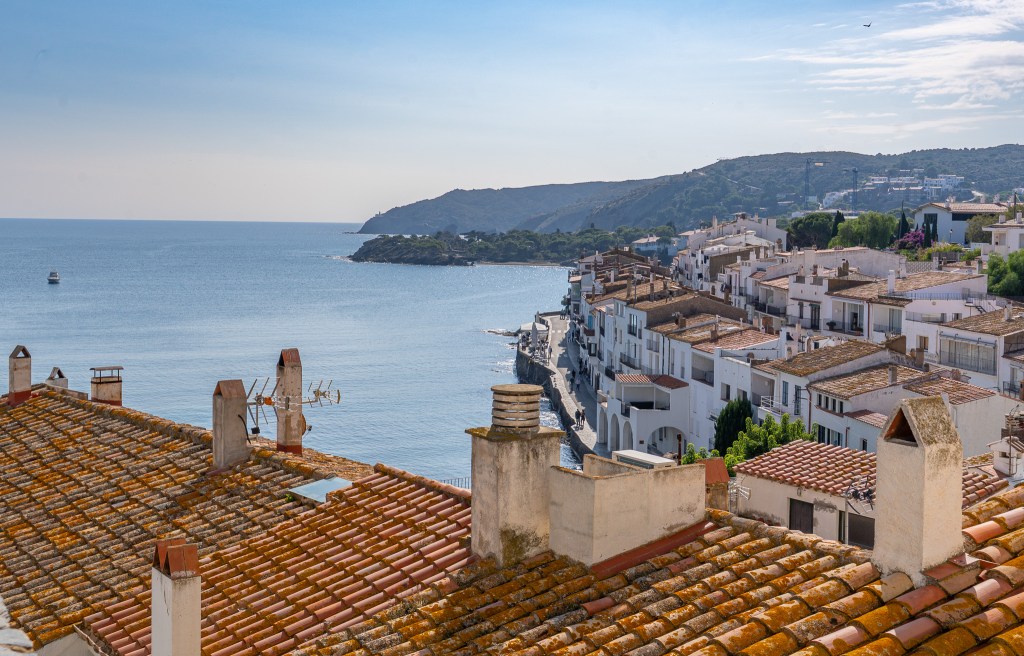
The seafront of Cadaqués. The buildings use nature’s best foundation, solid rock.

View from across the bay.

The best way to enjoy this overview of the town is to walk along the seafront. Or if you have the time, take a boat tour and savour a unique view from the sea.

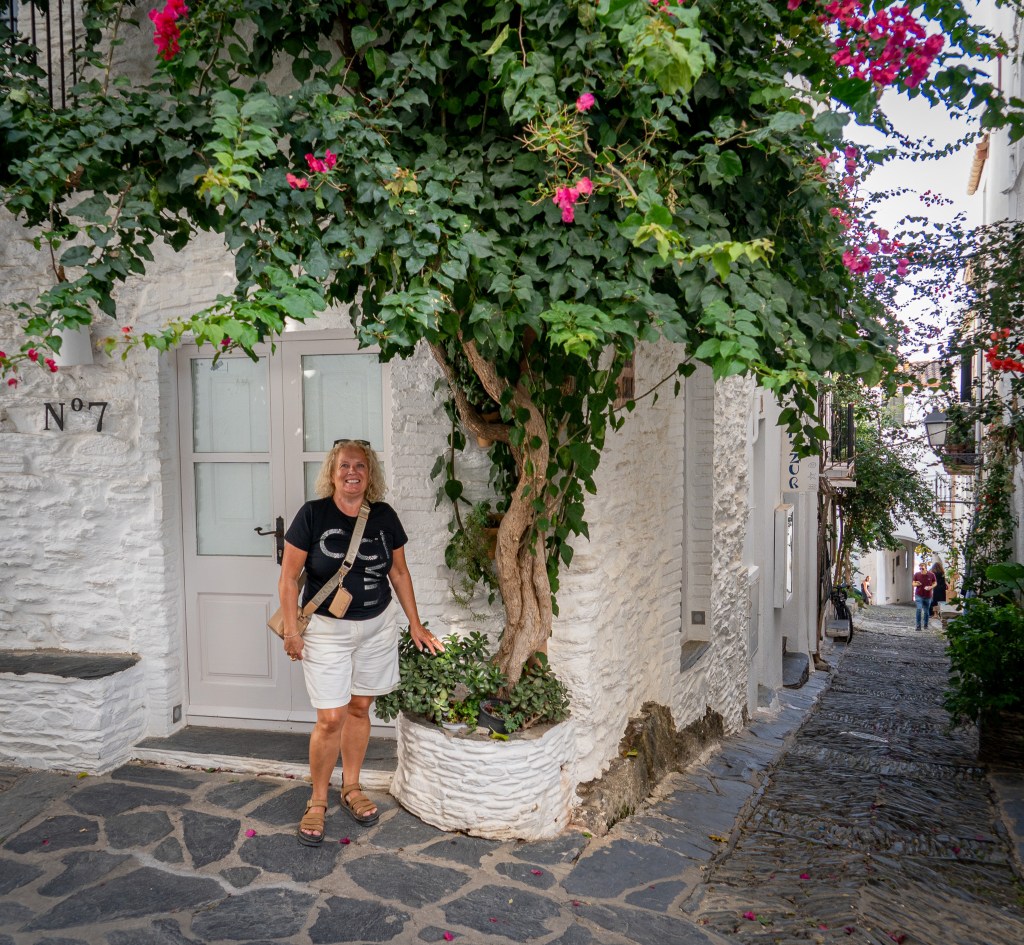
Street charm in Cadaqués.

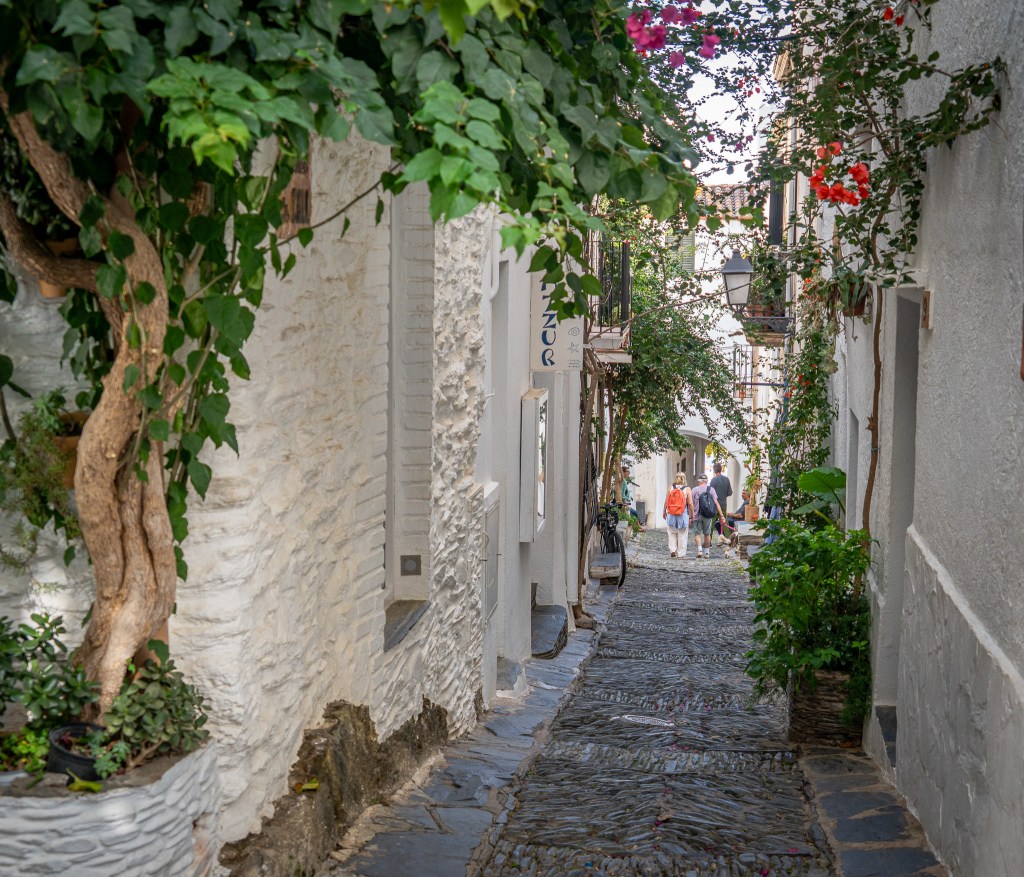
Heading inland, the narrow streets immediately take on an upward trajectory. Underfoot is a mixture of irregular shaped stone paving and small flat stones that have been embedded on their edge to provide extra grip. Navigating the town is best done by following a general rule of thumb, ‘keep climbing until you reach the top’. If you head downhill, you will end up at the harbour.

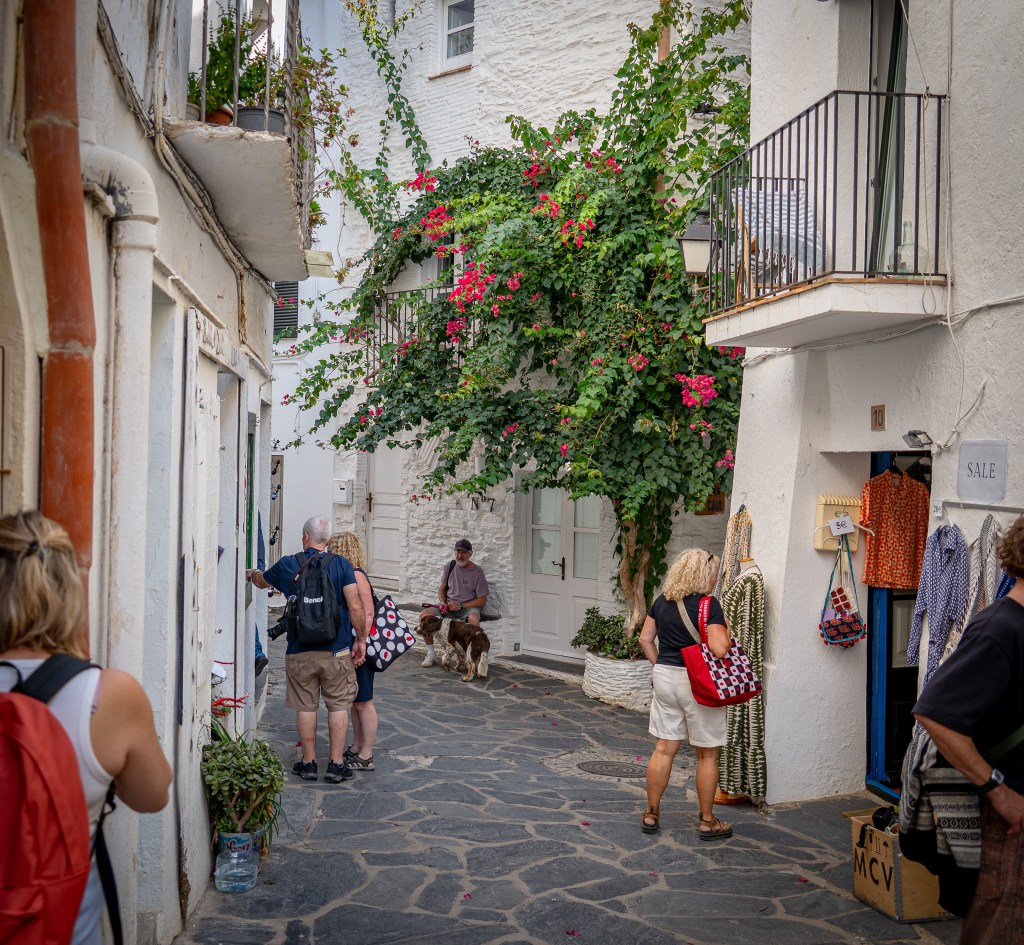
Small shops blend in with the adjoining houses.

The streets of Cadaqués are similar to many other Spanish towns and villages-whitewashed and winding, with wrought iron balconies draped with colourful splashes of bougainvillea and geraniums. The occasional shop appears every now and then, discreetly blending in with the house next door, differentiated by local handicrafts hanging at the entrance.

Bougainvillea adding colour and life to the stone.

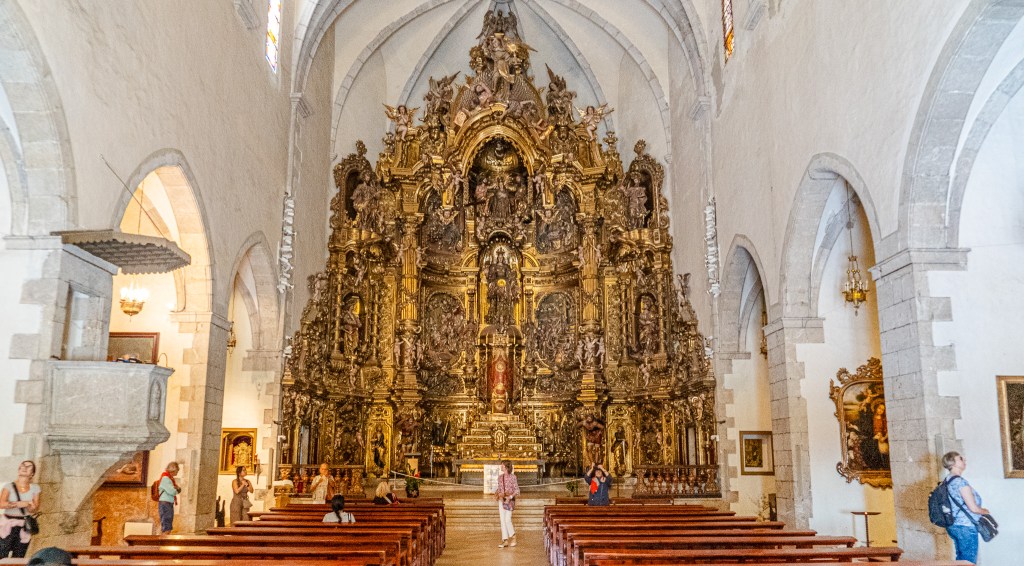
A short time after starting our ascent, we were at the church of Santa Maria. There is no grand approach, just another turn at the end of another narrow street and we were in the small plaza outside the church. A musician sitting on a bench playing classical guitar added an extra layer of serenity to the place. And looking down over the rooftops at the sun glinting on the Mediterranean, completed a very Catalonian experience.

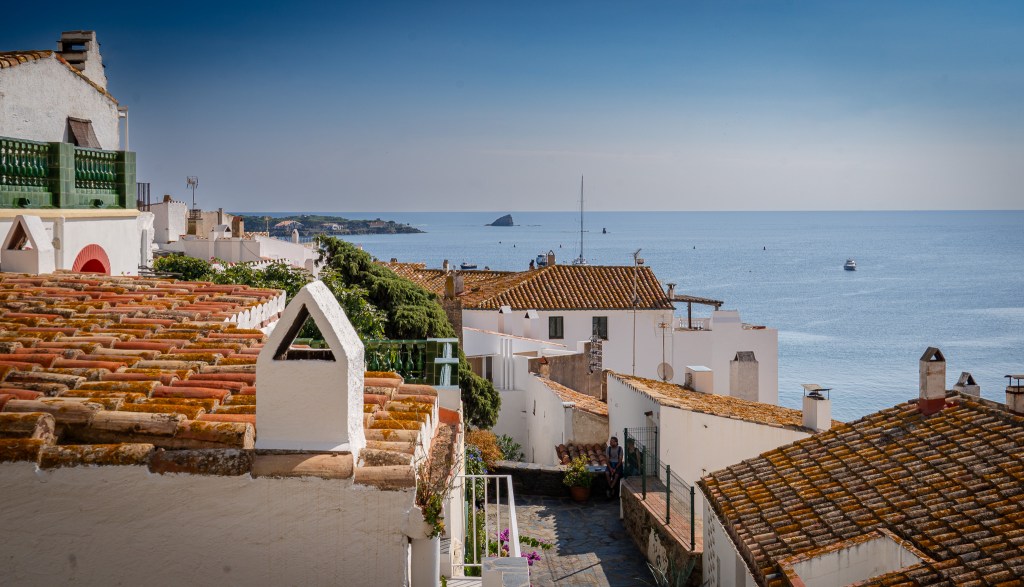
View from the plaza at the church of Santa Maria.

The rooftops of Cadaqués.

The church of Santa Maria.

The biggest surprise for me about Cadaqués was that I had never heard of it. And I haven’t met anyone else who was familiar with it either. It really is the best kept secret on the Costa Brava. I read an article about the town in a magazine called ‘Tapas’. It contained the following quote,
Be careful, lest you get caught by the tramuntana. Be careful, many people arrive for three days and stay for years. Be careful, lest you fall in love with Cadaqués”.

The Tramuntana is a strong north-westerly wind that blows through Cadaqués. And whether the wind blows you here or you arrive in a more conventional way, don’t be surprised if you want to stay for just a while longer..

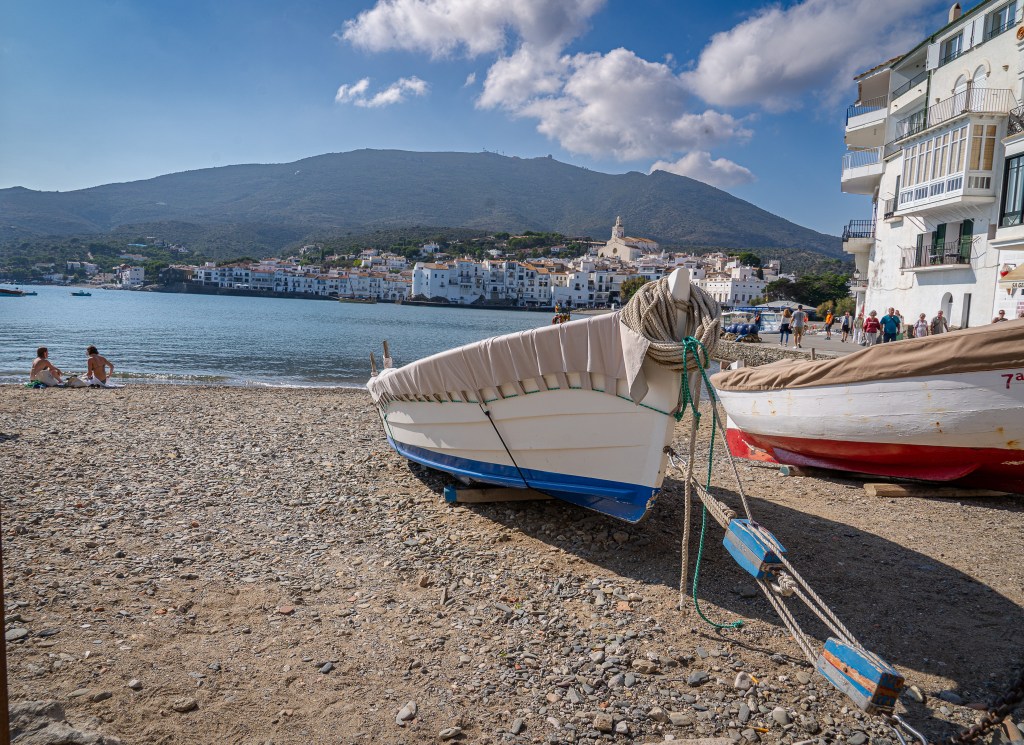
Summer beach vibes in October.

A place for everything and everything in its place.

Thanks for reading this far. If you’re interested, stay with me to read about Cadaqués’s most famous son, Salvador Dalí.

Cadaqués has a special place in art history and was a favourite of several famous names in the art world.

Marcel Duchamp, the French American artist and pioneer of the Avant Garde movement in America and New York in particular, spent time here.

Federico Garcia Lorca, Spanish poet and playwright who was assassinated by Francoists during the Spanish Civil War, was another well-known visitor, as was Picasso.

But Cadaqués’s most famous artist son is the surrealist, Salvador Dalí. His house is in Port Lligat bay on the outskirts of the town. His parents had a house nearby when Dalí was growing up and he spent his summers here. His childhood friends included future F.C. Barcelona footballers Emili Sagi-Barba and Josep Samitier. And during holidays here, the trio played football together. I was intrigued to discover that Lorca, the poet mentioned above, and Dalí had also been friends and I wondered how Dalí reconciled this friendship with his controversial support for the Franco regime.

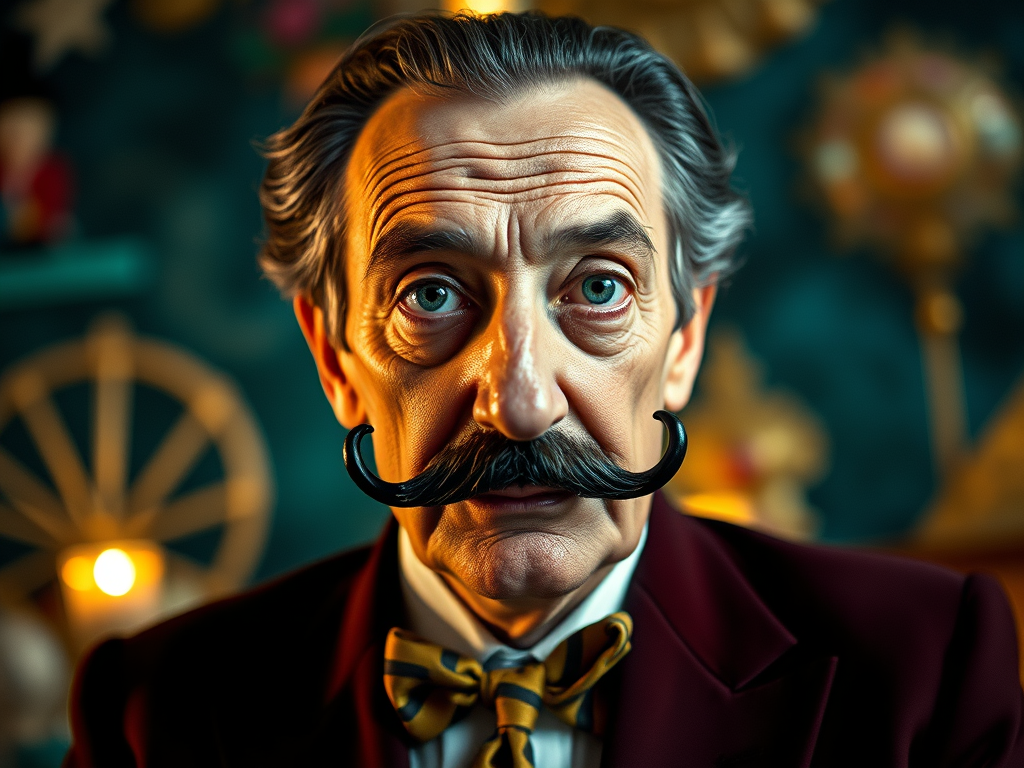
Salvador Dalí, surrealist painter. Controversial, eccentric, unique.

 It was in the Port Lligat house, in 1931, that he created one of his most iconic paintings, The Persistence of Memory. The painting depicts clocks or watches that appear to be melting, inferring that time is fluid. One analyst wrote that Dalí was projecting his view of the world according to Einstein’s theory of special relativity (the relationship between space and time). When asked about this, Dali replied that his inspiration was the surrealist perception of Camembert cheese melting in the sun! The painting has resided in the MoMA in New York City since 1934.

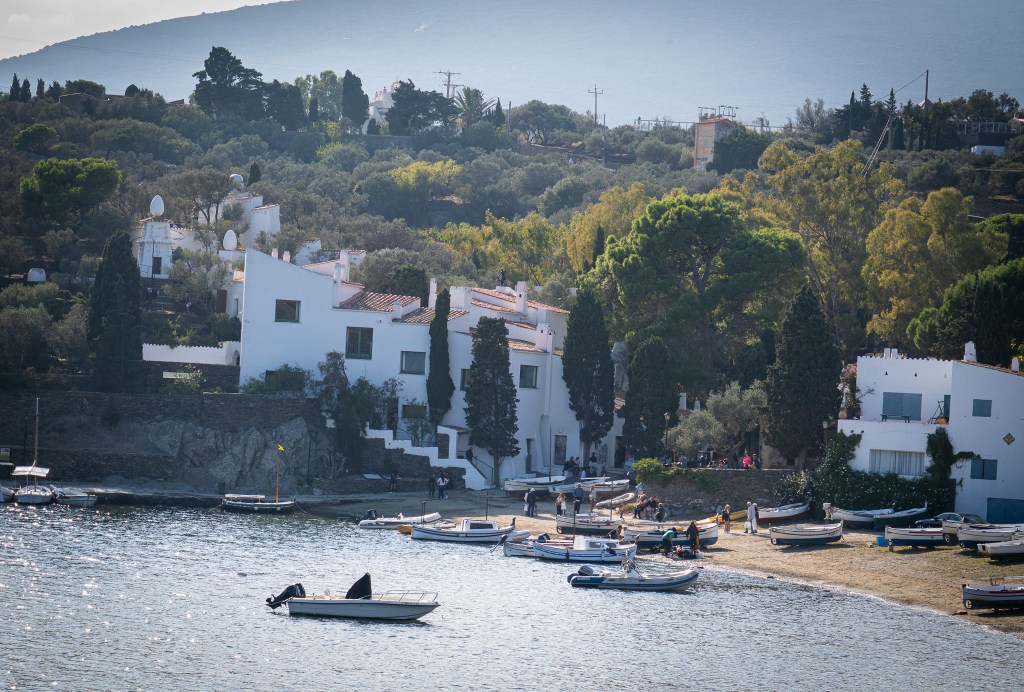
The location of Dalí’s house in Lligat Bay. Picturesque and serene.

His house is now a museum but Dali’s abstract interpretation of the world is not something that is to my taste (or so I thought), so, with our time not being as fluid as his, a visit was ruled out. We did get a glimpse of his house from the road as we were heading back to town from Lligat Bay and if the exterior is anything to go by, the house may just be worth a visit as a unique experience.

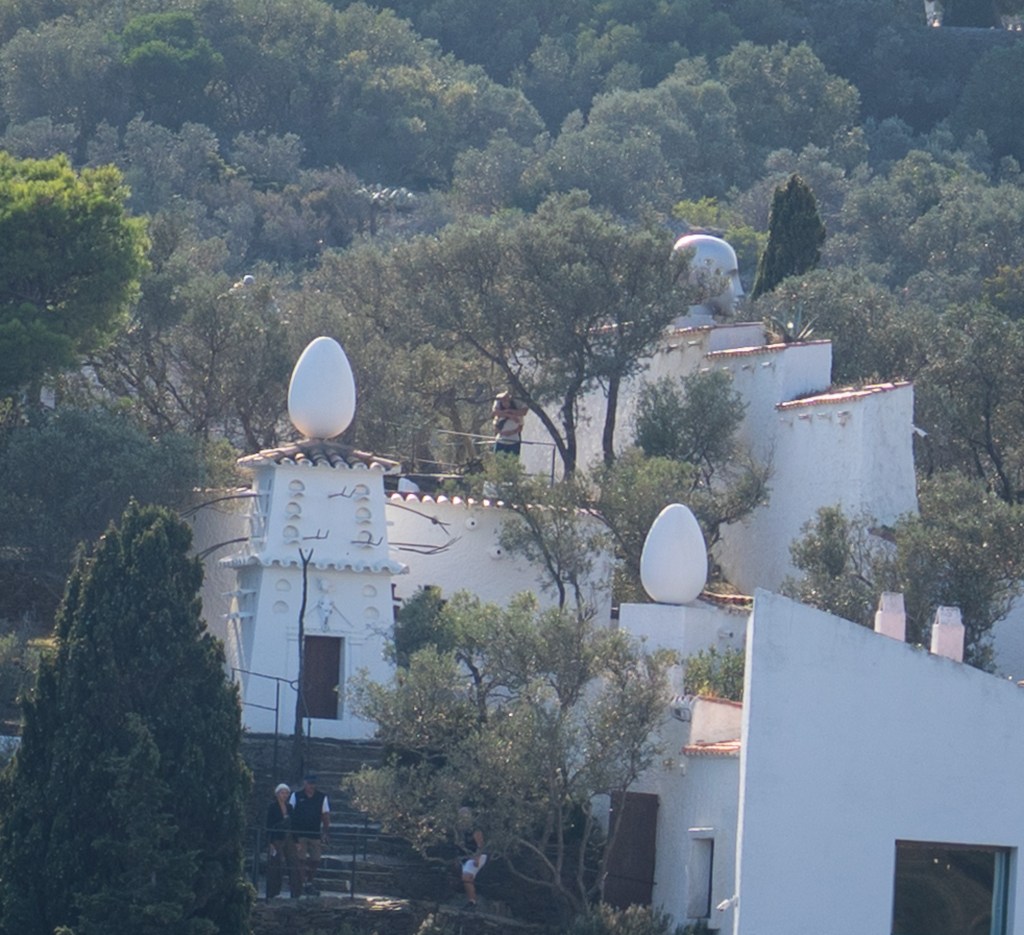
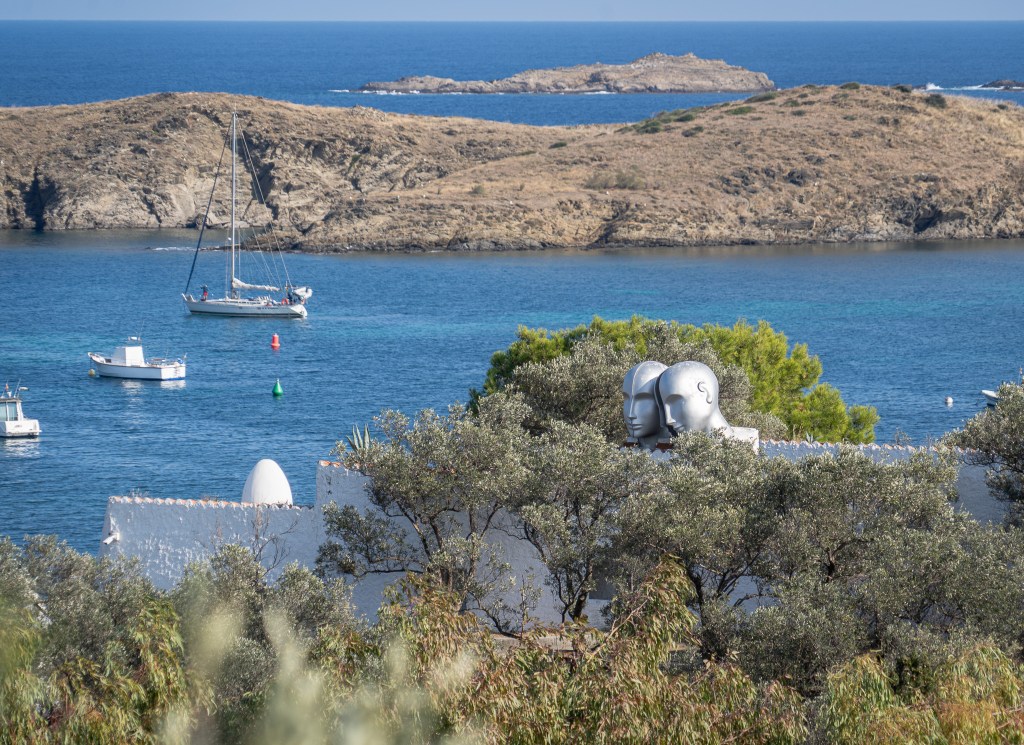
Close up of Dalí’s house, complete with giant eggs and steel heads..

Two heads are better than one. A view from the road overlooking Dali’s house.

As I reach the end of this piece, I find myself having a change of heart. I may have been hasty in dismissing him as just a ‘kooky’ painter. I am no art expert but the more I look at ‘The Persistence of Memory’, the more intrigued I am by the thought process behind his work. He has been described as a self promoting charlatan by some of his contemporaries. Others describe him as a technically brilliant genius. If I ever return to Cadaqués, I think I will pay a visit to the Dalí museum and maybe get an insight into the mind and work of this bizarre genius and hopefully reach my own conclusion.

See you next time..

Collioure. The beauty and the pain.

The French Catalan town of Collioure sits just fifteen miles from the Spanish border. It has a history as colourful as its streets and both the Spanish and French alternately controlled the territory over the centuries. It is part of the Cote Vermeille (Vermilion Coast) overlooking the Mediterranean. Walking through the cobbled streets, browsing the craft shops, the mood is unhurried and welcoming and the locals appear to have a genuine warmth towards the visitor.

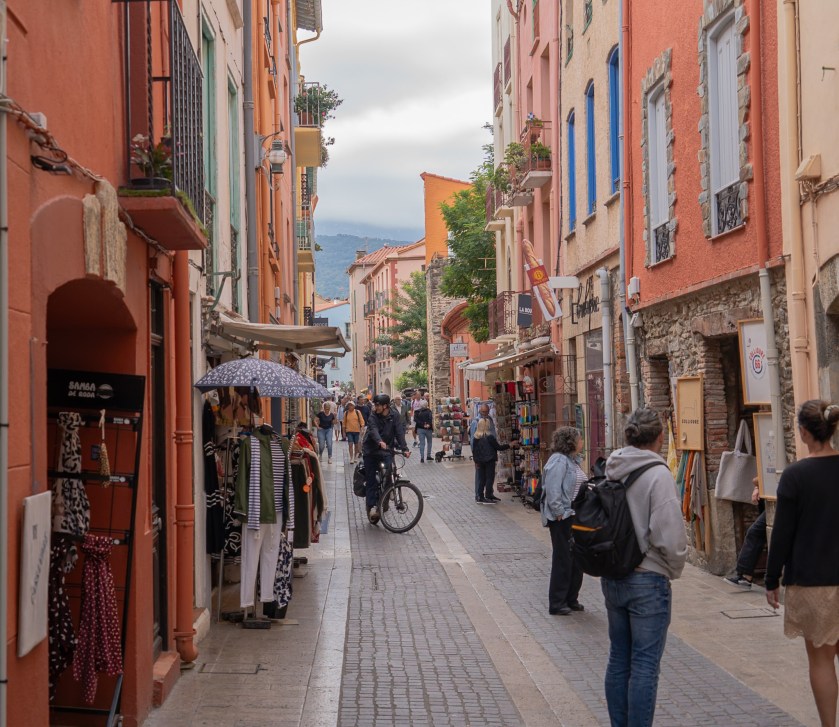
Colourful cobbled streets give Collioure its unique identity.

Although the buildings are colourful, the traditional Catalan architecture displays a prevailing mix of ocre, yellow and blue.

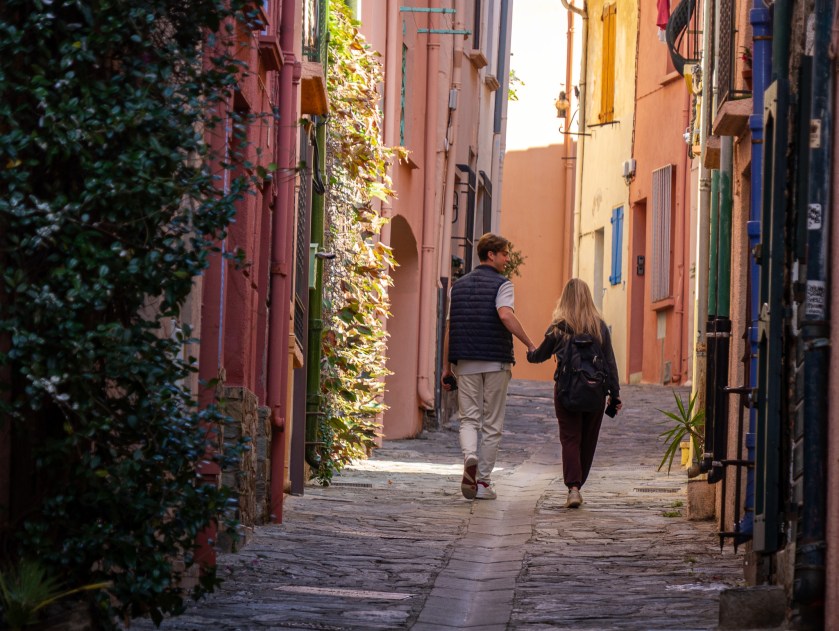
A young couple enjoying a quiet moment.

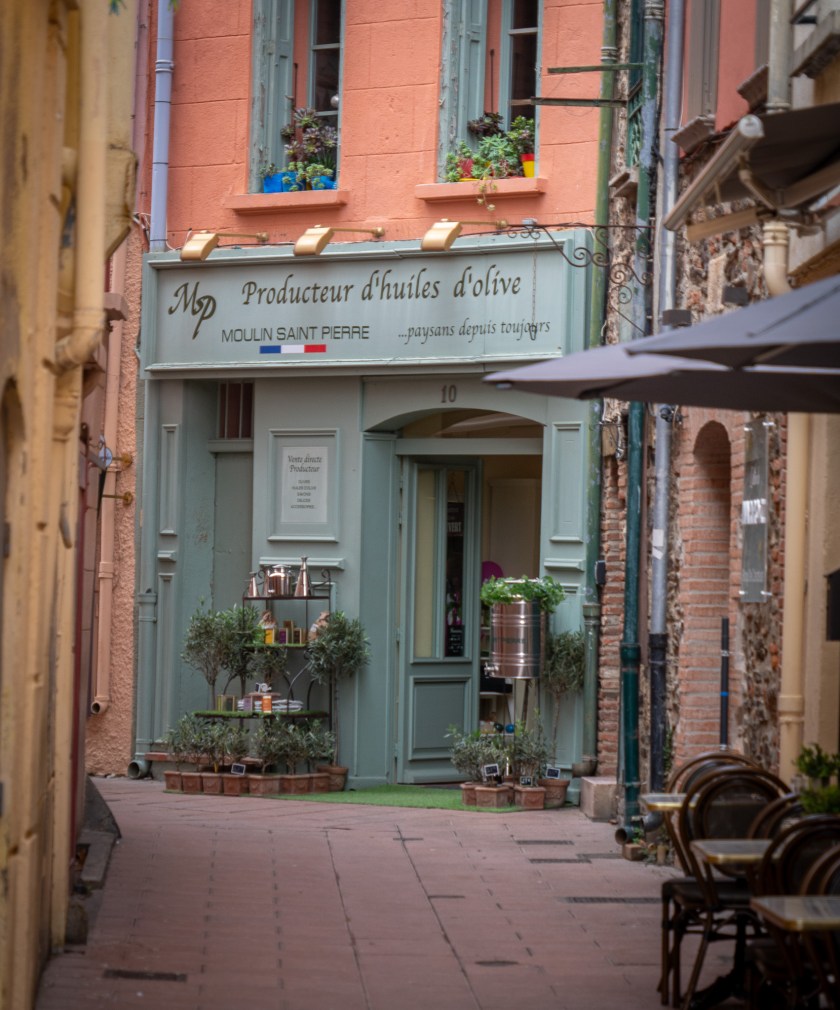
The unassuming charm of the backstreets.

Like all coastal towns, as you move to the seafront, the number of people increase. Understandable when you consider the visual offerings, from historic fortresses and churches to inspiring views of the Mediterranean.

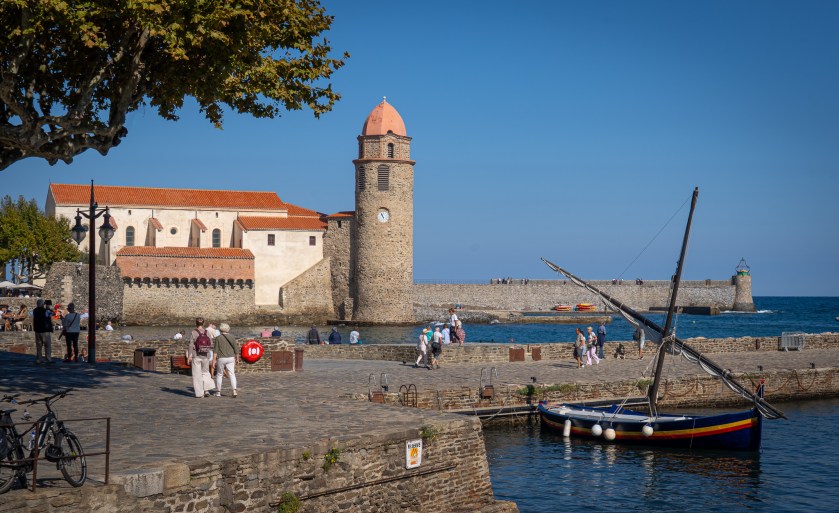
Notre Dame des Anges (Our Lady of the Angels). The bell tower of this 17th century church was once a lighthouse.

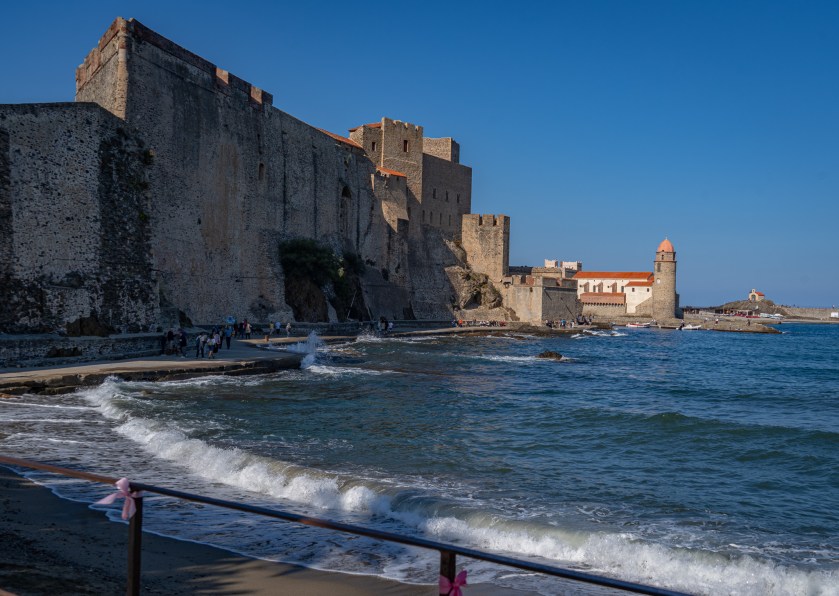
The imposing medieval Chateau Royal de Collioure.

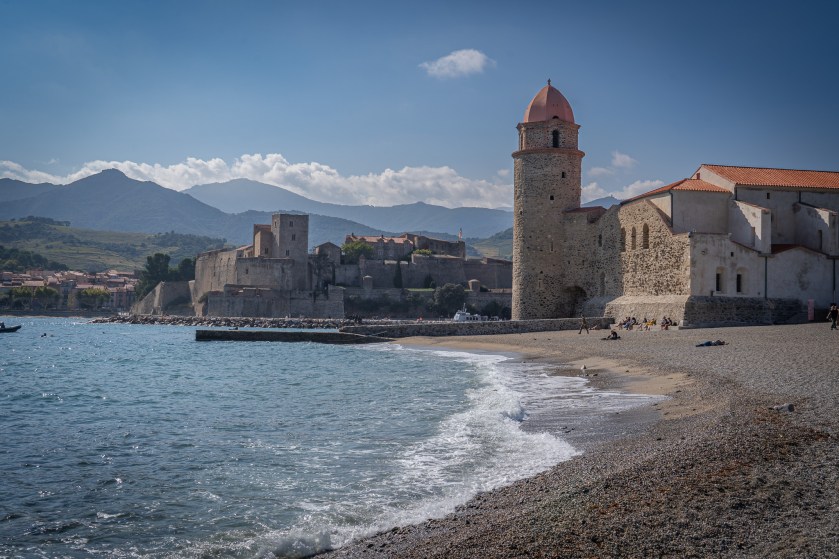
Notre Dame des Anges in the foreground with the Chateau Royal and the mountains behind.

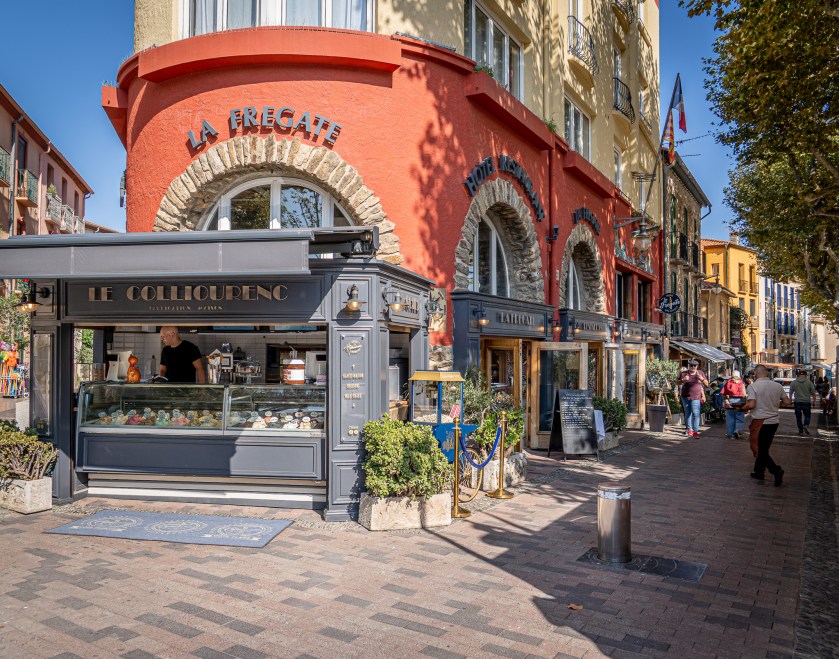
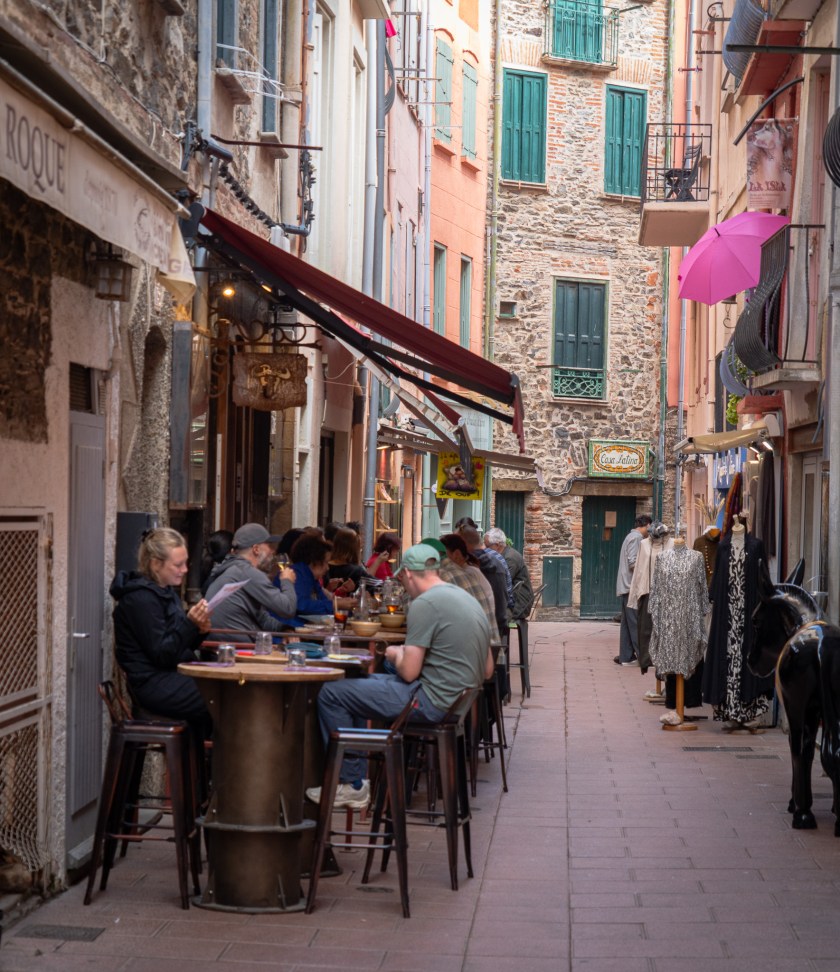
The streets in and around the bay offer food, drink and shade to recharge your energy levels.

Relaxed conviviality is the order of the day.

Collioure is famous for its anchovies. In some of the specialist establishments, you may need to make a reservation, especially for groups.

French charm.

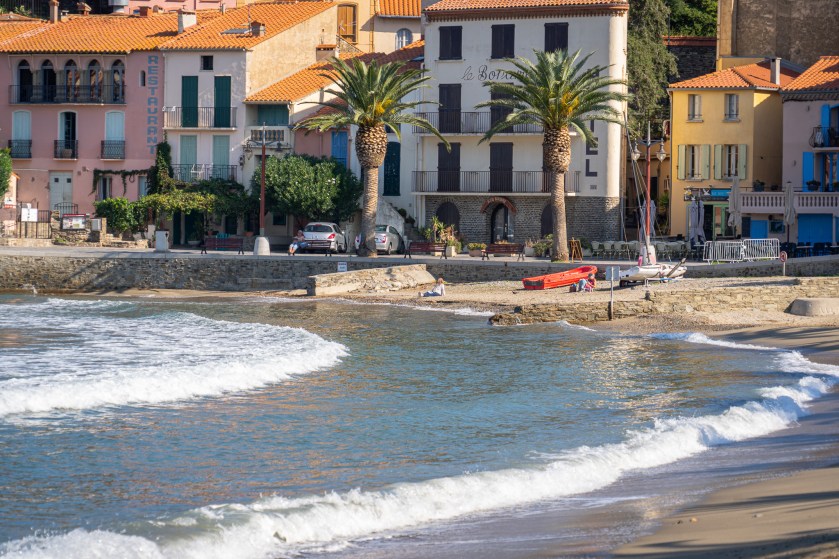
The Collioure seafront, rustic and elegant.

Taking in the views and cooling off in the breeze.

Collioure’s forgotten (or hidden) history.

Collioure is relaxed, inviting and aesthetically pleasing. It is perfect for a day’s sightseeing and the usual tourist activities. Yet you don’t have to look too far to uncover some of its painful past. The town’s proximity to the Spanish border made it a destination for hundreds of thousands of Republican soldiers, their families and those loyal to the republican cause, who fled Barcelona after the city fell to Franco’s forces on January 26 1939. In a matter of weeks, nearly half a million Spanish refugees crossed into France in what became known as ‘La Retirada’ (The Retreat).

During the Spanish Civil War, France, like Britain, had taken a non-intervention approach. This left the democratically elected republican government at the mercy of the fascist forces of Franco who were actively supported by Hitler and Mussolini. Some elements of French government were sympathetic and turned a blind eye when armaments were being brought across the border into Spain to arm the republicans. Yet when it came to receiving Spanish refugees, French authorities separated women, children and the elderly from the men and sent them to various locations throughout France, the men were sent to concentration camps that had been set up on the beaches. Conditions were harsh, with no drinking water or sanitation and as the death rates rose, many were forced to take up the offer of joining the French military or the Foreign Legion. Some returned to Spain were they lived in the mountains, others travelled to Latin America. In a cruel irony, after Germany invaded France in 1940, many Spaniards joined the French Resistance and fought for the liberation of a country that had abandoned them in their hour of need. The first French armoured vehicle that entered liberated Paris in 1944 was driven by a Spaniard.

A poet’s story

‘..Caminante, no hay camino, se hace camino al andar..’

‘..Traveller, there is no path, only the one you make..’

Antonio Machado

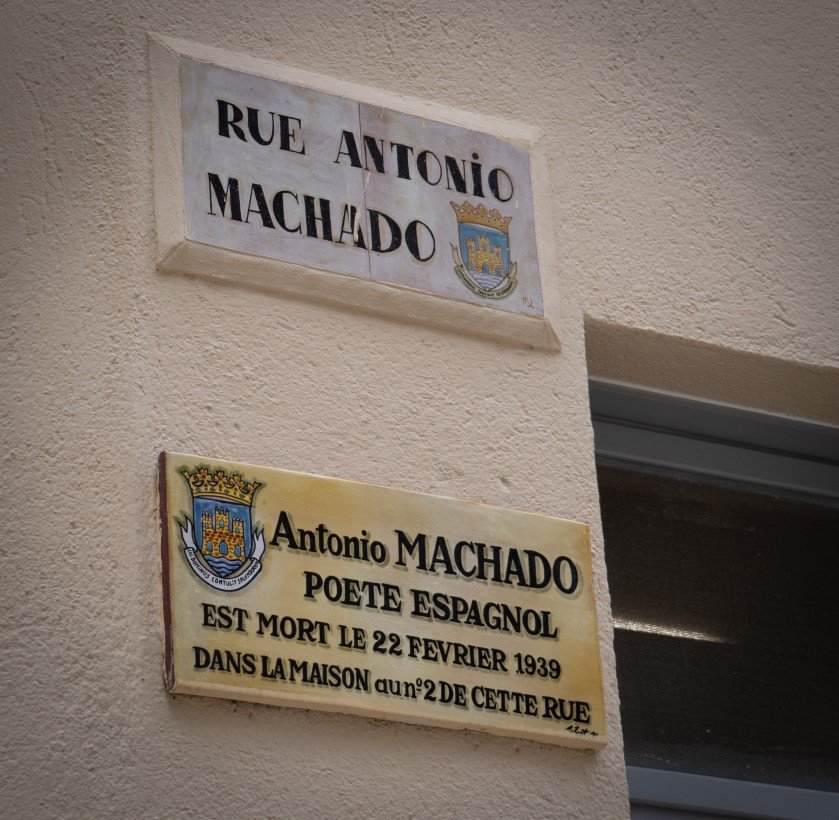
The street that is named in honour of, by consensus, one of the greatest Spanish poets of all time.

I had just finished a book about the Spanish Civil War by Javier Cercas (The Soldiers of Salamis) when my wife booked a trip to the Costa Brava. The trip included visits to several towns and cities including Collioure. In Cercas’s book, a brief reference was made to a Spanish poet named Antonio Machado who died in Collioure. In December 1938 he had left Barcelona with his brother, Jose and his elderly mother after Franco took the city. They travelled 90 miles in the dead of winter, mostly on foot and under cover of darkness with tens of thousands of their fellow citizens, until they reached Collioure. And so, I began to research Antonio Machado. The name that had begun as a brief reference, slowly revealed a captivating and tragic story of one individual who paid the ultimate price, simply for daring to wish for a better society in the Spain he loved.

Antonio Machado was born in Seville 1875. His family moved to Madrid in 1883. During his school years Antonio discovered his passion for literature. In 1899, he and his brother, Manuel, travelled to Paris to work as translators for a French publisher. During his time in Paris, he came into contact with and was inspired by, the great French Symbolist poets Jean Moréas, Paul Fort and Paul Verlaine, and also met other contemporary literary figures, including Oscar Wilde. Over the next few years he had several poems and collections of poems published.

In 1907 he was offered a teaching post in Soria in the Castile and Leon region of Northwestern Spain. Here he met Leonor Izquierdo. Antonio was staying in the guest house owned by her parents. In 1909 he and Leonor were married. He was 34 and she was 15! In early 1911 the couple went to live in Paris. A few months later Leonor was diagnosed with advanced TB. They returned to Soria in Spain where Leonor died on 1st August 1912. Machado was devastated by her death and left the city soon after, never to return. For several years afterwards he was consumed by the love and loss of Leonor and this was expressed in his poems from that time.

Machado spent the next seven years in Andalusia and then moved to Segovia to take up a post as Professor of French at the Instituto de Segovia. He moved there to be nearer to Madrid, where his brother Manuel lived but as the fascist coup of 1936 took hold, he moved north to Valencia and then to Barcelona. He would never see Manuel again.

People like Machado were the enemy of fascism. People who used the written word to advocate for democracy, equality and justice. And so, with every advance made by Franco’s army, came the brutal repression of anti-fascist views, popular culture, literature, theater and educated thinking. Not only did Franco target writers, poets, homosexuals (such as the gay poet Federico Garcia Lorca) and all political opponents. The fascists leveled entire towns and villages with the help of Hitler’s Luftwaffe. The most devastating example was the bombing of Guernica in the Basque Country when the German ‘Condor Legion’ obliterated the town in a matter of hours.

On his journey to Collioure, Machado wrote:

For the strategists, for the politicians, for the historians, all this will be clear: we lost the war. But at a human level I am not so sure: perhaps we won.

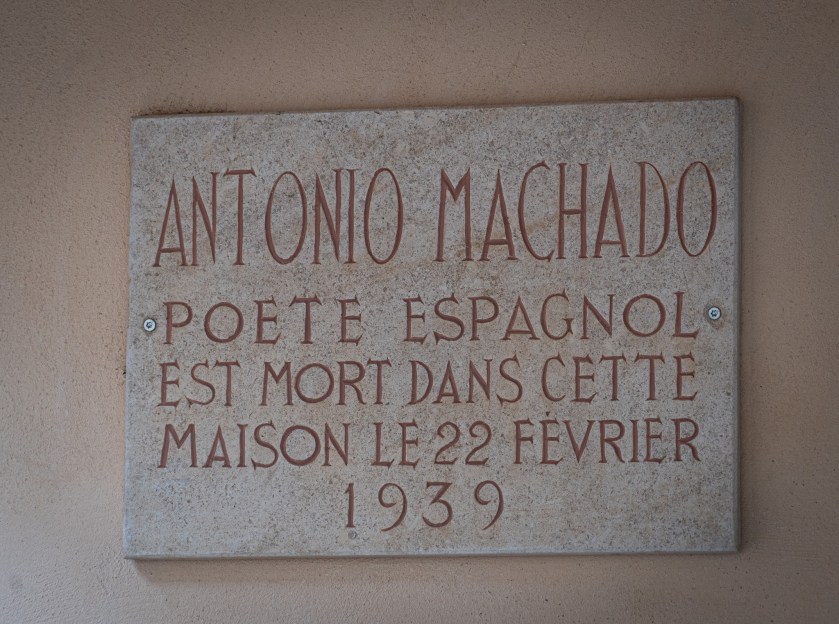
Machado, along with his mother and brother, reached Collioure and with the help of friends was able to get accommodation at the Hotel Bougnol-Quintana. It was in this hotel, on the 22nd February, two months after arriving, that Antonio Machado died. His mother died three days later. In the pocket of his overcoat, his brother Jose found some handwritten notes, including one which began, “Estos dias azules y este sol de la infancia” which translates to English as “These blue days and this sun of childhood”. It was the poet’s last poem.

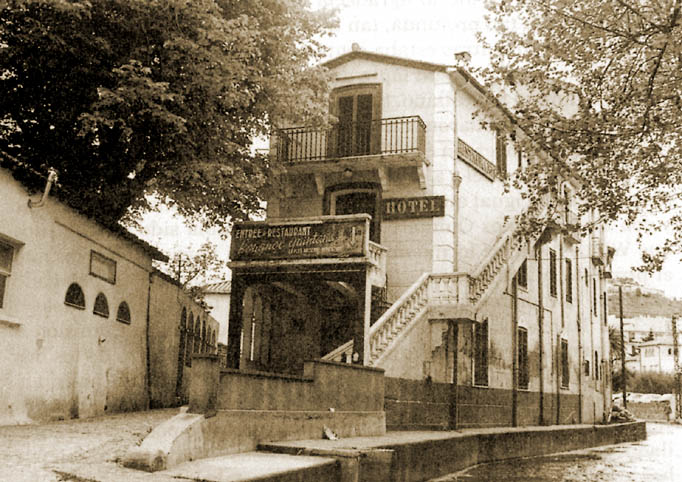
When we arrived in Collioure, I made my way to the location of the Hotel Bougnol-Quintana. In the years after the end of Franco’s dictatorship (he died in 1975), the hotel had been transformed into a visitors center. Sadly, on this particular day, it was closed. A ‘For Sale’ sign in the window suggested that the closure may become permanent.

The former Hotel Bougnol-Quintana in Collioure.

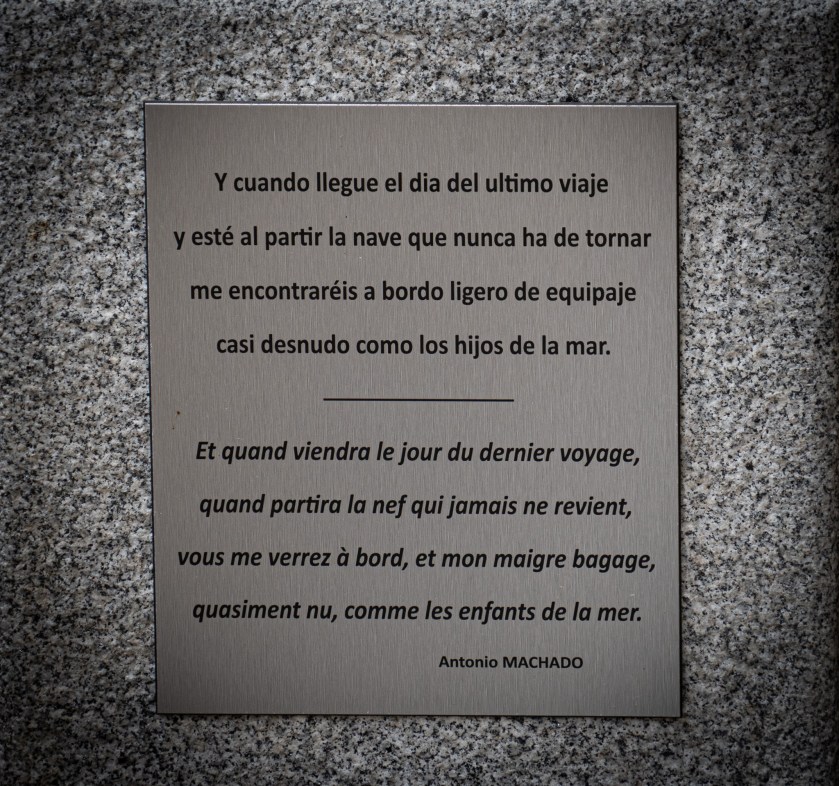
‘And when the day of the final voyage arrives. When the ship that never returns departs. You will see me onboard and my meager luggage. Almost naked, like the children of the sea.’

The hotel as Machado probably saw it.

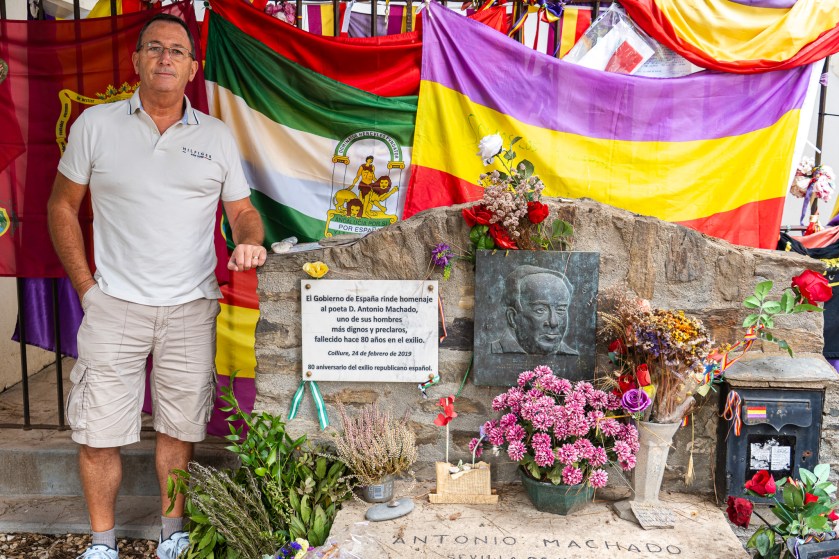
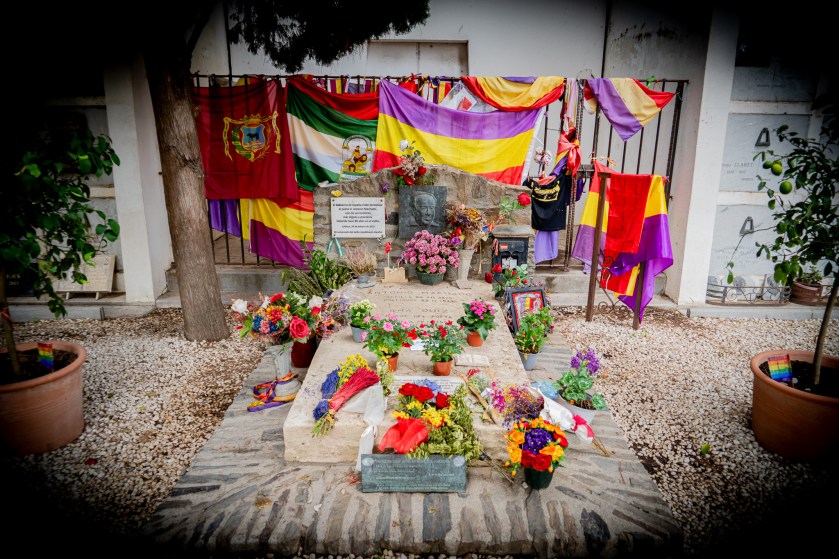
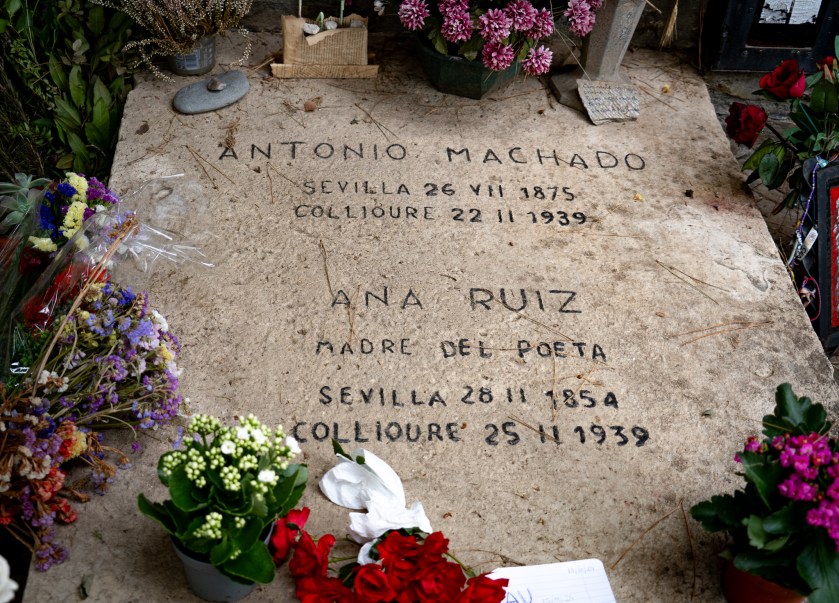
One hundred metres from the hotel is the cemetery of Collioure where Antonio Machado and his mother are buried. The grave is festooned with flags of the republic and provincial flags from Andalusia and Cordoba. More than 80 years after his death, followers and devotees still place flowers on his grave daily, along with tokens of affection, and the occasional poem.

Machado’s grave. A shrine to a man and an ideal.

Antonio and his mother died three days apart.

After our trip to Collioure, I found myself reflecting on the impact and causes of conflict. The impact is obvious. The human devastation, the heartbreak, suffering and the lasting legacy of loss. The causes can be less obvious. On the surface it can appear that wars are fought over race, religion or politics. But at the root of all wars is the lust for power and wealth.

Antonio Machado’s story is one of millions but it represents for me the struggle between good and evil. I believe that in this world there are many more people like Machado than there are like Franco, Mussolini, Hitler and Netanyahu. It is easy to believe, when confronted with the daily evidence, that the world is broken and doomed. But I agree with the poet when he said, “But at a human level I am not so sure: perhaps we won.”

As our bus slowly navigated the narrow roads out of the town at the end of the day, I caught a glimpse of a sign at the side of the road, informing visitors that the town of Collioure was twinned with Soria (Leonor’s resting place).

Summary

Collioure is definitely worth a visit. It is a compact town and a day is plenty of time to see everything it has to offer. Its aesthetic appeal and photo opportunities are reasons enough to visit but like towns and cities everywhere, it is the history that provides the depth to the experience. Behind every wall and under every roof, there are memories that deserve to be kept alive.

Regrets? I should have tried the anchovies!