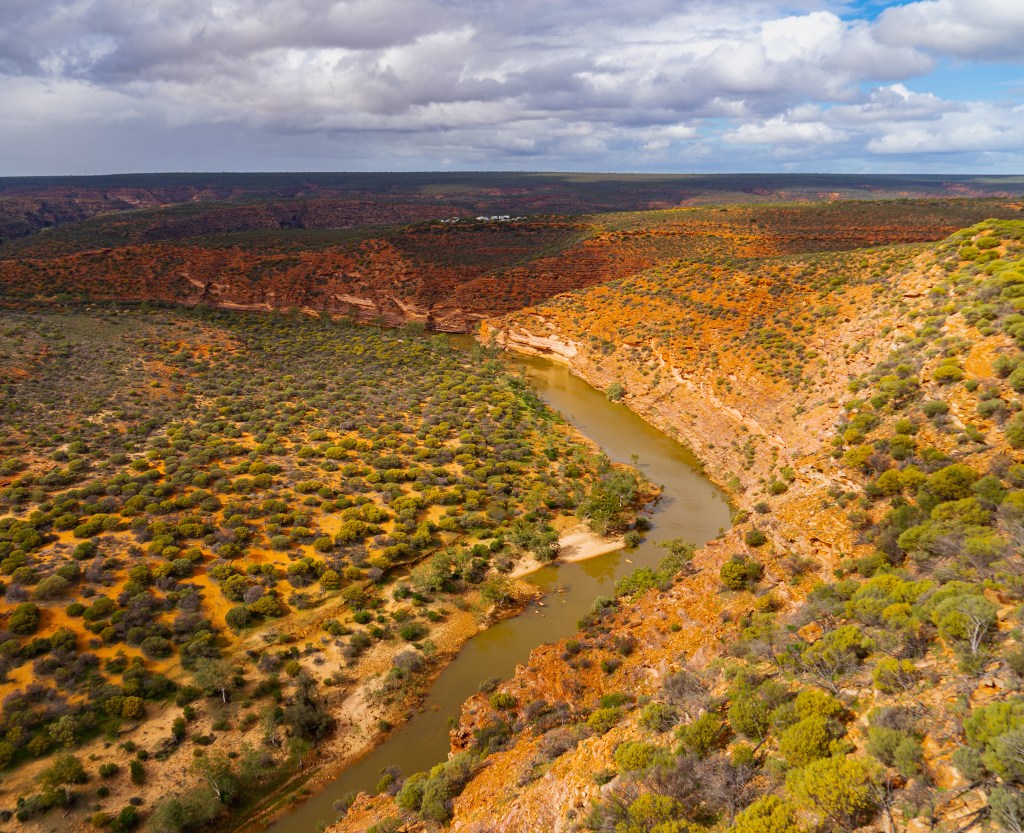
Kalbarri National Park.
Our next stop was Kalbarri National Park, 325km north of Jurien Bay. I should probably explain at this stage that road tripping in Australia requires careful planning. Turning up at a camp site without notice is not a good strategy. Road trips are not just for tourists. They are also a way of life for many Australians. Their popularity, combined with a finite number of sites, means that availability is limited. And it’s not just a simple case of securing a space. Some sites have a limited number of powered pitches. An electricity supply is essential if your stay is longer than one night, unless you have extra battery reserves for essential equipment, like your fridge. So, credit to our daughter who has a good deal of experience travelling around Australia. She planned the trip in a way that maximised our coverage of the west coast, whilst ensuring that we had adequate facilities along the way, with one minor exception, that was outside her control. Her task was all the more challenging because July is the busiest time of year. Which might come as a surprise because it’s winter ‘down under’ but the temperatures during their summer can be uncomfortable. At the most northerly point of our trip, the daytime temperatures reached into the high 20s. In December, Australian summer, daytime temperatures can reach 36 degrees Celsius or (97 degrees fahrenheit). So, planning is everything.
Back to the journey. As we travelled along Western Australia’s Coral Coast, on what is known as Indian Ocean Drive, it was easy to see why this is one of WA’s classic road trips. Once again, the long stretches of open road, the vast plains and huge skies, evoked an almost euphoric sense of freedom. The landscape was an ever changing vista. Long stretches of scrubland were punctuated by tantalising glimpses of white sand dunes and turquoise sea. As we approached the Kalbarri region, the rocks and plains took on a striking red hue and larger trees competed with the scrub for prominence. One more reminder that the vastness of this country is such, that you could be forgiven for thinking that you had left one country and entered another.
Kalbarri National Park has lots to offer, not least, its stunning sea cliffs. But the focus of our visit was the inland spectacle of the Murchison River Gorge. The dramatic scenery was awe-inspiring.
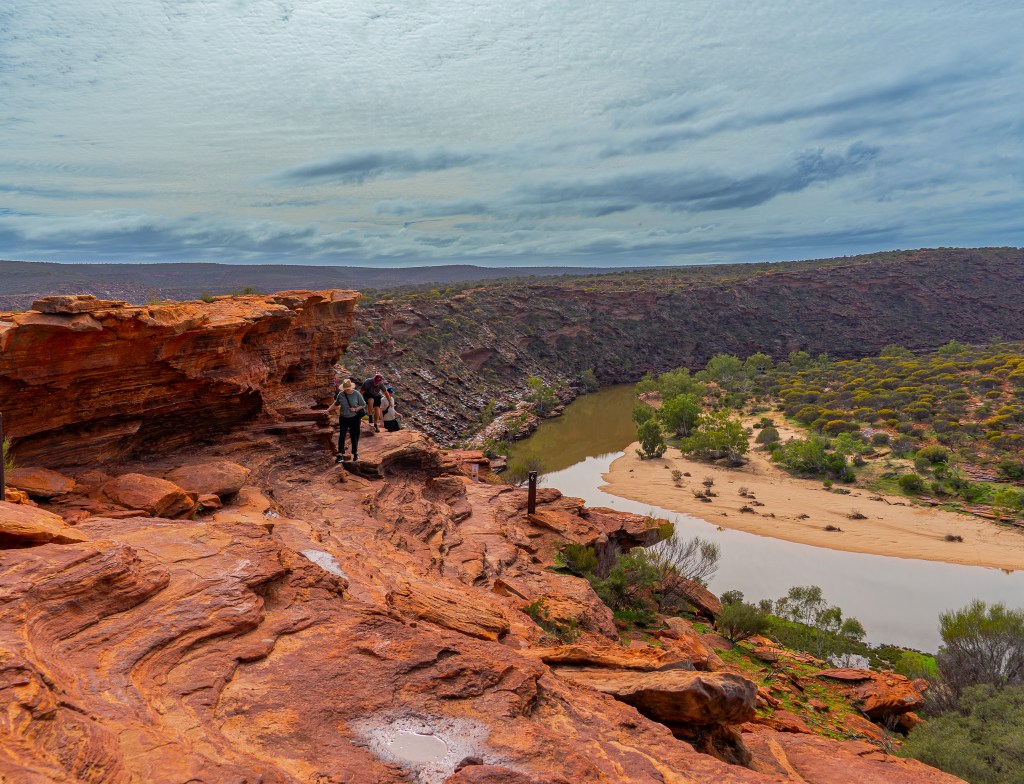
The Murchison River Gorge.
The gorge is a natural phenomenon consisting of Tumblagooda sandstone. Its features have been sculpted by the elements over millions of years. The rocks hold the key to its history and there is evidence, such as sea scorpion fossils, that this was once a tidal flat. Over millennia, the Murchison River has carved out a deep trench that makes the gorge a heat sink. In summer months, temperatures can reach 50 degrees Celsius (122 degrees Fahrenheit). Thankfully, during our visit, it was a pleasant 23 or 24 degrees Celsius.
However interesting the geological history may be, I prefer another explanation for the gorge’s existence. The traditional owners of this land, the Nanda (Nhanta) people, have their own creation story. The gorge was created by a huge ancestral water serpent, Beemarra, as she made her way across the arid plains to find the source of the sounds coming from the ocean. In her wake, she left behind pools of fresh water and springs. Beemarra’s final resting place is in one of these pools. I suppose, in their imagination, they felt compelled to tell a story that could convey the significance of this precious oasis of fresh water surrounded by miles of arid country and explain in mystical terms, how it came about. It goes some way to explaining their reverence towards this place. They consider it sacred. And why not? In a world where water resources are being destroyed and polluted on a cataclysmic scale, the Nanda people revere it for its life-giving and life-sustaining presence.
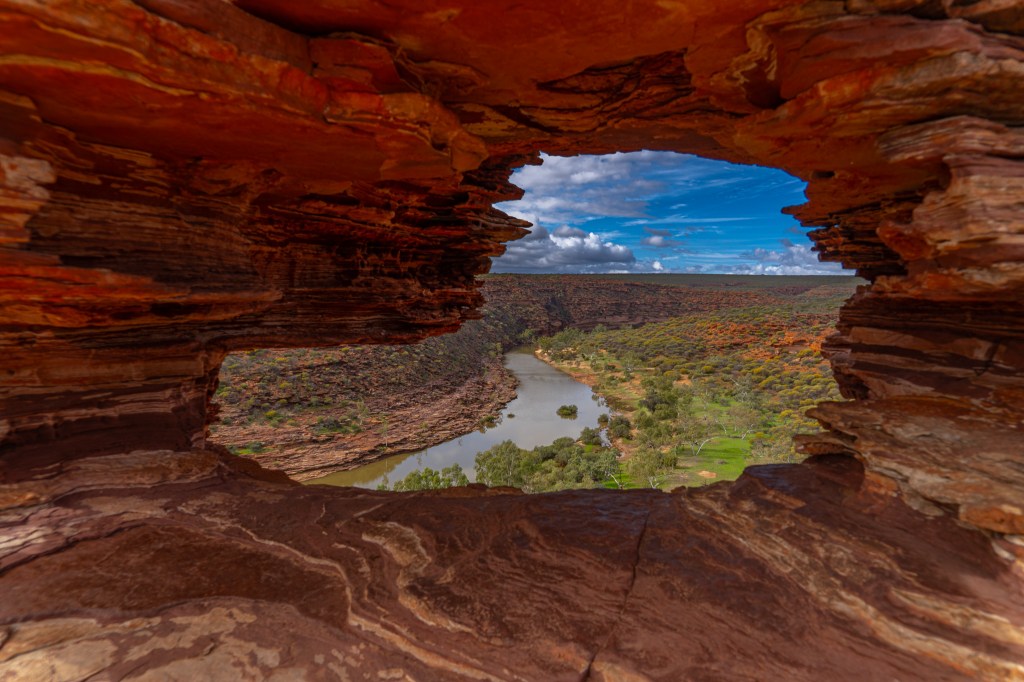
Nature’s Window.
Another fascinating natural ‘monument’, sculpted by eternal processes of water and wind, is Nature’s Window. This was one of those places I had to see, and was very close to the top of my bucket list, ever since our daughter posted photos of it in 2024. If you’re a photographer, you’ll know how that obsession works! But this location is so much more than a photo opportunity. It is a literal window that showcases a stunningly unique and ancient landscape. The perfect frame for a priceless work of art. A piece where the artist and subject are one in the same-nature. The ultimate goal would be to take a series of photos at different times of the day here, culminating in a spectacular sunset. Maybe next time…
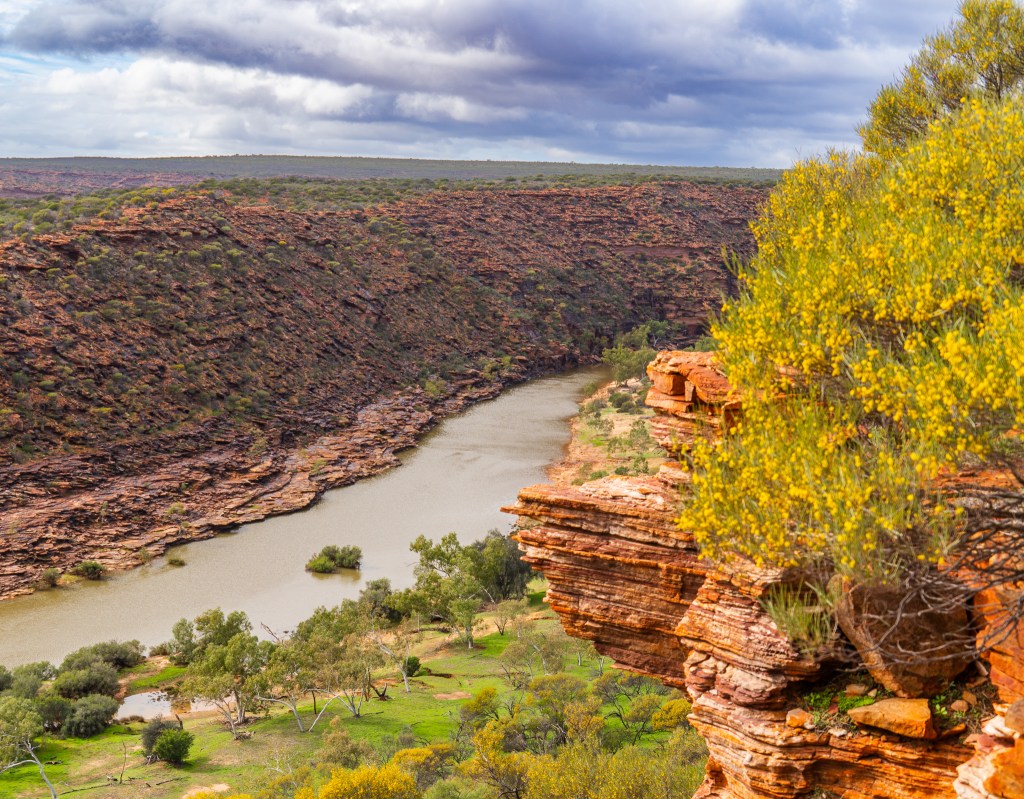
Beemarra’s legacy.
There was an unexpected consequence of our visit to Kalbarri National Park. I gained an insight into another aspect of this majestic region of Western Australia. The intimate connection of an ancient people to this primal place. Okay, let me start with one of those giant lies that the world has been fed. The aboriginal people were a single, homogenous entity. Wrong! The truth is that when the first Europeans arrived, there were 500-600 nations, each with its own distinct traditions and culture. There were over 250 distinct language groups (comprising around 800 dialects). As is always the case with colonialism, the indigenous population was subjected to mass murder and abuse. Their way of life was attacked and attempts made to eradicate their language and culture. Today, the result of colonization is a displaced and marginalized people. Fortunately there are occasional good news stories of restitution and recognition of aboriginal rights, as well as dedicated resources designed to revive and promote the culture and languages.
https://aiatsis.gov.au/explore/languages-alive
On 28 November 2018, a 24 year legal process concluded with the Federal Court of Australia formally recognizing the Nanda people as native title holders of an area of 17,000 square kilometers, including Kalbarri National Park. The Nanda story is now told through photographs and information boards at the visitors centre. It adds a whole other dimension to the place and goes some way to affording the visitor an insight into a way of life that has deep meaning for those whose existence is inextricably linked and intertwined with the land. If you ever visit this magical place, take a moment to consider its special place in the world. Yes it is visually stunning but it also has a spiritual connection for an ancient people who inhabited this land. Their ‘connection to country’ comes from a 10,000 year old symbiotic relationship where the land sustained them and they protected and nurtured the land. It is in their DNA. Personally, I felt enriched by our visit. Another reminder that the face of a country that is portrayed in modern literature or in the media is not always an accurate portrayal. Sometimes it is even a deliberate erasure of the truth. Next up, into the Outback at Wooramel. Hope to see you there.

